


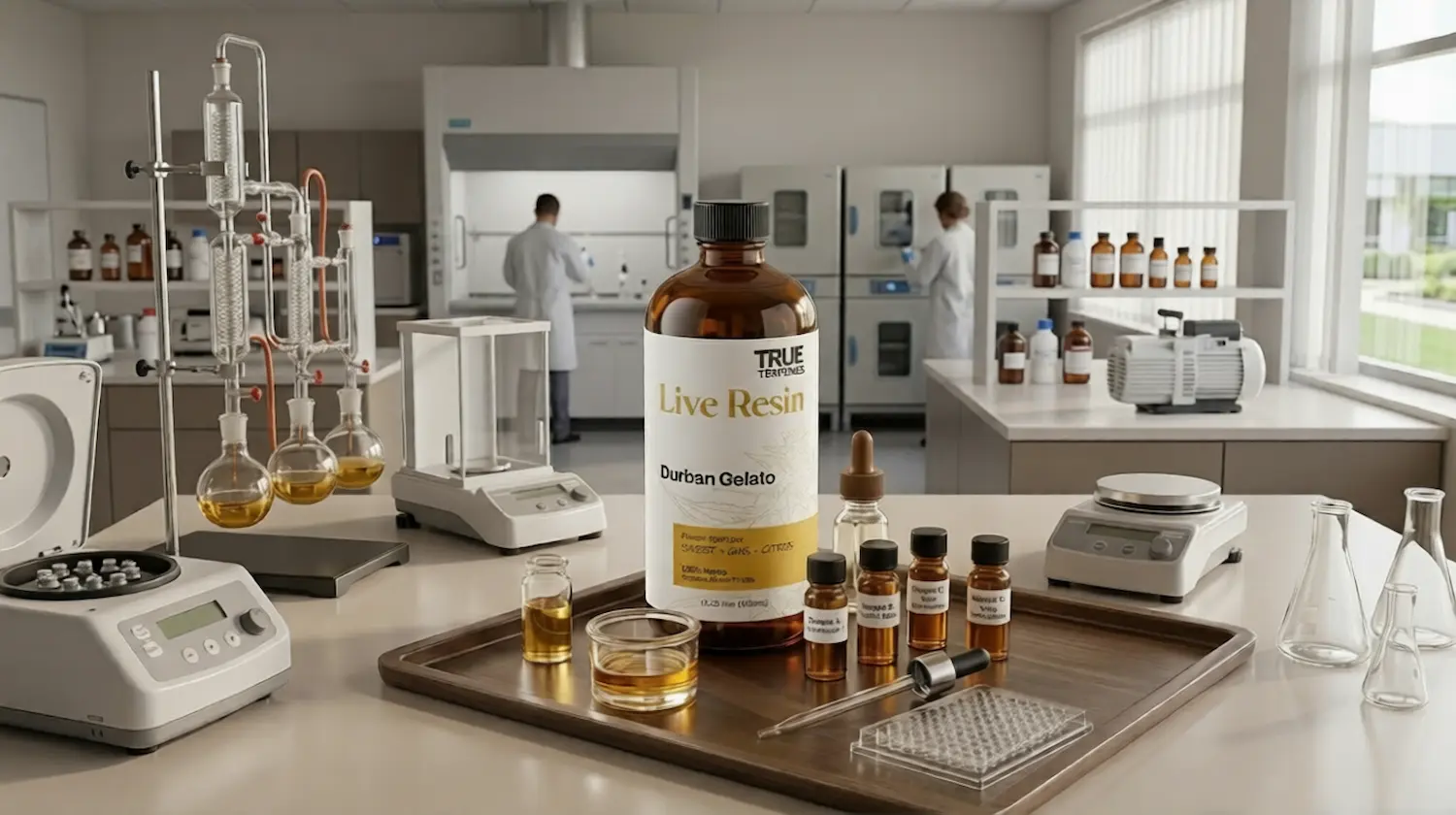
If you are searching for the best True Terpenes, you are probably not looking for a definition of terpenes. You are trying to work out which option makes the most sense for your product, your flavour goal and your production process.
That is what makes this keyword commercial. The word “best” sounds simple, but in practice it depends on what you are making. The best True Terpenes for a vape cartridge will not always be the best fit for a distillate blend, and neither of those choices should be treated exactly the same way as a CBD formulation.
A better way to choose is to stop asking which profile sounds most attractive on paper and start asking which one fits the actual job. That means looking at flavour direction, consistency, ease of use, dilution control and how the final product needs to perform once it is packaged and sold.
When people search for the best True Terpenes, they are usually trying to solve one of three problems.
The first is flavour fit. They want a profile that matches the kind of product they are building, whether that is more canna-forward, more flavour-led or more commercially approachable.
The second is formulation fit. A profile can smell great in theory and still be the wrong choice once it is added to distillate, run through a cartridge or scaled across repeat batches.
The third is product-market fit. Some terpene choices are better for brands that want bolder, more recognisable strain-style positioning. Others are better when the goal is cleaner consistency, easier repeatability or a more controlled formulation process.
That is why “best” should not be treated as a universal winner. It should be treated as a selection decision.
For cartridges, the best True Terpenes are usually the ones that balance flavour identity with real-world performance.
This is where many buyers get distracted by strain names alone. A profile may sound appealing, but if it does not suit the intended cartridge experience, it is not the right choice. Cartridges often need more than aroma. They also need a terpene direction that works with the overall formulation, hardware and final feel of the product.
True Terpenes’ current vape-facing materials separate vape development into flavour-forward distillate vape, canna-forward distillate vape and live resin vape, and they point those segments toward different profile families rather than one universal solution.
So for cartridges, the decision usually looks like this:
True Terpenes also highlights a flavourless flow-focused liquidizer product designed to help with vape clog and viscosity support, which matters because for some cartridge lines the performance issue is not only flavour selection.
So if the goal is to choose the best True Terpenes for cartridges, start with the type of experience you want the customer to have, then check whether the profile direction also makes sense for the hardware and the formulation.
For distillate, the best True Terpenes are not always the boldest ones. They are the ones that give you the flavour direction you want without making the formulation harder to control.
This is where buyers often make the mistake of choosing only by profile name. That can work for inspiration, but distillate needs more discipline than that. You still need to think about ratio, batch size, blending method and how consistent the result will be once you scale beyond a test sample.
True Terpenes’ public product pages repeatedly stress dilution guidance and suggest a maximum of 5% total added terpenes in a product for several terpene lines. That does not tell you which profile is “best” by itself, but it does confirm that ratio control matters just as much as flavour selection.
So for distillate, a stronger buying process is:
Decide whether the product should feel brighter, more strain-led, more canna-forward or more neutral.
A profile that seems exciting at first can become harder to manage if the percentage is off or the blend becomes too heavy.
The best result is not just the one that smells strongest. It is the one that can be repeated reliably from one batch to the next.
That is why ratio matters just as much as profile choice. Before finalising a blend, it helps to check the numbers with a terp to distillate ratio calculator, compare percentages against a terpene mixing chart, and use a terpene mixing calculator to keep batch planning consistent.
For CBD, the best True Terpenes are usually the ones that bring character without making the product harder to position or harder to repeat.
CBD formulations often need a slightly different mindset from cartridges and heavier distillate projects. In many cases, the goal is not to create the most aggressive profile in the room. It is to create something balanced, commercially usable and easy to reproduce across a product range.
True Terpenes’ public FAQ content says its Strain Profile Blends can be used with CBD, including CBD distillate and isolate.
That matters because it gives CBD-focused buyers more flexibility, but it does not remove the need for good selection. For CBD, a better question is not just which profile sounds best. It is:
Some CBD products need a cleaner, softer or broader appeal than a more strain-heavy direction.
A profile that works once but is difficult to repeat is not a strong commercial choice.
A CBD oil, tincture or related formulation may need a more controlled choice than a vape-first product.
Even the right profile can become the wrong result if the ratio is pushed too far.
So for CBD, the best True Terpenes are often the ones that support balance, repeatability and a product identity that makes sense beyond a single test batch.
If you want to make a better selection faster, use this framework:
Do not start with the profile name alone. Start with what the product actually needs to do.
Sometimes the best flavour choice is not the best production choice. You need both.
They are connected, but they are not the same decision.
The best True Terpenes for your product are the ones that still work when the formula moves beyond an early trial.
A good selection can still fail if the formulation process is sloppy.
The most common mistake is choosing by strain-name appeal alone. That can make the article or product concept sound exciting, but it does not guarantee the profile is right for the application.
The second mistake is treating all terpene use cases the same. A cartridge-focused choice is not always the right CBD choice, and a distillate-first selection is not always the best option for a broader commercial range.
The third mistake is ignoring the practical side of the blend. If ratio, dilution, measurement and repeatability are weak, even a good profile choice can lead to a poor product outcome.
The fourth mistake is forgetting that “best” is contextual. A good buying decision comes from matching the profile to the product, not from assuming one option wins in every case.
The strongest way to answer this keyword is not to pretend there is one universal winner. It is to recognise that the best True Terpenes depend on what you are making, how you are formulating it and what kind of product experience you want to deliver.
For vape cartridges, that usually means balancing flavour direction with performance.
For distillate, it means balancing flavour with ratio control.
For CBD, it means balancing identity with consistency and repeatability.
If you are still comparing suppliers, start with our True Terpenes vs Abstrax guide. If you are already narrowing down a distillate blend, review the terp to distillate ratio calculator and the terpene mixing chart before you lock in a percentage. And if you are ready to choose the right profiles for a cartridge, distillate or CBD line, explore our premium terpenes range or contact the team for help finding the right option for your product and production goals.
Try our sample pack now
No account yet?
Create an Account