


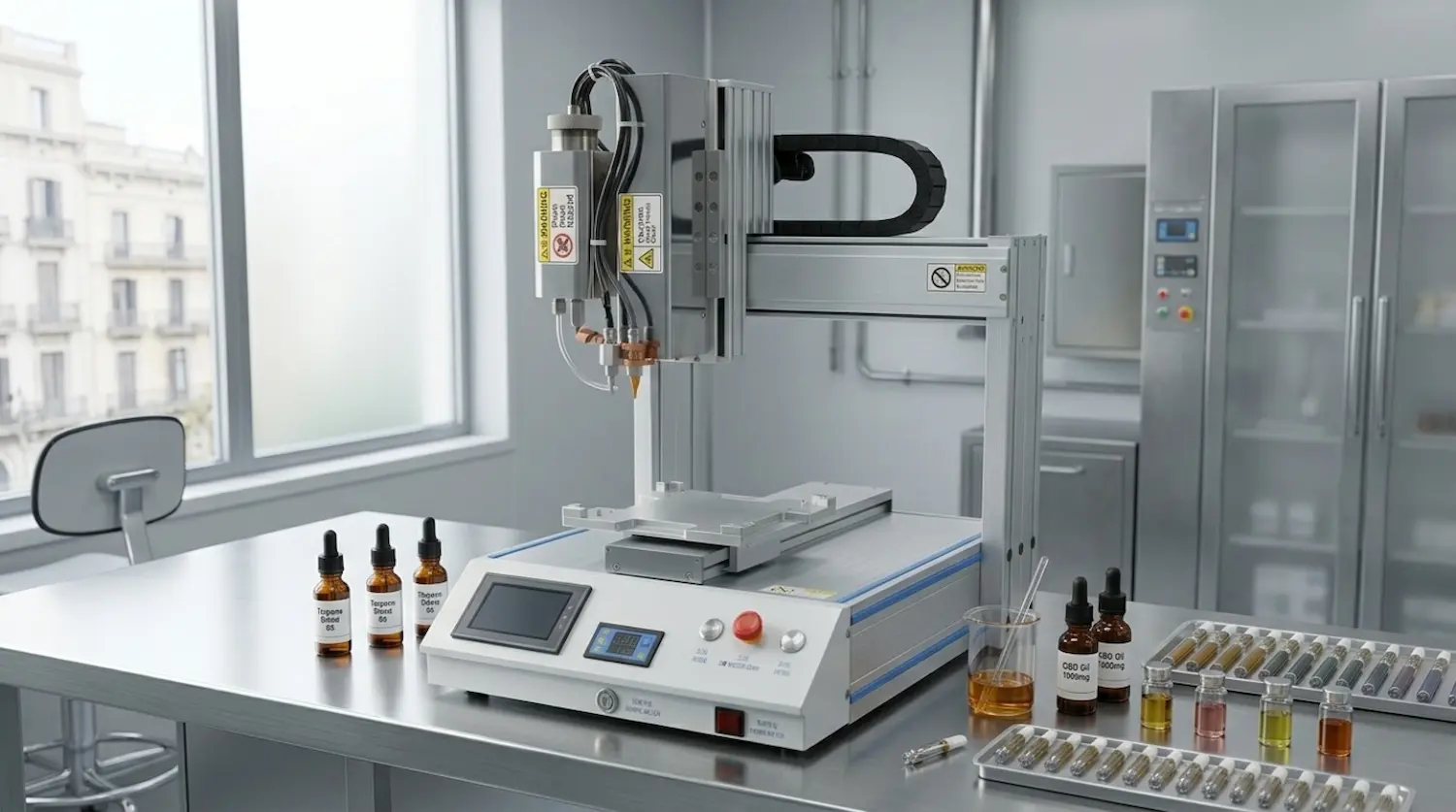
Choosing the right oil filling machine for terpenes is not just about speed. For most buyers, the real question is how to find a setup that matches the product, the container, the required dosing accuracy and the stage of the business.
That matters even more when you work with terpenes, CBD oils or vape formulations. Small errors in fill volume can affect consistency, waste, production flow and final product quality. A machine that works well for one oil may be the wrong fit for another, especially when bottle sizes, cartridge formats, viscosity and capping requirements start to vary.
This is why the best setup is rarely the biggest machine on the page. It is the one that fits your process now, while still leaving room to scale. In practice, the right oil filling machine for terpenes should match your fill volumes, packaging format and production goals without creating unnecessary complexity too early.
Before comparing specs, it helps to define exactly what you are filling.
A terpene-focused operation may be working with small bottles, flavour blends or aroma formulations where precision matters more than raw throughput. A CBD brand may need a filling machine for CBD oil that handles droppers, tincture bottles or repeat runs across multiple SKUs. A vape manufacturer may be looking for a cartridge filling and capping machine that reduces manual handling and improves line consistency.
So before choosing a machine, ask:
These questions matter because the right setup for 10ml terpene bottles is not necessarily the right one for CBD droppers or vape cartridges.
If your formulation process is still being refined, it often makes sense to first tighten the blend side of production with a clear terpene mixing chart and a reliable terpene calculator before automating the filling side.
When buyers search for an oil filling machine, they often think in general terms. But terpenes, CBD oils and vape products create a more specific set of demands.
A good setup should be chosen around:
When working with high-value formulations, overfilling and underfilling both become expensive. This is especially important in terpene-heavy blends, where even small measurement differences can affect the batch.
Some oils flow easily. Others are thicker, stickier or more sensitive during handling. That changes the type of filling system that makes sense.
Glass bottles, pipette bottles, cartridges and other formats all create different production needs. The machine must fit the actual packaging, not just the liquid.
Filling is only one part of the line. If capping remains slow or inconsistent, it quickly becomes the bottleneck.
If you run several SKUs, short runs or multiple flavour profiles, changeover time matters more than many buyers expect.
That is why a buyer comparing a CBD oil filling machine, hemp oil filling machine or oil filling and capping machine should look beyond headline capacity and focus on how the machine behaves inside the real workflow.
Not every business needs the same level of automation. In fact, buying too much machine too early can be just as inefficient as buying too little.
This is usually the best fit for testing, product development, very low-volume production or highly controlled small batches. It gives flexibility, but it is labour-heavy and becomes inefficient quickly once order volume grows.
For many growing brands, this is the practical middle ground. A semi-automatic oil filling machine for terpenes can improve consistency and speed without forcing the business into a large production footprint too early. This is often where scaling brands start to see the biggest operational gain.
A fully automatic setup makes more sense when output is already established, packaging is standardised and the business needs repeatable throughput at scale. This is where buyers may begin looking at broader cartridge filling & capping solutions or integrated production lines instead of standalone fillers.
The right answer depends less on what looks advanced and more on how stable the production demand really is.
A machine that fills fast but inconsistently is not a strong investment.
In this category, speed only helps when dosing remains controlled. If your team is dealing with product loss, inconsistent output or avoidable corrections, the issue is usually not the label on the machine. It is the match between the product, the fill system and the production process.
This is one reason buyers increasingly search for terms like automated oil dosing rather than just “filling machine”. They are not only looking for motion. They are looking for control.
That matters whether you are filling CBD oils for retail bottles, terpene blends for formulation work or vape oils for cartridge-based products. If dosing precision is weak, the entire process becomes harder to scale cleanly.
It also connects directly with upstream preparation. Before automation, it helps to get the basics right around measuring terpenes accurately and building a repeatable mixing process.
Many growing operators focus on the filling step first, then realise later that capping is what slows the line down.
That is why in some cases it makes more sense to move directly toward an oil filling and capping machine or a more integrated line. This is especially relevant for:
If your target product is cartridge-based, a standalone filler may not solve the real operational issue. In that case, it is more useful to compare a cartridge filling and capping machine or related cartridge capping machine setup that supports the full process rather than only one stage of it.
The same logic applies to buyers landing through broader searches such as cannabis capping machine or cannabis machines. The real decision is not about wording. It is about whether the production line needs a single filling function or a more complete packaging workflow.
A practical way to choose is to match the machine to the current stage of the business.
If you are still validating blends, changing packaging or testing different formats, flexibility matters most. At this stage, buying oversized automation usually creates friction.
Once the product range is clearer and order flow becomes more stable, a semi-automatic or scalable filling solution often makes more sense. This is where many buyers start seriously comparing a CBD filling machine, CBD oil filling machine or hemp oil filling machine depending on the product mix.
For many scaling brands, the best oil filling machine for terpenes is one that improves dosing consistency while still allowing flexibility across bottles, droppers or cartridges.
If cartridges are a core format, look closely at fill consistency, container handling and post-fill workflow. This is where a dedicated cartridge solution becomes more valuable than a general-purpose filler.
If the business serves multiple clients or runs many SKUs, changeovers, repeatability and process efficiency become more important than a simple speed claim. In that case, it also makes sense to review your wider production support and white label services rather than treat machinery as a standalone decision.
Before choosing any machine, ask the supplier practical questions that connect to real production:
These questions will tell you more than a headline claim ever will.
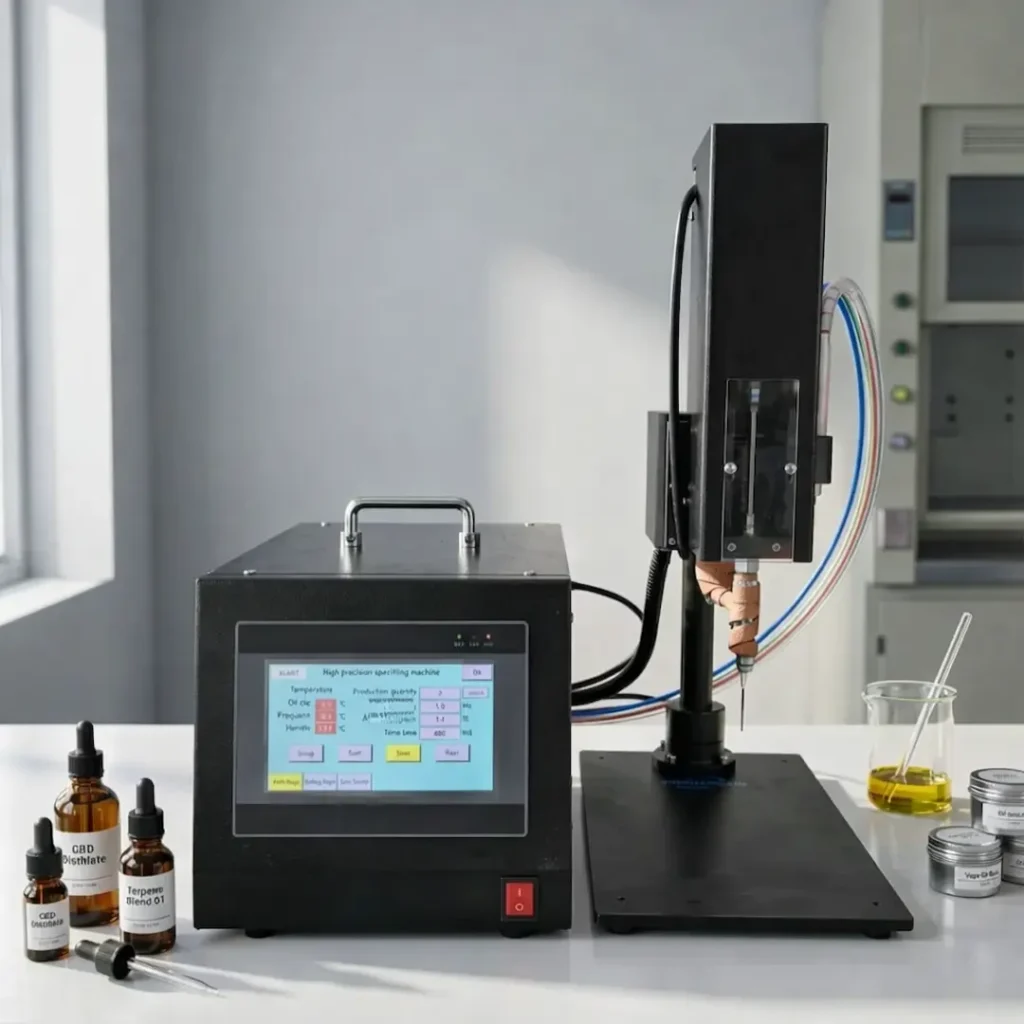
A lot of poor machinery decisions come from the same avoidable mistakes:
Fast output sounds attractive, but it means little if filling accuracy or workflow consistency is poor.
A filler can improve one stage while leaving the real bottleneck untouched.
A machine should support growth, but it should still make sense for today’s production reality.
Terpenes, CBD oils and vape formulations may sit in the same broad category, but that does not mean they behave the same in production.
A better machine will not fix an inconsistent formulation workflow. That is why it still helps to understand how to mix terpenes step by step and how to dilute terpenes for vape cartridges correctly before focusing only on the equipment side.
The best oil filling machine for terpenes is the one that fits the actual job: the oil, the packaging, the required output and the level of accuracy the business needs.
For some buyers, that will mean starting with a flexible semi-automatic system. For others, it will mean moving straight into a more complete oil filling and capping machine or cartridge-focused setup. The important part is choosing based on process fit, not just brochure language.
If you are comparing options for terpenes, CBD oils or vape products, the next step is to review the machinery range with your actual product and container in mind. And if you need a setup that fits a wider production model, from formulation to packaging, it is worth speaking to the team through the contact page to discuss the right direction for your line.
Try our sample pack now
No account yet?
Create an Account