

How to Compare Terpene Samples Before You Place a Bulk Order

Placing a bulk terpene order without a structured sample comparison is one of the most expensive shortcuts a procurement team can take. A drum that is ‘close enough’ to the sample on aroma but five percent off on assay can ruin a production run, force a reformulation or — worse — ship out as finished product and trigger a recall. The right way to compare terpene samples is the same way you would qualify any critical raw material: with a written protocol, repeatable measurements and a scoring sheet that does not change halfway through the test.
Why sample comparison decides the success of a bulk order
A bulk order locks in price, lead time and a specific batch — sometimes for months of production. Once the drums are in your warehouse, the room to negotiate disappears, and any quality gap becomes your problem to solve, not the supplier’s. A short, disciplined sample comparison front-loads that risk into the cheapest, most reversible stage of the buying cycle.
It also tells you something the price list cannot: how a supplier behaves under technical scrutiny. Suppliers who answer specification questions promptly, send fresh samples that match the latest CoA, and welcome a side-by-side test against competitors are the ones worth issuing a purchase order to. The full picture of terpene quality standards buyers should check applies here in miniature: every conversation in the sample stage is a preview of the relationship at scale.
What to request from each supplier before testing
Before any liquid leaves the supplier’s warehouse, ask for the documents that let you interpret what arrives. Without them, even a perfect sensory result is impossible to verify against the bulk drum that follows.
- Batch-specific Certificate of Analysis for the exact lot the sample was drawn from — assay, density, refractive index, residual solvents, heavy metals and microbial counts.
- Safety Data Sheet matched to the same lot, with current transport classification.
- Sample size sufficient for at least two independent tests — typically 25–50 ml per terpene.
- Stability data or guidance on shelf life and recommended storage.
- Origin and process information: natural, semi-synthetic or synthetic; distillation method; country of manufacture.
If a supplier hesitates on any of these requests, that is a procurement signal in itself. Our overview of quality and compliance sets out the documentation we expect to provide ourselves with every sample.

Start with the range at Mr Terpeenes
A fair comparison needs candidates worth comparing. Browse the terpene profiles stocked in the UK and pick the shortlist you actually want to assess.
The terpene sample comparison protocol
The six steps below turn an informal sniff test into a defensible evaluation. They take roughly half a day for a panel of three samples and they remove almost all of the subjectivity that creeps into ad-hoc tasting sessions.
1. Set up a controlled tasting and sniffing session
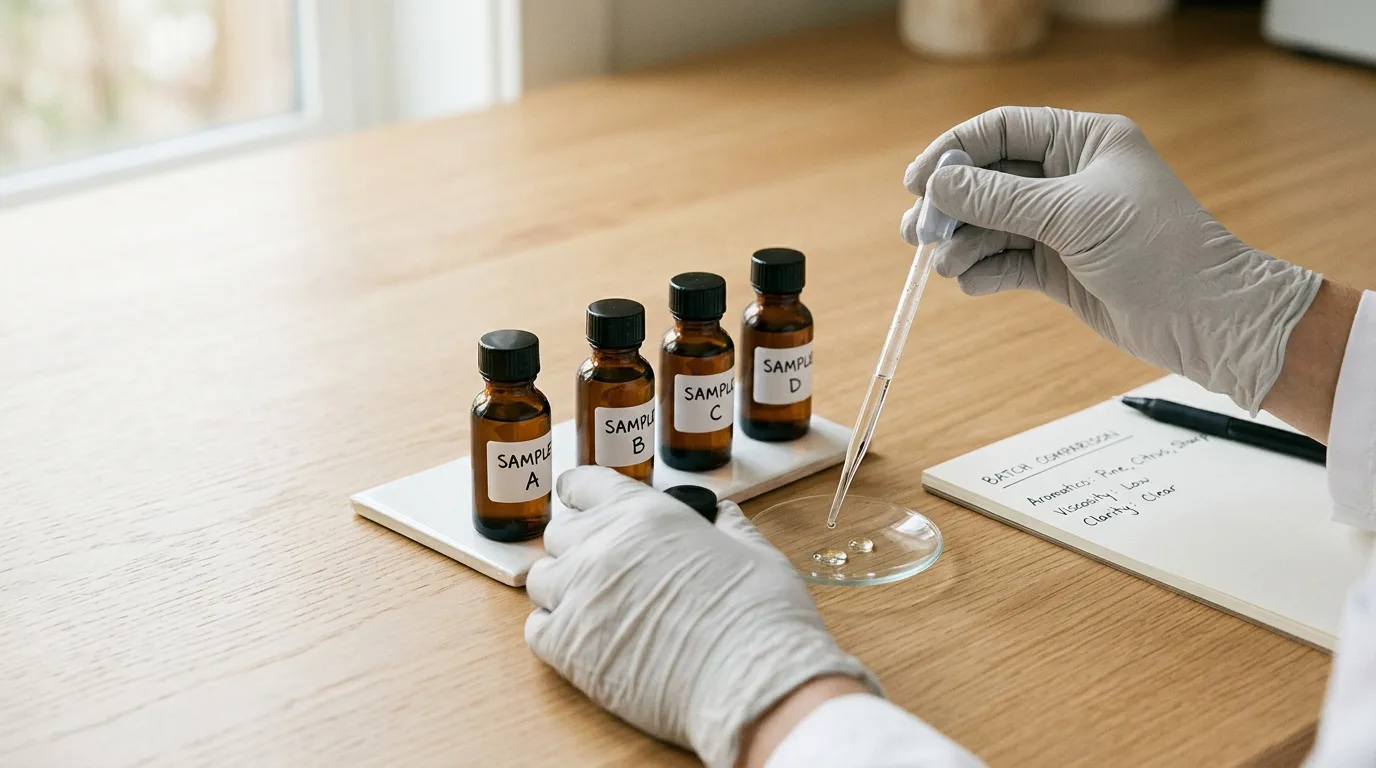
Decant equal volumes of each sample into identical, neutral-glass vials and code them blind — letters or numbers, not supplier names. Evaluate at the same temperature, in the same room, with the same neutral background (filtered air, no competing aromas, no perfumed staff). Score top notes, mid notes and dry-down separately on a one-to-five scale, and record any off-notes (sulphurous, plasticky, oxidised) verbatim.
Have at least two evaluators score independently before discussing results. The point is not to crown a winner on day one but to surface the differences that any single nose would miss.
2. Compare the Certificate of Analysis side by side
Print the CoAs for every sample on the same page and check them against the specification you sent the supplier. Look first at the main-component assay, then at residual solvents, heavy metals and any allergen disclosures. A sample that smells excellent but reports a 3 % gap on assay is not necessarily disqualified — it is a flag to ask the supplier why, and how tightly that figure is controlled across batches.
Pay particular attention to method statements. Two laboratories using different GC columns can return different numbers for the same drum; without harmonised methods, ‘identical’ CoAs may not be comparable at all.
3. Run a small-scale formulation test
Move from neat-terpene evaluation to your actual matrix. Mix each sample at the target concentration into the carrier (distillate, MCT oil, propylene glycol, fragrance base, edible matrix) and assess clarity, colour, viscosity and aroma after a settling period of at least twenty-four hours. Use the same syringes or pipettes for every sample to keep dosing repeatable — see our notes on pipettes vs syringes when measuring terpenes.
This is the step that exposes hidden incompatibilities. A terpene that performs beautifully on its own can drop out of solution, change colour or develop an off-note once it sits in your real product.
4. Check stability under realistic storage conditions
Run an accelerated stability check on the formulated sample — typically four weeks at 40 °C with regular sniff and visual checks, mirrored by a refrigerated control. Oxidation-prone monoterpenes such as limonene and α-pinene reveal themselves quickly under heat; if a supplier’s sample turns yellow or develops a turpentine note in two weeks, that is what the bulk drum will do in the warehouse over a hot summer.
Pair this with the supplier’s own stability claims and our practical guidance on terpene shelf life and storage. The goal is to align the supplier’s stated shelf life with what you observe in your actual conditions.
5. Test viscosity and solubility in your carrier
For vape, edible and topical applications, viscosity at fill temperature and solubility in the chosen carrier are as important as aroma. Measure both at the temperatures and concentrations you will use in production, not at the lab default. A small change in viscosity can mean the difference between a clean cartridge fill and a clogged production line.
Brands aiming for a fully bespoke profile often go further with custom terpene blends built around their product; the principles below still apply when comparing two custom-blend proposals.
6. Score samples against a written specification
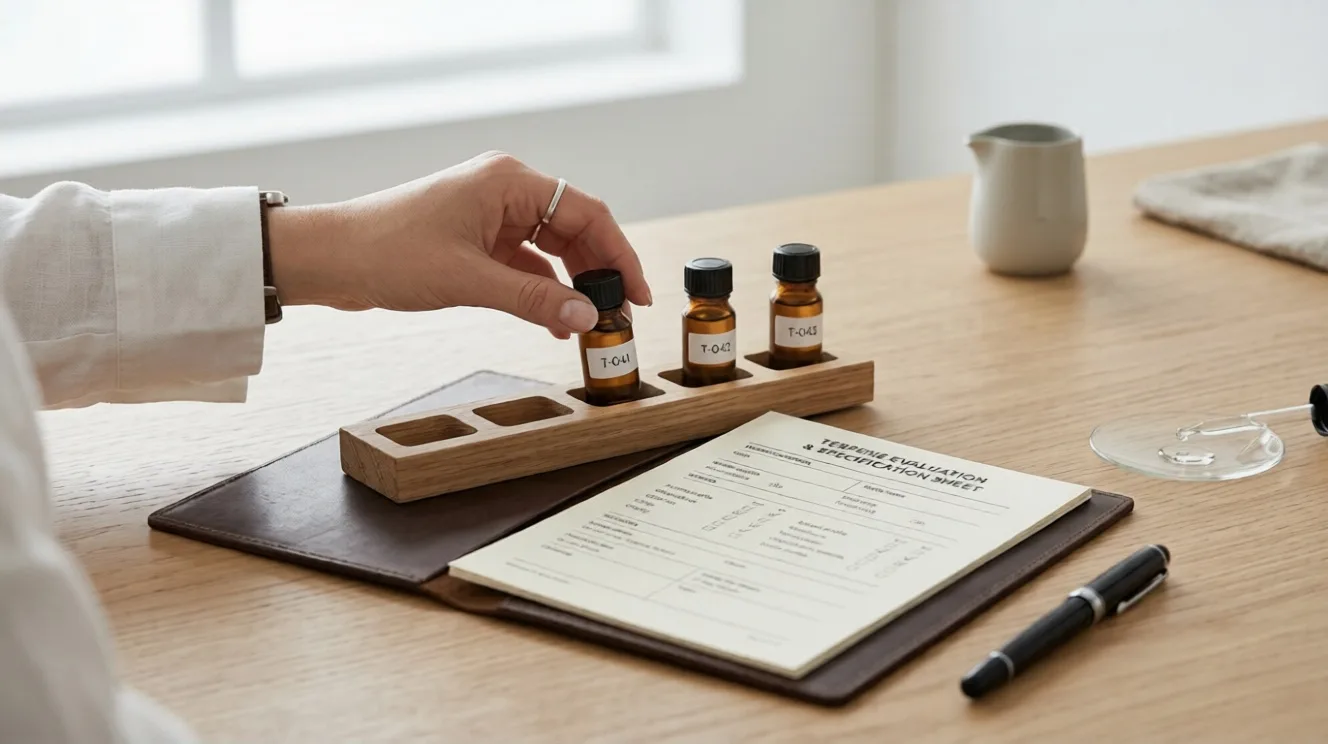
Bring every observation back to a single scoring sheet with explicit weightings: aroma, CoA fit, formulation behaviour, stability, viscosity, supplier responsiveness and price. Decide the weightings before you taste — not after. The winning sample should win on the sheet, not because it was the last one evaluated.
This scoring sheet becomes the baseline for repeat orders. The next time the supplier sends a fresh batch, you compare against it, not against memory.
Move from samples to supply with Mr Terpeenes
Comparison ends when a profile wins. Discuss bulk quantities, pricing and lead times so the chosen sample becomes a reliable production input.
Common pitfalls when comparing terpene samples
Most failed sample evaluations share the same handful of errors. Catch them in the protocol stage and the comparison becomes far harder to game:
- Tasting samples in the order they arrived — order effects can decide a winner more than the liquid does. Randomise.
- Letting branded packaging into the room — knowing which bottle came from which supplier biases every score.
- Skipping the formulated test — neat-terpene comparisons rarely predict in-product behaviour.
- Treating one batch as the supplier’s baseline — request CoAs from at least three consecutive lots before committing.
- Negotiating price before testing finishes — locks in a number that the technical evaluation may not justify.
- Discarding samples after the test — keep retains for the shelf life of the bulk drum, in case a future complaint needs investigating.
Checklist before placing the bulk order
Run through this list once the comparison is complete and before any purchase order is approved:
- Blind, randomised sensory evaluation with at least two independent scorers.
- CoAs for at least three consecutive batches reviewed for consistency.
- Formulated bench test in the actual production carrier.
- Accelerated stability data for the winning sample.
- Viscosity and solubility confirmed at production temperature and concentration.
- Scoring sheet completed with weightings agreed in advance.
- Acceptance tolerances and dispute mechanism written into the purchase order.
- Retain samples archived and labelled for the shelf life of the bulk drum.
- Supplier change-control commitment confirmed in writing.
- Lead time, MOQ and incoterms aligned with the production schedule.
FAQs on comparing terpene samples
The questions below cover the points buyers most often raise once they start running structured sample comparisons.
How many samples should I compare before placing a bulk order?
Three to five from different suppliers is the sweet spot. Below three you cannot tell whether the ‘winner’ is good or just better than one alternative; above five the panel fatigues and scoring becomes noisy. If you know the field — for example, when comparing two well-known brands as in our True Terpenes vs Abstrax breakdown — two well-prepared samples can be enough.
How much sample do I need from each supplier?
Plan for 25–50 ml per terpene, enough to repeat the formulated test and keep a retain. For complex blends or stability work, request 100 ml or more so you are not rationing liquid halfway through the protocol.
Do I need a sensory panel or is one taster enough?
One trained taster can rank samples reliably for routine work, but a panel of two or three independent scorers gives you the inter-rater agreement that defends a procurement decision later. The marginal cost is small compared with the cost of a wrong bulk order.
How do I move from a winning sample to a consistent bulk order?
Lock the specification, the analytical methods and the acceptance tolerances into the purchase order, and request the supplier’s change-control policy in writing. Our guide on moving a consistent terpene product from sample to scale covers the controls that bridge the gap.
Where should I source samples to compare in the first place?
Start with suppliers who already publish full CoAs and will send batch-matched samples without quibbling. If you are buying for the UK or Europe, our notes on how to choose the right product when buying terpenes in the UK are a useful starting point, and our terpene catalogue sets out the grades and pack sizes available for production buyers. Bulk pricing and dedicated account management are handled through wholesale registration.