
Terpene COA Checklist: 12 Items Bulk Buyers Must Verify

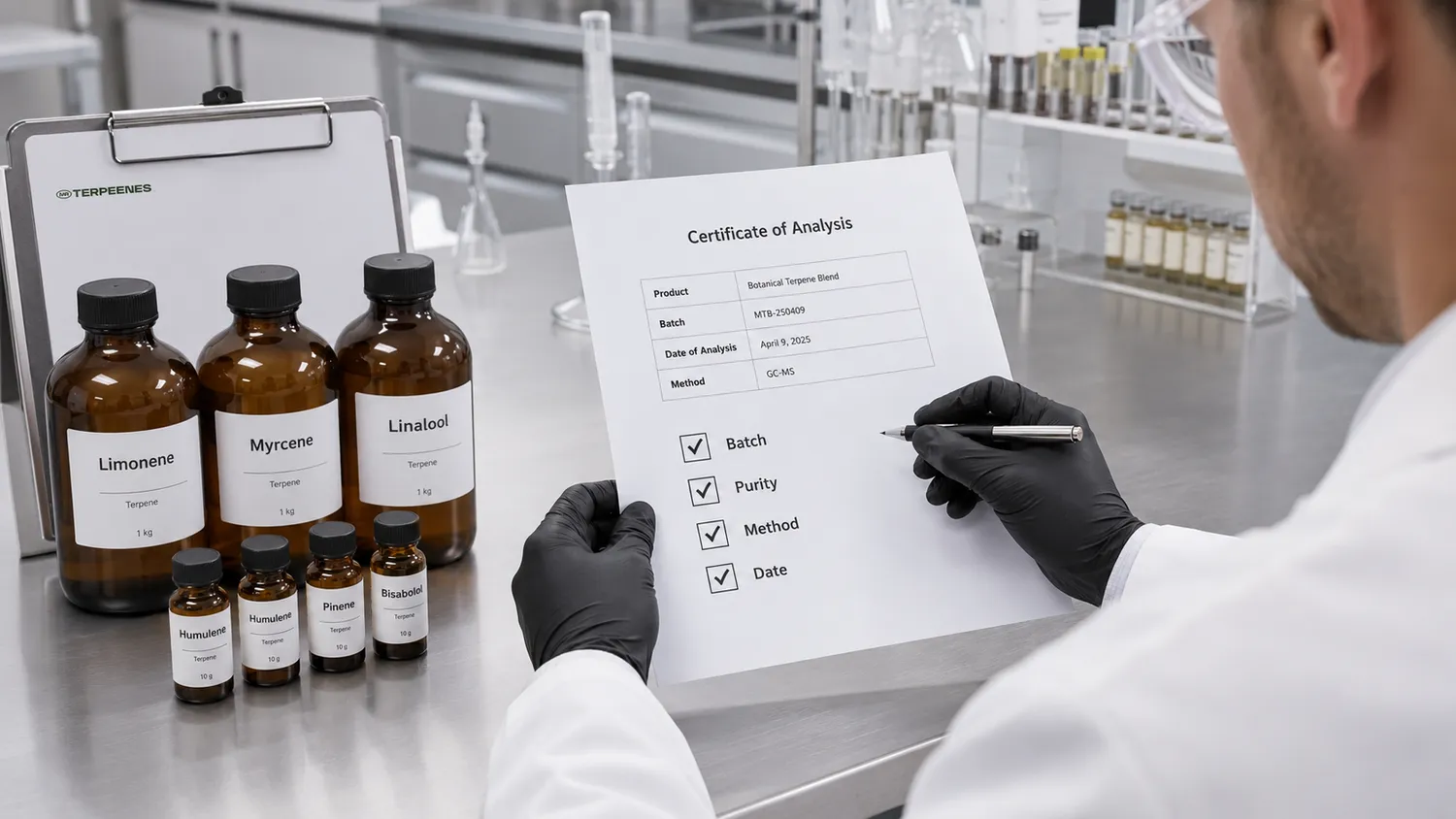
A terpene COA checklist turns a stack of laboratory paperwork into a clear pass-or-fail decision before a bulk order leaves the warehouse. Bulk buyers who read every certificate of analysis the same way protect their margins, their formulations and their brand reputation from off-spec shipments.
Buying terpenes in volume is no longer a gut-feeling trade. European regulators, vape manufacturers and cannabis processors all expect documented evidence of purity, identity and safety. A certificate of analysis (COA) is that evidence, and a structured terpene COA checklist is how serious B2B buyers read it without missing the small print that matters most.
This guide walks through what a complete COA should contain, how to spot weak documentation, and how to align supplier paperwork with your own internal terpene quality standards before money changes hands.
What Is a Terpene Certificate of Analysis?
A certificate of analysis is a laboratory document that confirms what is — and is not — inside a batch of terpenes. It is issued by a third-party or in-house lab and tied to a specific lot number, manufacturing date and product code.
For bulk terpene buyers, the COA is the single most important piece of paperwork in the entire purchase. It is the bridge between a sales claim (“99% pure D-Limonene”) and the analytical reality of the drum, jar or pail you are about to receive.
Why Bulk Buyers Cannot Skip the COA Step
Production-scale formulators blend hundreds of kilograms per run. A single mislabelled isomer, an unflagged residual solvent or a heavy-metal spike can contaminate a full batch of distillate, vape oil or edibles. The cost of recalling finished product is always higher than the cost of reading the COA properly the first time. Many of the common mistakes when buying terpenes for production start with a buyer who glanced at the COA instead of working through it line by line.
The Terpene COA Checklist: 12 Items to Verify Before Ordering
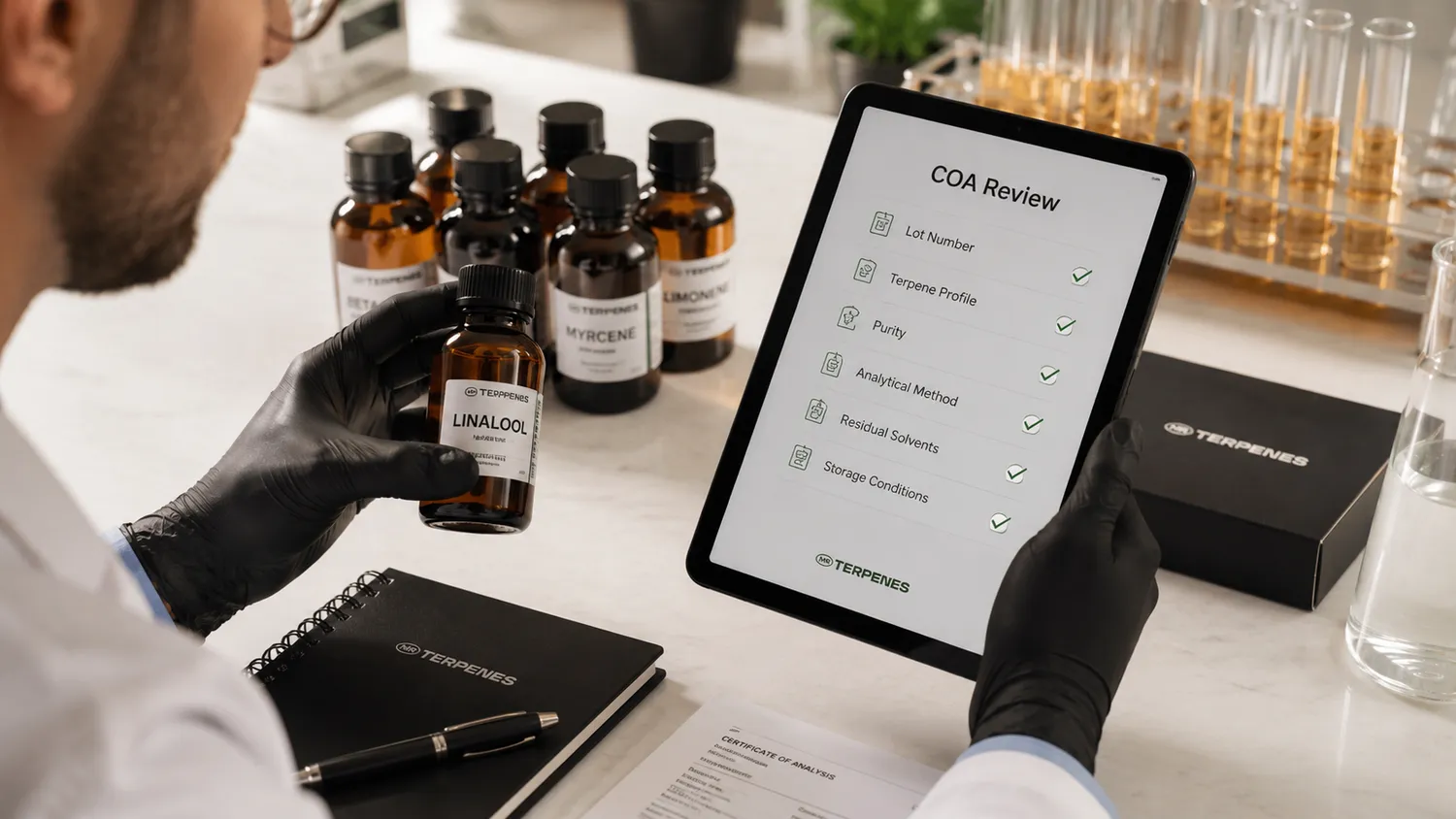
Print this list. Compare every supplier document against it before you raise a purchase order. If a COA fails on more than two items, request a re-issue or look elsewhere.
1. Laboratory Identification and Accreditation
The lab name, address, contact details and accreditation number must be visible. Prefer reports from labs accredited to ISO/IEC 17025, the international standard for testing laboratory competence. An unaccredited in-house result is not the same as an independent third-party COA.
2. Sample and Batch Traceability
Look for the product name, lot or batch number, manufacturing date, sampling date and the date of analysis. Without traceability, the COA cannot be matched to the drum that arrives at your dock.
3. Identity Confirmation by GC-MS
Gas chromatography-mass spectrometry (GC-MS) is the industry baseline for confirming terpene identity. The COA should list every detected compound, not only the headline molecule.
4. Purity Percentage and Profile
Single-molecule terpenes should report above 95% purity for production use. Strain-specific profiles should show the full ratio of monoterpenes and sesquiterpenes against the target profile.
5. Residual Solvents
Any solvent used during extraction or distillation must be tested and reported below regulatory limits (typically ICH Q3C Class 2 and Class 3 thresholds). Watch especially for ethanol, hexane and acetone residues.
6. Heavy Metals
Lead, arsenic, cadmium and mercury must each appear with a quantified result and a clearly stated action limit. A bare “Pass” without a number is not enough for a B2B buyer.
7. Pesticides and Mycotoxins
Particularly relevant for botanical and cannabis-derived terpenes, where plant material can carry agricultural residues. A complete panel should cover at least the EU pesticide reference list.
8. Microbiological Testing
Total aerobic count, yeast, mould, E. coli and Salmonella should be reported for any terpene destined for inhalable or ingestible products.
9. Physical Properties
Density, refractive index, optical rotation and viscosity confirm the terpene matches the declared specification. These numbers also help downstream when you tune comparative samples in the lab.
10. Allergen and Food-Grade Declarations
If the terpene will end up in food, cosmetics or vape products sold in the EU, a food-grade or cosmetic-grade declaration must be attached. Allergens such as linalool and limonene should be flagged for label compliance.
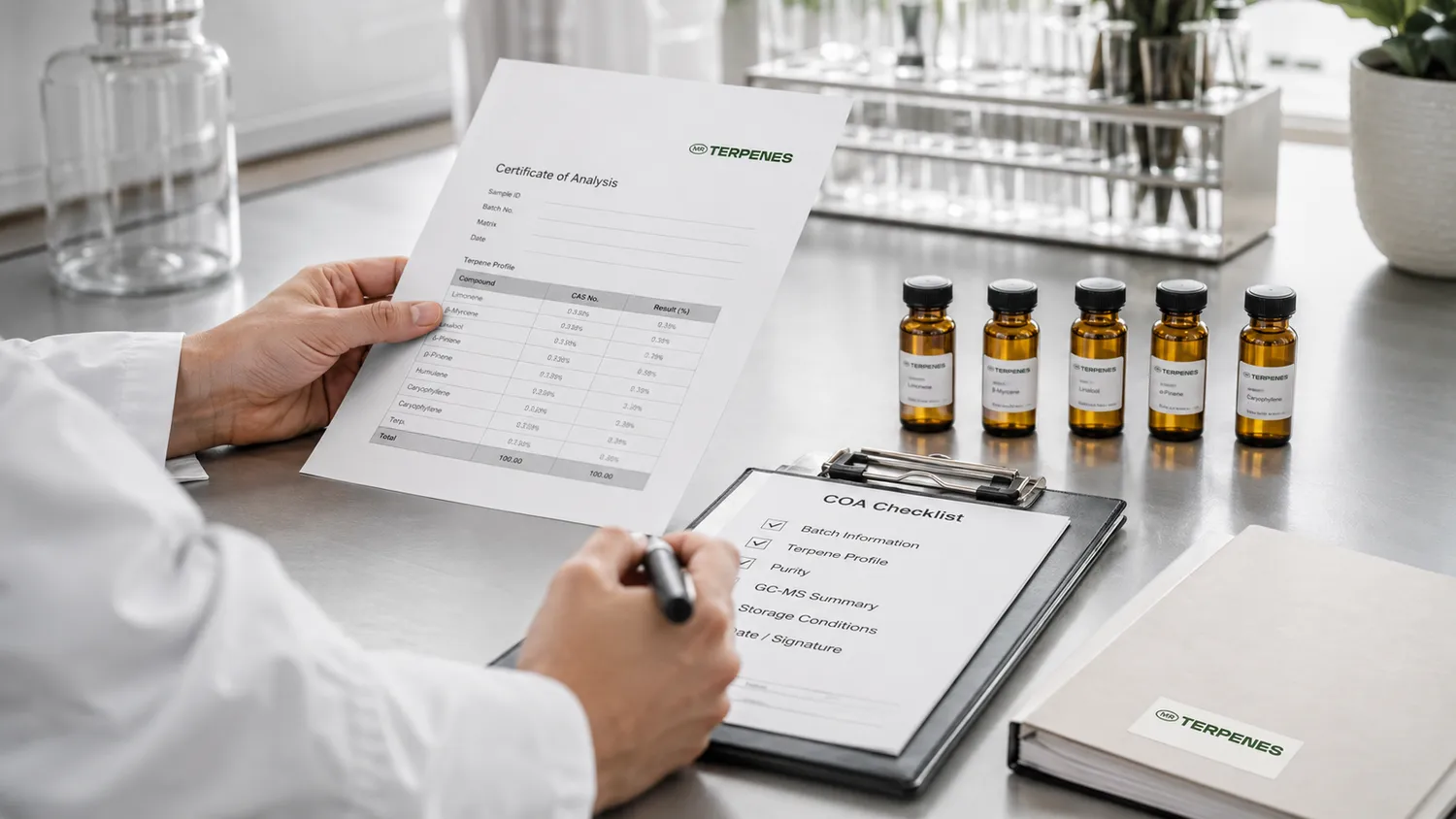
11. Authorised Signature and Date
A COA without a named analyst, signature and issue date is a draft, not a certificate. Verify the document is dated within twelve months of your purchase, and ideally within the same manufacturing window as the lot you are buying.
12. Methods and Limits of Detection
Each test should reference the analytical method used (for example USP 467 for residual solvents) and the limit of detection. “Not detected” is meaningless without knowing how low the lab can actually see.

Certificate-backed supply from Mr Terpeenes
A checklist is only as good as the certificate behind it. Browse profiles supplied with batch-matched documentation you can verify before accepting a lot.
Red Flags That Should Stop a Bulk Order
Even when a COA exists, certain warning signs justify pausing the purchase. Treat these as automatic rejections until the supplier clarifies in writing.
- Generic COA reused across different lot numbers.
- Pass or fail results with no underlying numerical data.
- Missing residual solvent or heavy metal panels.
- Issue date older than twelve months.
- Lab name not searchable or not accredited.
- Purity figures that contradict the GC-MS chromatogram attached.
If the COA cannot be matched to the lot in front of you, it does not exist for procurement purposes.
Matching the COA to Your Internal Specification
The terpene COA checklist only delivers value when each line item is cross-checked against your internal product specification. Build a one-page specification sheet for every SKU you buy: target purity, allowed residual solvents, accepted isomer ratio and any customer-driven constraints such as kosher, vegan or organic claims.
When a supplier sends a new lot, the receiving team should sign off both documents together — COA and specification — before the lot enters production stock. Mismatches are escalated to procurement, not absorbed by the production floor.
How a Terpene COA Checklist Protects Bulk Buyers Over the Long Term
A single rigorous review of one COA is useful. A repeatable terpene COA checklist applied to every incoming lot is what builds a defensible quality programme. Over a year of orders, the same checklist surfaces supplier drift, lot-to-lot inconsistency and slow changes in extraction methods that would otherwise hide inside acceptable-looking averages.
Bulk buyers who keep a structured archive of every COA, searchable by supplier, lot and molecule, can also respond faster to regulatory audits, customer complaints and reformulation requests. The checklist becomes a quality dataset, not just a gatekeeping tool.
Frequently Asked Questions About Terpene COAs
What is the difference between a COA and a safety data sheet?
A COA documents the specific properties of one production lot. A safety data sheet (SDS) describes the general hazards, handling and transport rules for the substance regardless of lot. Bulk buyers need both: the SDS for compliance and the COA for quality control.
How recent must a terpene COA be?
Best practice is a COA dated within twelve months and tied to the actual lot being shipped. For volatile terpene blends, a COA older than six months should prompt a request for a fresh analysis.
Should I trust an in-house COA from the supplier’s own lab?
An in-house COA is acceptable as an internal control document, but for B2B purchases you should also receive, or be able to request, an ISO 17025 third-party certificate for each lot.
What is an acceptable purity level for production-grade terpenes?
For single-molecule terpenes used in vape, distillate or edible production, target a purity of at least 95% with documented residual solvent and heavy metal panels below regulatory limits.
Can a terpene COA checklist replace sensory and stability testing?
No. The checklist confirms what the laboratory measured. Sensory evaluation, viscosity checks and accelerated stability tests still belong in your incoming-goods workflow, especially for bulk lots destined for vape and distillate products.