
Vape Oil Viscosity and Cartridge Filling Temperature

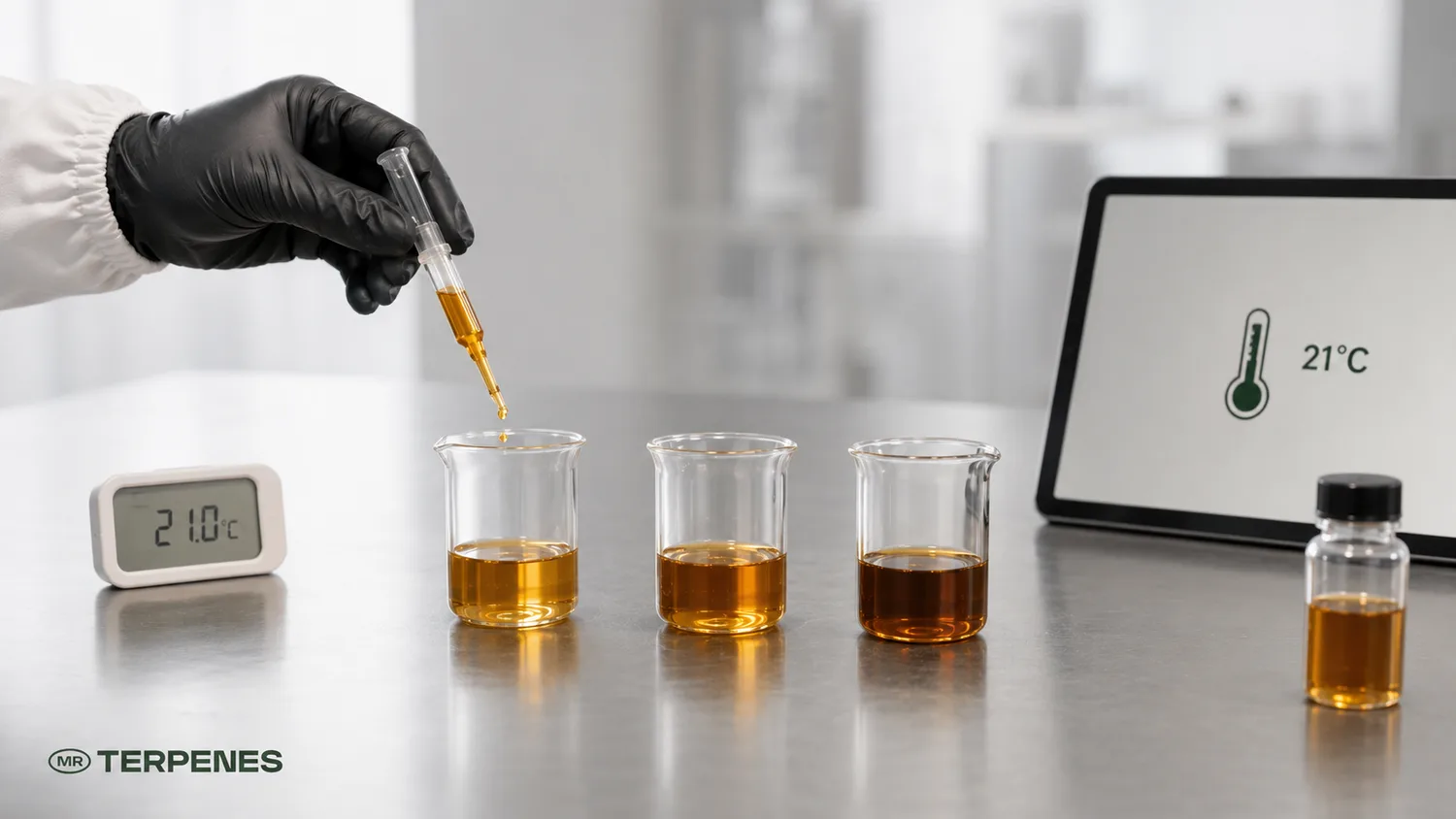
Vape oil viscosity is one of the most underestimated production variables in the cartridge industry. It dictates how cleanly a distillate-and-terpene blend pours into a cartridge, how fast the fill heads can move, and how stable the finished product feels in the consumer’s hand. Behind every clean fill there is a tight relationship between viscosity, cartridge filling temperature and the exact terpene ratio used in the recipe — and most production headaches on the line can be traced back to one of those three numbers being slightly off.
For brands building their own cartridge programmes, treating the terpene ratio as a flavour decision alone is a mistake. The ratio is also a viscosity decision, and viscosity is a temperature decision. A small change in any of these three values shifts the entire filling window, the wick saturation profile and the long-term performance of the cartridge.
What vape oil viscosity really means on a production line
Viscosity is, in practical terms, how much a vape oil resists flow when it is pushed through a needle, nozzle or capillary. On a filling line, it determines how quickly the dispenser empties, how clean the cut-off is between cartridges and how much oil clings to the inside of the reservoir between runs.
The base oil — typically a high-purity distillate — is extremely viscous at room temperature. Cold distillate behaves more like honey or soft toffee than a liquid that can be metered into a 1 ml cartridge. To make it pumpable, two levers are available: heat the oil to lower its viscosity, or add terpenes to dilute it. Both work, and in real production both are used together.
The trade-off is that vape oil viscosity is not linear. Adding 1% extra terpenes does not reduce viscosity by 1%. The relationship is exponential at the low-terpene end, which is why small recipe changes can shift the entire filling temperature window by several degrees.
How terpene ratios alter viscosity and the filling temperature window
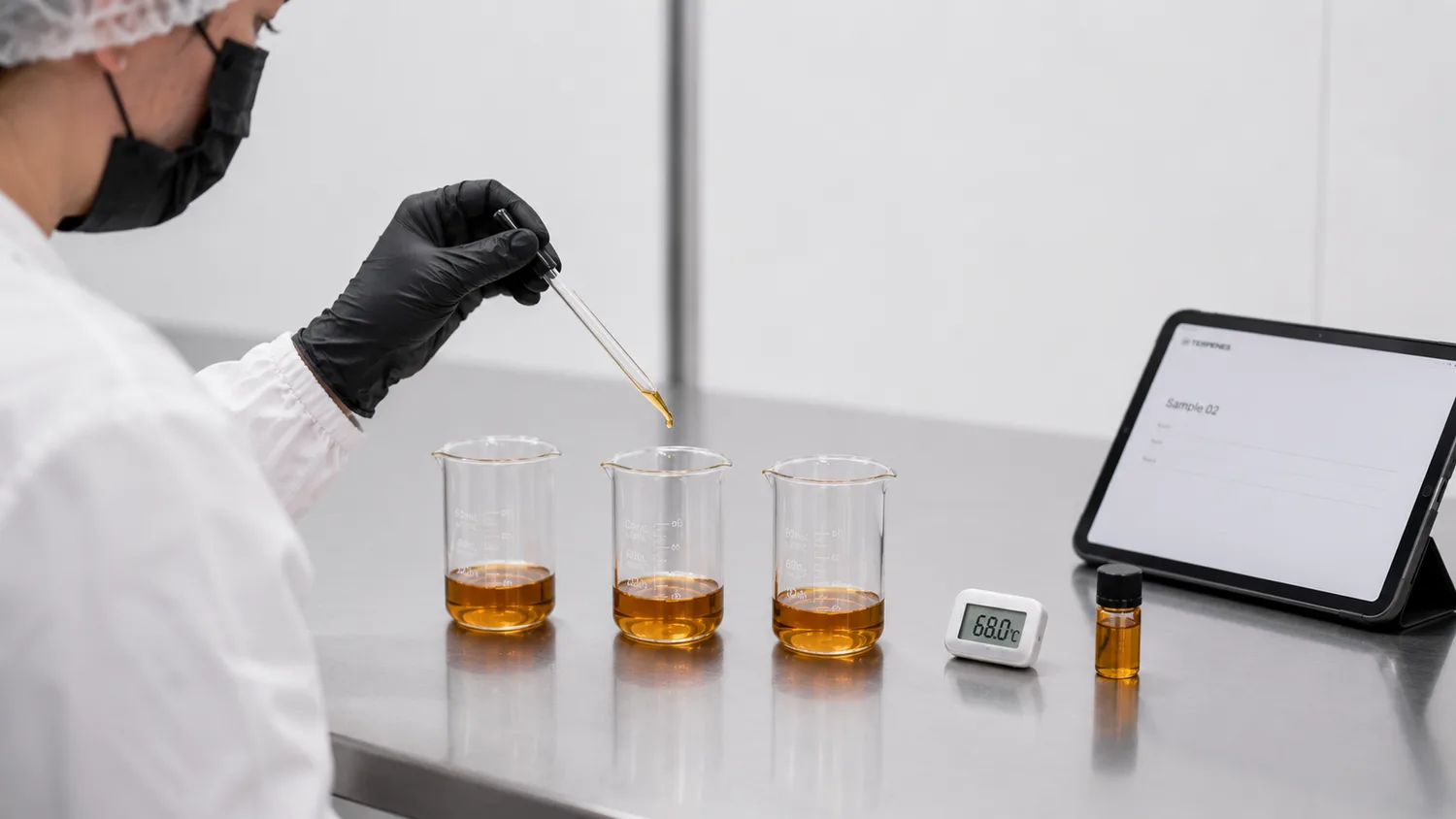
Terpenes are far less viscous than distillate. Adding them lowers the resistance of the blend and widens the temperature range in which the oil can be filled without quality issues. As a rough working frame for production planners:
- 1–3% terpenes: oil remains highly viscous. Fill temperatures typically sit around 50–60 °C to keep flow consistent.
- 4–7% terpenes: a balanced middle ground for most brands. Fill temperatures usually drop to 40–50 °C.
- 8–12% terpenes: oil is significantly thinner. Fill temperatures of 30–40 °C are often enough, and overheating becomes a real risk.
These ranges are indicative and should always be validated against the specific cartridge hardware, distillate purity and terpene blend in use. They illustrate the core principle: every extra percentage point of terpenes drops the temperature you need on the heater jacket, and that has knock-on effects across the line.
Filling equipment stocked by Mr Terpeenes
Viscosity behaviour changes what the machine has to do. Browse heated filling and capping equipment built for thick oils and temperature-sensitive formulations before choosing a setup.
The vape temperature calculator approach: matching ratio to fill temperature
Rather than guess, a structured “vape temperature calculator” mindset gives the production team a repeatable starting point. The logic is straightforward: define the terpene percentage in the blend, work out the expected vape oil viscosity at room temperature, pair it with a recommended filling temperature range, and use that as the first set-up value before fine-tuning with line trials.
The same logic underpins a terp to distillate ratio calculator, which works out how much terpene to add to a given mass of distillate. Pairing both calculations — ratio first, temperature second — is what turns a recipe from a flavour idea into a production-ready specification.
Why low-terpene blends still need careful temperature control
At the 1–3% range, the oil is barely diluted. Operators sometimes assume that because the blend is “mostly distillate”, the line behaves like a pure distillate fill. In practice, even a small amount of terpene changes the surface tension and the way the oil releases from the nozzle. Pushing the temperature too high to compensate for the residual viscosity can degrade terpenes, dull the flavour profile and lighten the colour of the finished product.
High-terpene blends and viscosity drift
At 10% and above, the opposite problem appears. The oil becomes thin enough to leak through wicks that were specified for thicker blends, and small temperature swings cause noticeable viscosity drift across a batch. Holding the reservoir 5 °C above the target is enough to cause overfills, while sitting 5 °C below can leave the last cartridges of a run underfilled. For these blends, accurate jacket control and short hold times matter more than the absolute temperature value.
Cartridge filling temperature targets driven by vape oil viscosity
The cartridge filling temperature is not chosen in isolation. It is the result of three inputs working together: the distillate grade, the terpene percentage and the cartridge hardware itself. Ceramic-coil cartridges with wider intake holes tolerate thinner oils more comfortably, while older cotton-based hardware tends to leak with the same blend.
For brands building blends with botanical or cannabis-derived terpenes, the guidance in how to dilute terpenes for vape cartridges is a useful reference point. It explains how to keep flavour intact while still reaching a viscosity that the line can handle without raising temperatures into the range where aromatic compounds start to suffer.
As a general rule, prolonged exposure above 60 °C should be avoided wherever possible. Short heating cycles followed by quick fills protect the terpene profile and reduce the risk of separation, oxidation and colour change in the bulk reservoir.
Match machine to oil with Mr Terpeenes
Temperature control and nozzle choice depend on the formulation you actually run. Share your viscosity range and fill target, and the specification can be checked properly.
Quality, throughput and reject rate: where viscosity errors show up
When vape oil viscosity is poorly matched to filling temperature, the symptoms are predictable. Underfilled cartridges, dripping nozzles, stringing between fills, air pockets, inconsistent dose volumes, and a higher reject rate at the capping stage. All of these tie back to the same root cause: the oil was either too thick for the temperature, or the temperature was too high for the oil.
For brands moving from manual workflows to semi-automatic or fully automated lines, the same recipe can perform very differently depending on the dispensing system. Choosing the right setup — covered in detail in this guide to oil filling machines for terpenes, CBD and vape oils — is part of getting viscosity, temperature and throughput aligned.
Once those three are aligned, the line stabilises: less downtime cleaning leaks, fewer rejects at capping, and a more consistent puff experience for the end consumer. The improvement is usually visible in the first full production day.
Building a repeatable workflow from terpene ratio to filled cartridge
A production-ready workflow does not start at the filling station. It starts at the bench, where the terpene ratio is locked in and vape oil viscosity targets are written into the specification sheet. From there, the cartridge filling temperature can be defined as a range rather than a single value, with upper and lower limits that the line operator can trust.
For brands working with premium ingredients, choosing the right terpene blend is a quality decision as much as a flavour decision. The selection criteria in best terpenes for distillate are also viscosity criteria — purity, profile and behaviour under heat all influence how the finished oil moves through the fill head.
When the ratio, the viscosity target and the filling temperature are documented together, the team has a workflow that survives shift changes, hardware swaps and seasonal variation. That repeatability is what separates a brand that scales cleanly from one that fights its own line every week.
Frequently asked questions about vape oil viscosity and filling temperature
What is the ideal vape oil viscosity for cartridge filling?
There is no single ideal value. Most cartridge hardware fills cleanly when the oil sits in the medium-viscosity range that a 4–7% terpene blend produces at 40–50 °C. The exact target depends on the hardware, the terpene profile and the dispensing system used on the line.
How does terpene ratio affect filling temperature?
A higher terpene ratio thins the oil, which lowers the temperature needed at the fill head. A lower ratio leaves the oil thicker and pushes the working temperature upwards. The relationship is not linear, so each recipe should be trialled before committing to a production target.
Why do my cartridges leak after filling?
Most post-fill leaks come from oil that is too thin for the cartridge, either because the terpene ratio is too high or the filling temperature was set above the safe window. Reviewing the viscosity target and lowering the jacket temperature usually resolves the issue without changing the recipe.
Can I use a vape temperature calculator for any blend?
A calculator-style approach gives a reliable starting point for most distillate-and-terpene blends. It should always be combined with a short line trial to confirm the values for the specific hardware, terpene profile and ambient conditions in the production environment.
Does heating vape oil damage the terpenes?
Prolonged exposure above 60 °C, and especially repeated heating cycles, can degrade the more volatile terpenes and dull the flavour. Keeping fill temperatures as low as the viscosity allows, and minimising the time the oil spends in the heated reservoir, protects the aromatic profile.