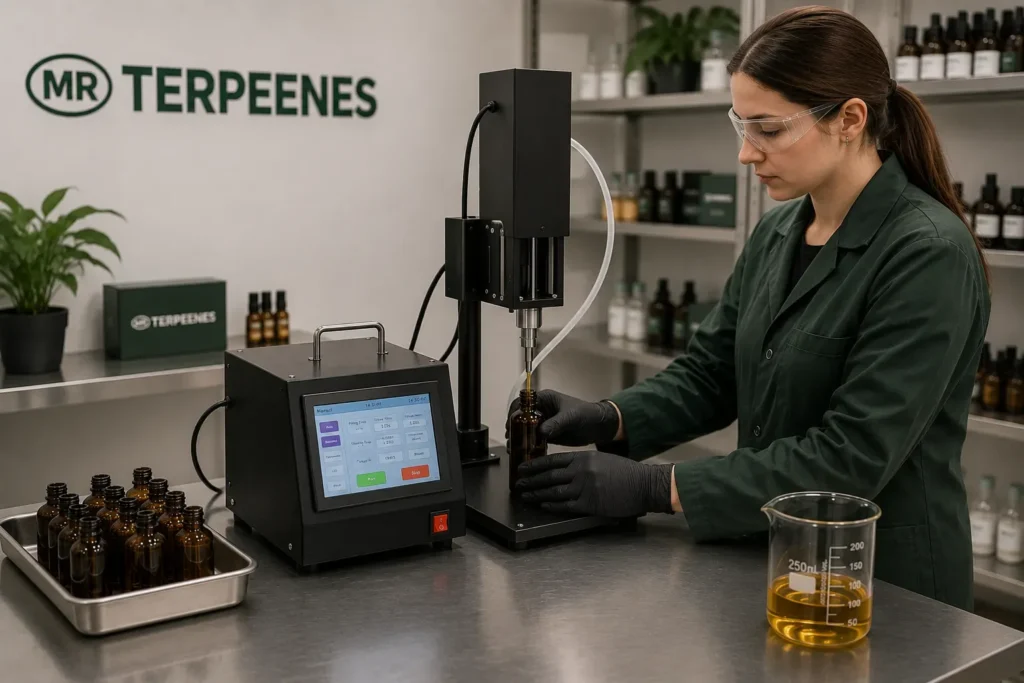
CBD Oil Filling Machine Setup: Accuracy, Viscosity and Batch Control for Brands

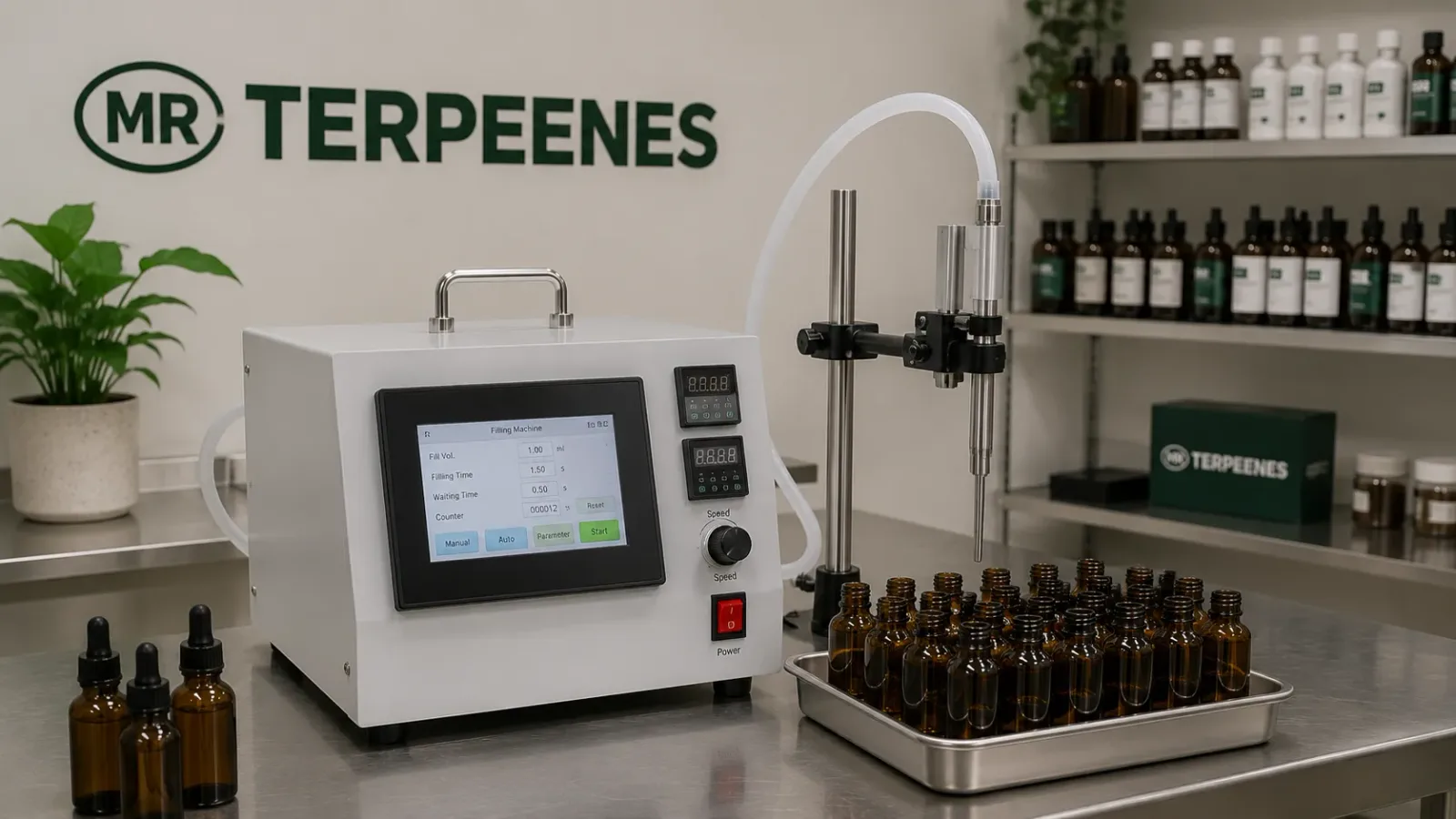
A reliable CBD oil filling machine setup is a documented combination of four things: a characterised product, a defined container, a dose confirmed by trial fills, and in-process checks recorded against a batch number. The machine only executes the number on the screen. Accuracy comes from how well the oil, the container and the procedure around them were defined before production started.
That distinction matters because two CBD oils can behave very differently in the same equipment. Carrier oil, formulation, temperature and density all influence how a dose leaves the nozzle, so a setup that filled consistently last month may drift the moment the formulation, the bottle or the target volume changes.
MR TERPEENES supplies filling and capping machinery to CBD, terpene and vape brands, and the recurring question is rarely which machine to buy — it is how to make a machine repeat itself. This guide covers that side: calibration, viscosity management, fill accuracy and batch control.
Key setup principles
- Characterise the product first. Viscosity and density belong to the formulation, not the machine.
- Validate, do not assume. Confirm every setting with trial fills using representative product.
- Measure what you actually deliver. A displayed volume is a target; a measured fill is evidence.
- Document the approved configuration. An undocumented setup cannot be repeated at the next batch.
- Keep checking during the run. A correct first fill does not guarantee a correct hundredth fill.
- Treat any change as a trigger for revalidation. New oil, new container, new nozzle: re-test.
What Does a CBD Oil Filling Machine Setup Include?
A filling machine setup is the operational sequence that turns installed equipment into a repeatable process. Installing a machine is a one-off event. Setting up a filling process is something you do for every product, container and batch.
A complete setup covers product preparation, machine inspection, the assembly and condition of product-contact components, priming, dosing configuration, container positioning, trial fills, calibration, in-process quality checks, batch documentation, cleaning and changeover.
Equipment selection sits before all of this. If you are still comparing platforms and capping options, our buyer checklist for filling and capping machines covers the purchasing side, and the oil filling machinery range shows the platforms available. This article assumes the machine is already in front of you.
Start With the Oil, Container and Target Fill
Three variables should be defined before anyone touches a machine setting: what you are filling, what you are filling it into, and how much of it counts as correct.
Understand the formulation
Record the carrier oil, the formulation reference and the batch of oil in use. Note viscosity and density if they have been determined, and whether the product contains suspended material that could settle or block a nozzle. Establish whether the formulation is sensitive to temperature or prolonged agitation. Two batches of the same recipe should behave alike — confirm that rather than assume it.
Define the container
Container geometry changes filling behaviour as much as the oil does. Confirm the container type, the internal diameter of the opening, whether the nozzle enters cleanly without touching the neck, and how stable the container is while being filled. Confirm the closure method too, since capping problems often originate at the fill stage. Formats vary widely across custom vape cartridge and hardware formats, and a nozzle suited to a dropper bottle may not suit a cartridge.
Define the target fill
State the target volume, whether verification is by volume or weight, and the tolerance your business has documented for that product. Tolerance is an internal decision informed by your packaging and market requirements — no universal figure applies across products or jurisdictions. In the UK, quantity requirements for prepacked goods sit in the Weights and Measures (Packaged Goods) Regulations 2006, with guidance published by the Office for Product Safety and Standards. Confirm what applies to your product and market before fixing a tolerance.
How Viscosity Affects CBD Oil Filling
Viscosity determines how readily product moves through the filling path, and it is the most common reason a machine that worked yesterday will not repeat today.
Higher viscosity slows flow rate, raises the pressure needed to move product through tubing and lengthens the time a dose takes to release fully. That produces short fills where cycle timing has not been adjusted, and it makes nozzle cut-off less clean, leading to stringing between nozzle and container. Lower viscosity moves the problem the other way: faster flow and cleaner cut-off, but more dripping between cycles and more entrained air. Air matters twice over, because a dose containing air delivers less product than the machine believes it has delivered.
Viscosity is not fixed. It changes with temperature, which is why some operations manage product temperature during filling. Whether heating is appropriate at all — and to what temperature — depends on the formulation, the container, product stability and the manufacturer’s instructions. It is a validation decision, not a default setting, and no single figure transfers safely between products. Our article on vape oil viscosity and cartridge filling temperature covers that relationship in more depth.
See the filling machinery at Mr Terpeenes
Fill accuracy starts with the machine, not the recipe. Browse the filling and capping equipment supplied to UK and European producers before you settle on a setup.
How to Calibrate a CBD Oil Filling Machine
Calibration means adjusting machine settings until measured output matches the target fill, using product representative of the real batch. Water is not a substitute for the actual oil unless the manufacturer specifies a water-based procedure, because a different density and viscosity produce a different dose from the same setting.
- Confirm the product and container against the batch documentation.
- Inspect and assemble product-contact components — tubing, seals, nozzle — checking for wear or residue.
- Prepare a representative product sample at the condition it will be filled in.
- Prime the tubing and nozzle until flow is continuous and free of air.
- Enter an initial dosing setting, using a saved recipe as a starting point if one exists.
- Run several trial fills and discard the first few, which are rarely representative.
- Measure the actual filled quantity for each trial fill and record the values.
- Adjust the machine settings from the measured deviation, changing one variable at a time.
- Repeat the test until results sit within tolerance and repeat consistently.
- Document the approved setup: every setting, the components fitted, and the measurements that justified approval.
How many trial fills are needed depends on the product, the machine and your internal procedure. The requirement is not a fixed count — it is enough consecutive results to show the process is stable rather than accidentally correct once.
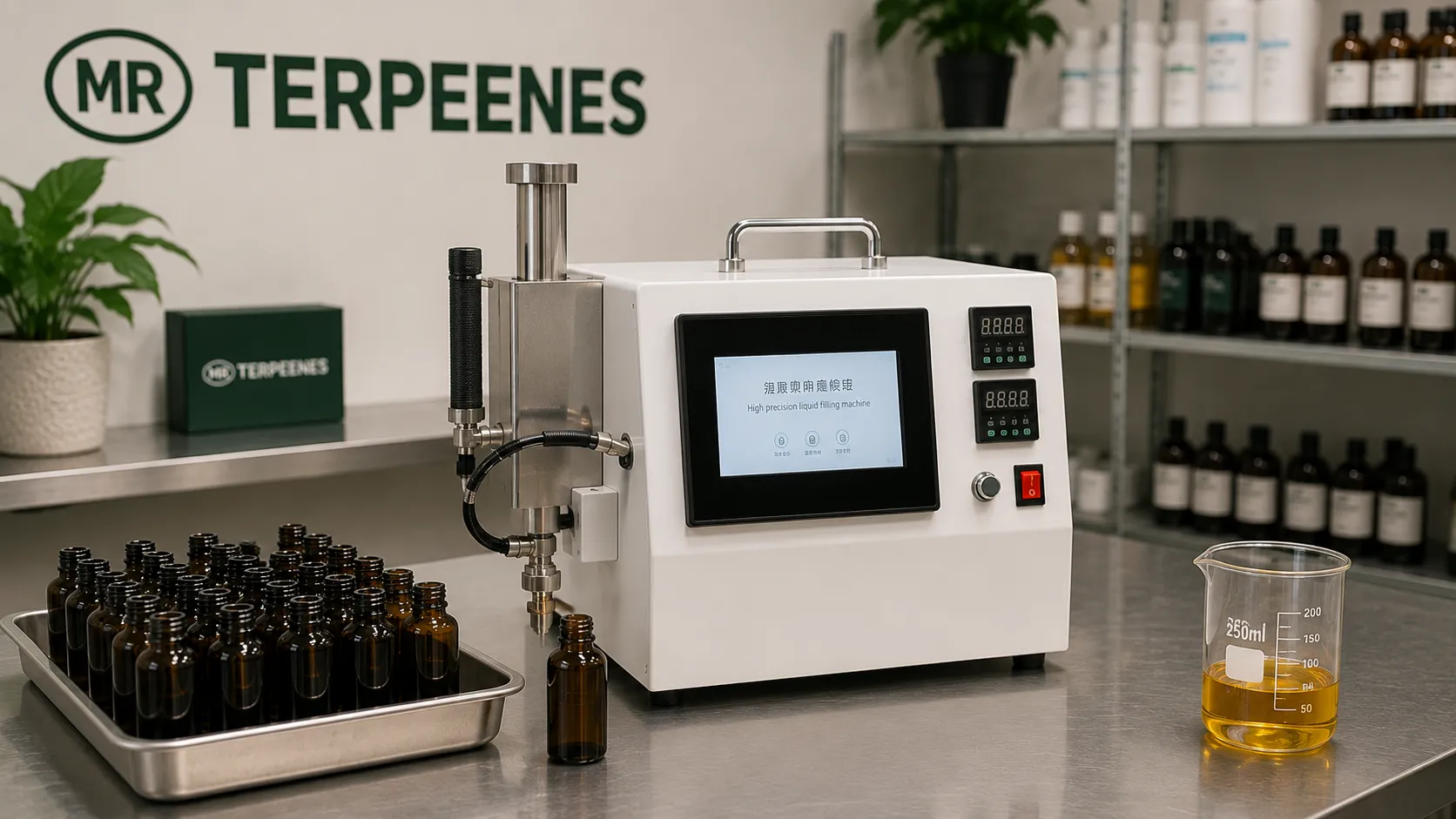
Checking Fill Accuracy by Weight or Volume
Volume checks suit graduated containers, calibrated measuring vessels and quantities declared as a volume. Weight checks are usually faster and more repeatable in practice, because a balance gives a direct reading without transferring product to another vessel.
Weight and volume are not interchangeable without knowing the product density. Two oils filled to the same weight occupy different volumes if their densities differ, which is why density belongs in your product record.
Net product weight = filled container weight − empty container weight
Calculated volume = net product weight ÷ product density
The empty container weight must be deducted, and glass containers vary enough between units that an average tare is worth considering over a single sample. Any conversion is only as reliable as the density behind it, so density should be determined for the formulation rather than borrowed from a similar product. OIML R 87 sets out international guidance on quantity control in prepackages and is a useful reference when designing a checking procedure. Record every measurement — an unrecorded check cannot support a batch release decision. Where filling is done by hand alongside a machine, align both routes; our comparison of measuring with pipettes versus syringes covers the manual side.
Spec your filling line with Mr Terpeenes
Once the format is settled, the line has to match the oil, the fill volume and the cartridge. Talk through the specification before committing to equipment.
Fill Accuracy and In-Process Quality Checks
A successful calibration proves the process was correct at the moment it was approved. It does not prove the process stays correct for the next four hours. Reservoir level drops, product temperature drifts, tubing fatigues and containers shift — all of which move the delivered dose gradually rather than obviously.
In-process checks should detect underfills, overfills, dripping, incomplete doses, air entrainment, container movement, changing reservoir level, viscosity change through the run, partial nozzle blockage, tubing wear, leakage after filling and inconsistent closure. Most show as a trend across consecutive checks rather than a single dramatic failure, which is why results should be recorded and compared rather than simply judged pass or fail.
Check frequency is a decision for your own procedure. It should reflect batch size, the risk profile of the product, your internal SOP, applicable requirements and how the process has performed previously. A well-characterised product on a short run does not need the sampling intensity of a new formulation on a long one.
What to Record for Every Filling Batch
Batch documentation is what makes filling auditable and repeatable. It also lets you reproduce a good batch, or investigate a poor one, six months later.
| Record | Why it matters | Example of what to document |
|---|---|---|
| Batch or lot ID | Links every check and unit to a traceable run | Unique reference issued before filling starts |
| Product and formulation reference | Identifies exactly what was filled | Product name plus recipe version |
| Container type | Geometry affects fill behaviour | Format, size and closure type |
| Target fill and tolerance | Defines what counts as a correct fill | Declared quantity and internal tolerance |
| Machine identification | Ties performance to a specific unit | Equipment ID or asset number |
| Machine settings | Allows the setup to be reproduced | All dosing and timing parameters as entered |
| Nozzle and tubing configuration | Changing either changes the dose | Component sizes and identifiers fitted |
| Product temperature, when relevant | Temperature influences viscosity and flow | Recorded value and time taken |
| Start and finish time | Supports investigation of drift | Clock times for the filling operation |
| Trial fill results | Evidence the setup was approved on data | Individual measurements before production |
| In-process check results | Shows the process stayed in control | Measurements with time and operator |
| Rejected and reworked units | Reconciles output against material used | Counts with reason for rejection |
| Cleaning status | Prevents cross-contamination | Reference to the completed cleaning record |
| Operator | Assigns responsibility, supports training review | Name or initials per stage |
| Approval or release status | Records the decision to release the batch | Signature and date of the approver |
If you are building this into a wider quality system, our quality and compliance page outlines the documentation standards we work to.
Common Causes of Inconsistent CBD Oil Fills
Filling problems rarely have a single cause. The table below is a starting point for investigation, not a diagnosis.
| Problem | Possible causes | What to check |
|---|---|---|
| Inconsistent fill quantity | Air in the line, worn components, reservoir level change, temperature drift | Priming, seals and tubing, reservoir level, product temperature |
| Slow or irregular flow | Higher viscosity than expected, partial blockage, restricted tubing | Product condition, nozzle and filter, tubing routing and bore |
| Dripping nozzle | Low viscosity, cut-off timing, worn nozzle or seal | Cut-off and suck-back settings, nozzle condition, temperature |
| Product stringing | Higher viscosity, abrupt cut-off, nozzle geometry | Nozzle type and size, dose end timing, product handling |
| Air bubbles | Incomplete priming, loose connection, turbulent fill, agitated product | Connections and seals, fill speed, product preparation |
| Incomplete fills | Cycle time too short for the viscosity, low reservoir, line restriction | Timing settings, reservoir level, full filling path |
| Changes during the batch | Temperature drift, falling reservoir, component wear, settling | In-process trend, temperature record, component condition |
| Leakage after filling | Overfill, product on neck or thread, inconsistent closure | Fill level, nozzle position and cleanliness, capping method |
| Inconsistent bottle positioning | Unsupported container, unstable platform, manual placement variation | Container guides, work surface, operator procedure |
Cleaning and Changeover Between Batches
Changeover is part of the setup, because the state a machine is left in determines how the next batch starts. Drain residual product from the reservoir and lines, clean the product-contact components, and pay particular attention to tubing and nozzles where residue accumulates out of sight. Check seals and connections while the machine is apart, dry components appropriately before reassembly, then prime and run a trial fill before restarting production. Record what was cleaned, when and by whom.
Cleaning agents and methods must follow the manufacturer’s instructions, the material compatibility of your wetted parts, your internal SOPs and any product-specific requirements — no generic procedure is safe across all machines and formulations. For the scheduled side, see our oil filling machine maintenance checklist.
A Practical CBD Oil Filling Machine Setup Workflow
- Review the batch documentation.
- Confirm the product and packaging against it.
- Inspect the machine before use.
- Assemble the filling path.
- Prepare the oil to its defined filling condition.
- Prime the system until flow is clean.
- Configure the initial dose.
- Complete trial fills.
- Calibrate against measured results.
- Start production.
- Perform in-process checks at the defined frequency.
- Record any deviation as it occurs.
- Complete and reconcile the batch.
- Clean, changeover and document.
When a Filling Setup Needs Revalidation
An approved setup applies only to the conditions it was approved under. Revalidate whenever the formulation or carrier oil changes, viscosity changes, the container or closure changes, the nozzle or tubing is replaced with a different specification, the target fill volume changes, a machine component is repaired or swapped, the operator procedure changes, the production environment shifts materially, or the cleaning method changes.
Saved machine recipes are a convenience, not a validation. Recalling a stored configuration reproduces the settings, not the conditions those settings were approved under — components wear, oils vary between batches and ambient conditions move. Trial fills at the start of each batch remain the check that confirms the setup still delivers what it did last time.
Frequently Asked Questions
How do you calibrate a CBD oil filling machine?
Calibrate by filling with representative product, measuring the actual quantity delivered, and adjusting the dosing settings until measured results sit within your documented tolerance across consecutive fills. Discard the first fills after priming, change one variable at a time, and record the settings, components and measurements that justified approving the setup.
Does CBD oil need to be heated before filling?
Not necessarily. Some formulations fill consistently at ambient temperature, while others flow more predictably when warmed. Whether to apply heat, and at what temperature, depends on the formulation, the container, product stability and the machine manufacturer’s instructions. Treat it as a validation decision for each product rather than a standard setting applied to all CBD oils.
How does viscosity affect filling accuracy?
Viscosity changes how quickly and cleanly product moves through the filling path. Thicker oils flow more slowly and can produce short fills if cycle timing is unchanged, and they tend to string at the nozzle. Thinner oils flow faster but drip more readily and entrain air. Because viscosity varies with temperature, accuracy can drift during a run.
Should CBD oil be checked by weight or volume?
Either can be valid. Weight checks are usually faster and more repeatable, since a balance gives a direct reading without transferring product. Volume checks suit graduated containers and volume-declared quantities. The two are only interchangeable if you know the product density, so record density for the formulation before converting between them.
What should a CBD oil batch record include?
At minimum: batch ID, product and formulation reference, container type, target fill and tolerance, machine identification and settings, nozzle and tubing configuration, product temperature where relevant, start and finish times, trial fill results, in-process check results, rejected and reworked units, cleaning status, operator, and the approval or release decision.
Why does fill accuracy change during production?
Because conditions change while the machine setting stays the same. Reservoir level falls, product temperature drifts, viscosity shifts with it, tubing fatigues, seals wear and containers move. Each acts gradually, so the delivered dose trends away from target rather than failing outright — which is why in-process results should be compared over time, not judged individually.
Can the same machine setup be used for different CBD oils?
Not reliably. Different carrier oils and formulations vary in viscosity and density, so the same dosing setting can deliver a different quantity. A stored recipe is a sensible starting point for a similar product, but it should always be confirmed with trial fills and measurement before the batch runs, and the result documented separately.
How often should fill accuracy be checked during a batch?
There is no universal frequency. Set it in your own procedure based on batch size, the risk profile of the product, applicable requirements and how the process has performed previously. Longer runs, new formulations and products with a history of drift warrant more frequent checking than short runs of a well-characterised product.
Build a More Consistent Filling Workflow
A reliable CBD oil filling machine setup starts with the product, the container and the production requirement — not with a universal machine setting. Viscosity, target fill, packaging format and batch size all shape what the right configuration looks like, and that configuration is only useful once it has been validated and written down.