
CBD Oil Vape Cartridge Filling and Capping Machine: Buyer Checklist for Brands

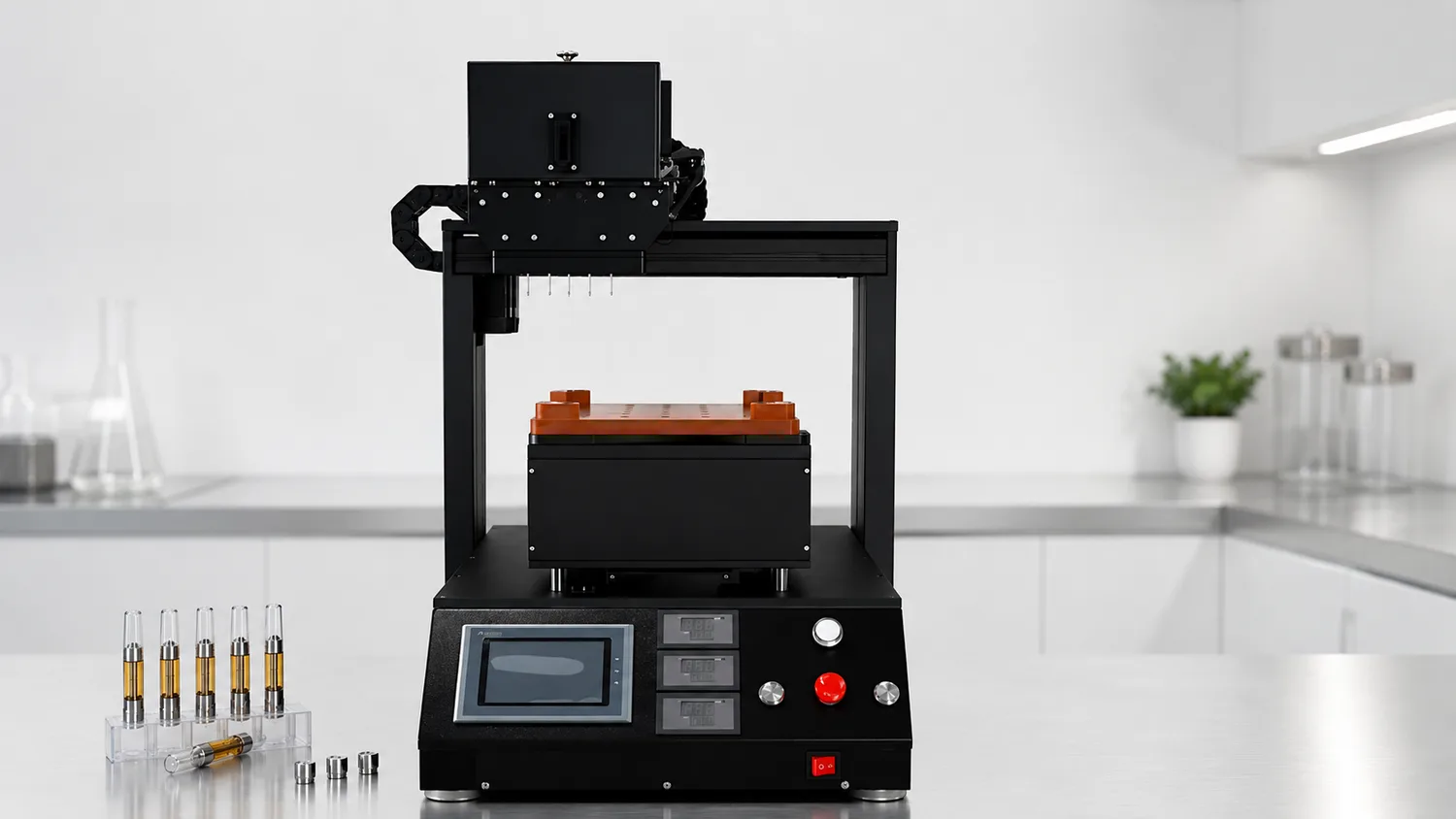
Choosing a CBD oil vape cartridge filling and capping machine is the single biggest production decision a vape brand will make in its first three years. The right machine protects margin, keeps fill weights legal, and lets you scale from 200 to 20,000 carts a day without re-tooling. The wrong one bottlenecks every launch.
If you are scoping equipment for a new line, white-label run, or contract-fill service, this checklist walks through every spec that actually matters — throughput, dosing accuracy, viscosity range, capping force, validation, and total cost of ownership — so you can brief suppliers without surprises.
Why the right CBD oil vape cartridge filling and capping machine matters for serious brands
Distillates, live-resin blends and broad-spectrum CBD oils behave very differently in a dosing nozzle — viscosity in cannabis extracts can swing across more than two orders of magnitude depending on chemotype and temperature, as documented in standard fluid-viscosity literature. A machine that handles a 1,500 cP isolate at room temperature can choke on a 250,000 cP rosin sauce unless its heaters and pump are sized for it. That is before you factor in the regulatory pressure on consistent fill weights, child-resistant cap torque, and batch traceability.
Investing in a properly specified CBD oil vape cartridge filling and capping machine means fewer rejects, fewer leakers, and a record of every batch you can hand to a tester or auditor on demand. It is also the only realistic way to keep gross margin positive once your SKU count climbs past a handful of strains.
The cost of getting it wrong
A 5% over-fill on a 1 ml cart, multiplied across a 10,000-unit run with $30/g distillate, burns through $1,500 of oil per batch. A 0.05 mm cap misalignment that lets vapour escape during transit triggers returns, refund requests and review damage that no marketing budget recovers. Equipment is where unit economics are won or lost.
Throughput: choosing the right cartridge filling machine for your real demand
Manufacturers love to quote peak carts-per-hour. Real-world output usually lands at 60–70% of that figure once you account for changeovers, oil top-ups and the operator pace.
- Pilot & sample work (under 500 carts/day): a single-head semi-automatic is plenty. Lower capex, easy to clean, ideal for menu testing.
- Boutique brands (500–3,000 carts/day): a dual-head semi-automatic with heated reservoir hits the sweet spot of price and consistency.
- Scale and contract fillers (3,000–20,000+ carts/day): five-head fully automatic with vision-guided capping is the floor. Anything less becomes the bottleneck.
Browse the full machine ladder on our range of oil filling machines for terpenes, CBD and vape oils to see which platform fits your projected SKU count.
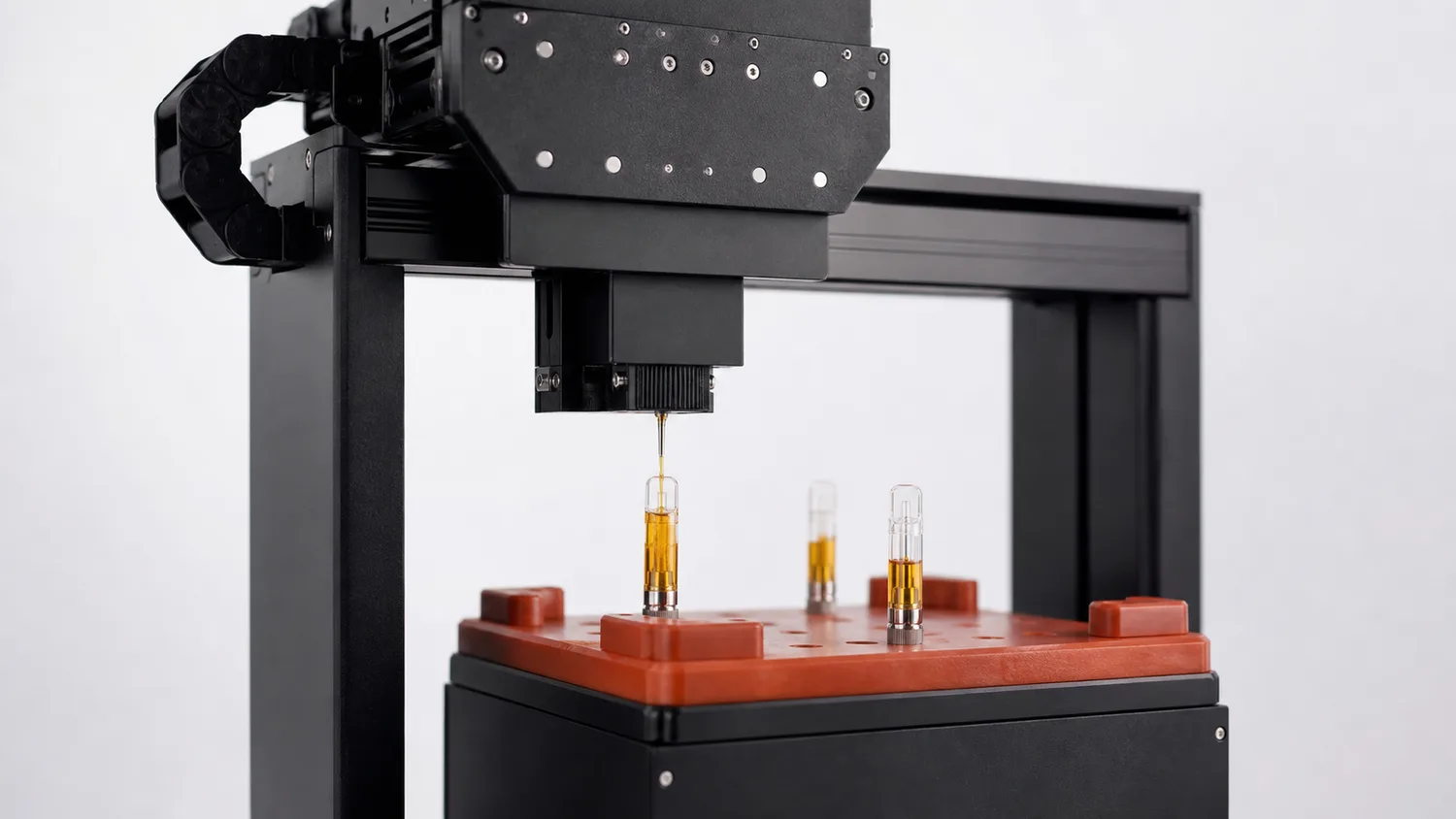
Dosing accuracy and repeatability
Industry-grade machines should hit ±1.5% on volume and ±2% on weight across a full reservoir. Anything looser will eventually show up in compliance testing or customer complaints about “short” carts.
Volumetric vs. peristaltic vs. piston dosing
- Peristaltic pumps: simplest to clean, but accuracy drifts as tubing fatigues. Best for thin oils, weakest for high-viscosity rosin.
- Volumetric (gear) pumps: the workhorse for distillate. Tight tolerances, predictable wear.
- Servo-driven pistons: the gold standard for sub-1% accuracy on heavy, terpene-rich oils. Higher capex, lower scrap.
Compare filling machines at Mr Terpeenes
Specifications read alike until you compare them side by side. Browse the filling and capping machines held for UK and European producers and see where they differ.
Viscosity range and heating
Viscosity is non-negotiable. Confirm three numbers with the supplier in writing:
- Minimum viscosity the dosing head can handle without dripping.
- Maximum viscosity the heated reservoir and lines can pump at the rated cycle time.
- Reservoir temperature stability — ±2 °C is acceptable, ±5 °C is not.
If you run multiple chemotypes — a thin CBD distillate alongside a thick CBG sauce — pick a machine that can be re-zeroed inside ten minutes. Re-calibration time is a hidden cost that destroys utilisation.
Capping: the spec brands forget to ask about
Filling gets the marketing photos. Capping is what determines whether your carts arrive intact. A press-cap that is under-torqued vents oil; one that is over-torqued cracks the polycarbonate and leaks during pressurisation in transit.
What to confirm with the supplier
- Force range, in newtons, and tolerance band per cycle.
- Cap geometry compatibility — press-fit, screw-on or magnetic, across both 510-thread and pod formats.
- Whether the head can be swapped to handle child-resistant caps for the US market without re-buying the platform.
Pair the right machine with the right hardware: see our white label vape hardware catalogue to confirm cart and cap compatibility before you commit to a filler.
Cleaning, changeover and downtime
Between strains, you will clean. Calculate cleaning time honestly: a quick-disconnect manifold turns a 45-minute teardown into a 10-minute swap, and that is 35 minutes of billable production every changeover. On a five-strain day, that is three extra hours of output.
Ask for the supplier’s documented CIP (clean-in-place) procedure. If they cannot share one, treat that as a red flag.
Validation, software and traceability
Modern buyers want batch records, not paper logs. Look for:
- Touchscreen HMI with recipe storage for at least 50 SKUs.
- USB or network export of fill data per cartridge — date, time, target volume, actual volume, head ID.
- Optional 21 CFR Part 11-style audit trail if you sell into regulated US channels.
This data is also what your QA team will use to defend a batch if a retailer challenges fill weight or potency.
Compliance and packaging integration
The filler is one node in a packaging line. Plan for what happens immediately after capping: induction sealing, child-resistant outer packs, batch labels and tamper bands. If your filler outputs faster than your packaging cell, you have just moved the bottleneck.
For end-to-end planning, our terpene packaging solutions are built to feed straight off a CBD vape cartridge filling and capping machine without manual handling between stations.
Shortlist your machine with Mr Terpeenes
A buyer guide narrows the field; your throughput and cartridge format decide the winner. Go through both with the team before committing budget to a machine.
Total cost of ownership: the number that actually matters
Sticker price tells you very little. Build a five-year TCO model that includes:
- Purchase price, shipping, installation and operator training.
- Annual service contract and consumables (tubing, seals, nozzles).
- Energy use at your typical duty cycle.
- Estimated oil scrap from over-fill at the spec’d accuracy rate.
- Downtime cost during changeover and unplanned repair.
A machine that costs 30% more upfront but cuts oil scrap by 2% pays for itself inside one production year for any brand running premium distillate.
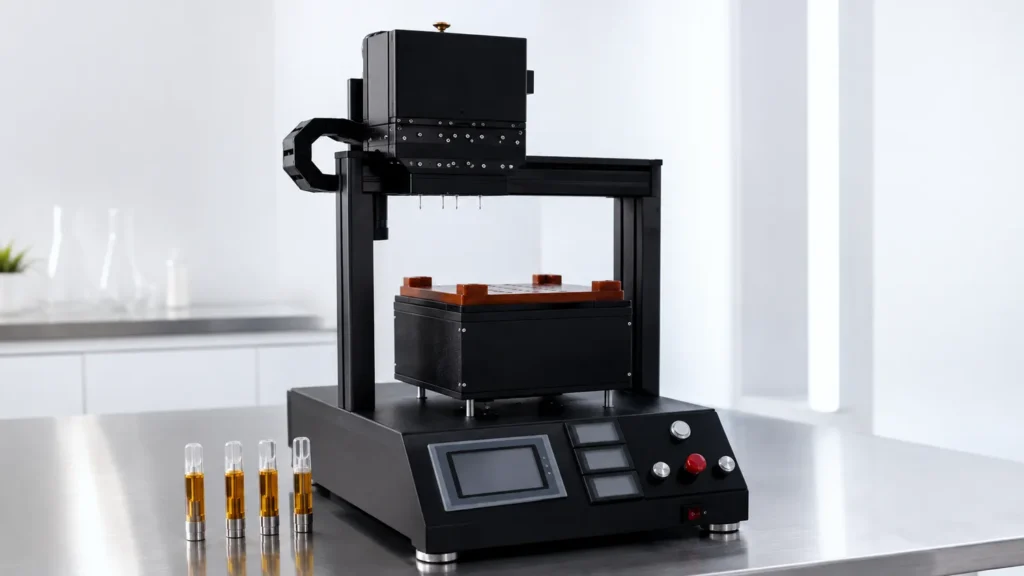
Automatic capping equipment finishing a batch of CBD vape cartridges.
Buyer checklist: the questions to ask every supplier
- What is the realistic carts-per-hour figure at our oil’s viscosity, not the brochure peak?
- Can you provide a video of the machine running our exact cart format?
- What is the documented dosing accuracy and repeatability, with third-party verification?
- What spare parts do you recommend stocking for year one, and what is lead time on each?
- What is the warranty scope, response SLA and on-site service availability in our region?
- Can the platform grow with us — extra heads, vision capping, automation hand-off?
A day on the line: what production looks like with the right CBD oil vape cartridge filling and capping machine
Picture the floor at 7:42 a.m. on a Tuesday. The reservoir is pre-heating, the operator is wiping down the dosing manifold, and the day’s recipe — a 1 ml live-resin cart with 8% terpene reintroduction — is already loaded on the touchscreen from last week’s run. By 8:05, the first 96-cart tray is filled, capped, induction-sealed and labelled. The operator has not lifted a single cartridge by hand.
That quiet rhythm is the difference between a production line and a hobby. It is also where the real ROI of a properly specified vape cartridge filling and capping machine for CBD oil hides: not in the peak hour, but in the boring middle of a long shift, when accuracy holds, temperature holds, and nobody is improvising.
Hour three: the test most machines fail
Anyone can run a clean first hour. The honest spec is what happens at hour three, when reservoir oil has thinned, ambient temperature has crept up, and the operator’s attention has drifted to the next changeover. A platform built for serious throughput will hold ±1.5% on volume right through that window. A platform sold on its brochure peak will start drifting, and the day’s reject pile will tell the story long before QA does.
The 4 p.m. changeover that pays the rent
Run the maths on a single afternoon switch from a thin CBD distillate to a heavy CBG sauce. With quick-disconnect tooling and recipe presets, that swap is a 12-minute coffee break. With a legacy machine, it is a 50-minute teardown that eats the rest of the shift and forces a same-day overtime call. Multiply by twenty changeovers a month and the “expensive” platform suddenly looks like the cheap one.
What veteran fillers wish they had asked on day one
Talk to anyone who has run a CBD cartridge filling line for three years and the regrets are remarkably consistent: nobody complains they over-specified the heater, the accuracy or the data export. They complain they bought for last year’s volume instead of next year’s, that they trusted a brochure number, that they bolted a cheap capper onto a good filler and lived with leakers ever since. Specify for the brand you intend to be in 24 months, not the one you launched as.
The unromantic edge: data your sales team can use
The least exciting feature on the spec sheet — per-cartridge fill data exported to CSV — is the one that quietly closes wholesale deals. Buyers at dispensary chains and white-label retailers want to see batch records before they place a second order. A machine that hands you that file at the end of every shift is also a machine that earns a higher margin per cart, because trust travels up the supply chain at exactly the speed of paperwork.
Frequently asked questions
What is a CBD oil vape cartridge filling and capping machine?
It is a piece of production equipment that meters CBD oil into empty vape cartridges and presses or screws the mouthpiece cap into place in a single, repeatable cycle, replacing slow and inconsistent manual filling.
How accurate should the dosing be?
For CBD distillate, ±1.5% on volume and ±2% on weight is the industry-grade benchmark. Loose tolerances cost real money in over-fill and risk under-fill complaints.
Can one machine handle distillate, live resin and rosin?
Only if the heated reservoir, lines and pump are sized for the highest viscosity oil you plan to run. Always confirm the maximum viscosity rating in writing before purchase.
Do I need a fully automatic machine to start?
No. Most boutique CBD brands launch on a dual-head semi-automatic and upgrade to a five-head automatic once steady demand exceeds 3,000 cartridges per day.
How long does changeover between strains take?
A well-designed machine with quick-disconnect tooling can be cleaned and re-loaded in 10–15 minutes. Older platforms can take 45 minutes or more — a major hidden cost over a full production week.