
Oil Cartridge Filling Machine vs Manual Filling: When Should You Upgrade?

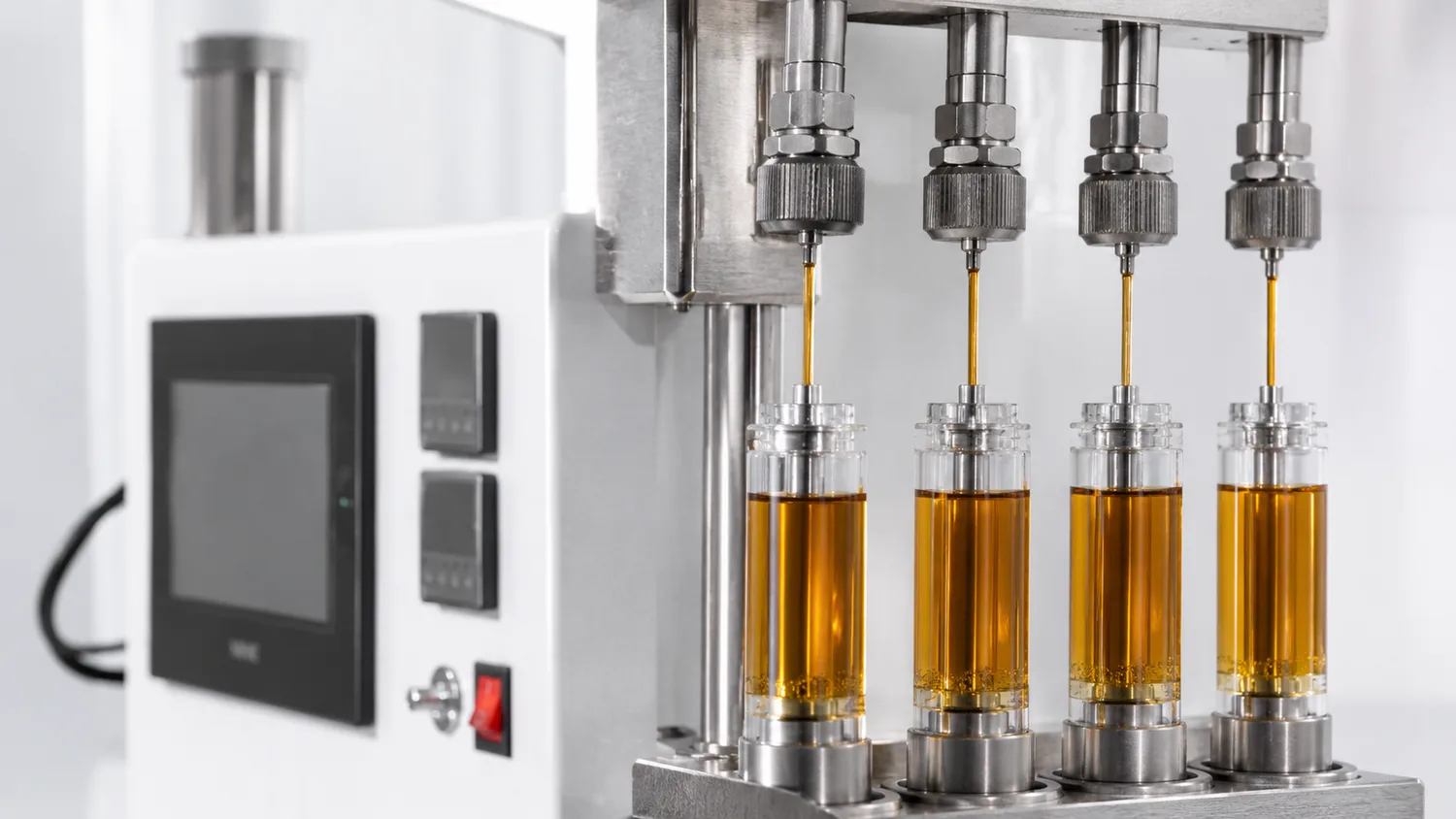
An oil cartridge filling machine can turn a weekend batch of fifty cartridges into a clean run of five hundred, with tighter fill weights and far less waste. For a vape brand still working with syringes or pipettes, that shift is not just about speed: it is about consistency, compliance and the kind of finish a retail buyer expects on the shelf. The question is rarely if a brand will upgrade, but when the maths and the risk start pointing in the same direction.
This guide compares manual cartridge filling with semi-automatic and automatic equipment, sets out the throughput, cost and quality thresholds that justify the jump, and explains what to check before placing an order. If you are growing a CBD, terpene or vape line and you keep hitting the same production ceiling, this is the framework to use.
Manual filling vs an oil cartridge filling machine: what really changes
Manual filling typically means a heated syringe, a pipette or a needle-tip bottle, an operator with steady hands, and a workbench. It is cheap to set up, forgiving when recipes change daily, and ideal for sampling and very small runs. It is also slow, hard to standardise and tiring, which is where errors creep in.
An oil cartridge filling machine swaps that variability for a peristaltic, gear or pressure pump, a heated reservoir, and a dosing system that hits the same volume cartridge after cartridge. The operator stops measuring and starts loading, which changes the bottleneck from the human to the hardware.
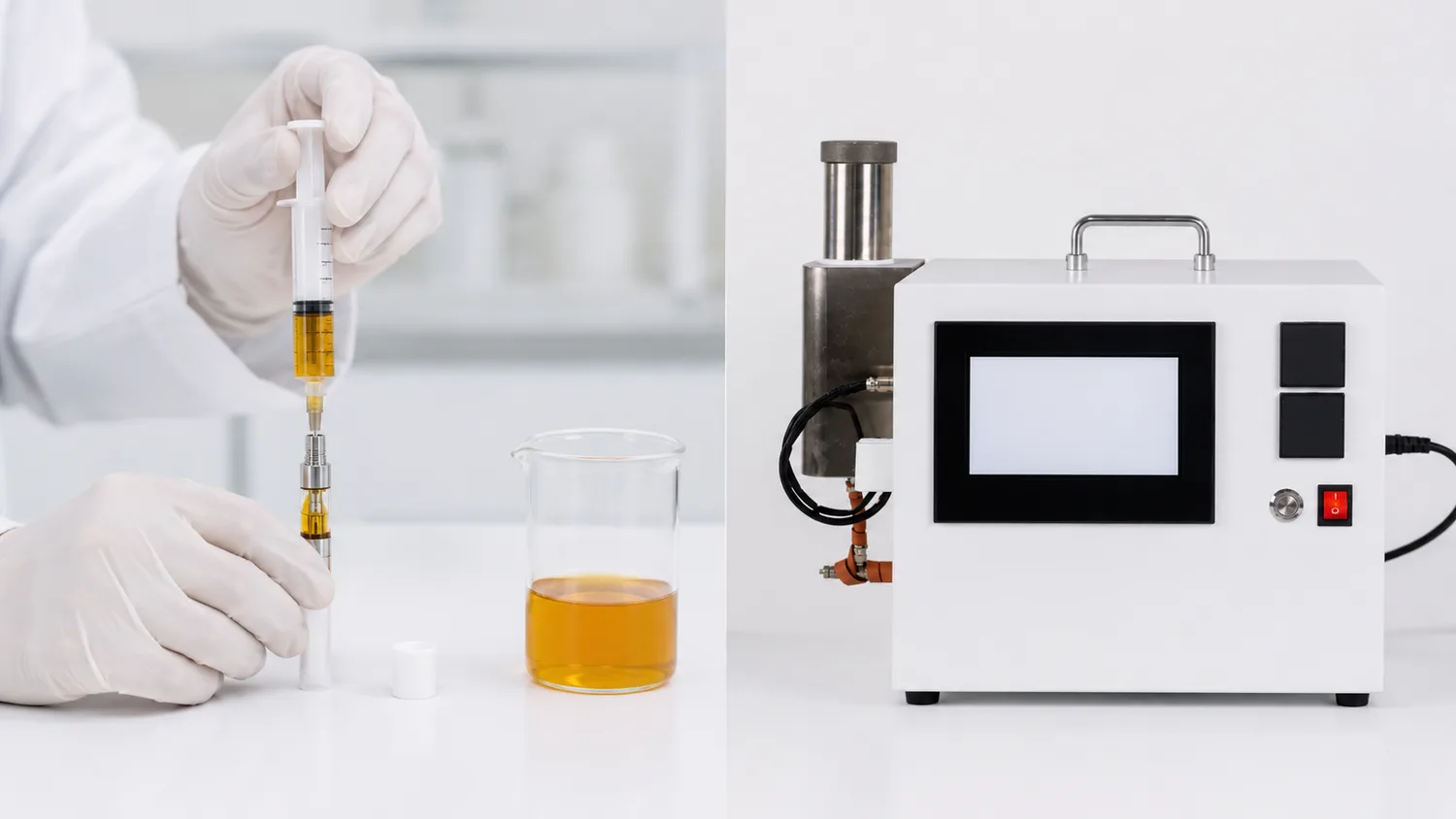
Where manual filling still makes sense
- R&D batches and flavour trials under fifty units.
- Custom one-offs for events, gifting or proof-of-concept.
- Very high-viscosity blends that need hand pressure or extended dwell.
- Brands operating below 1,000 cartridges per month with no near-term growth plan.
At that scale, a machine sits idle, and idle equipment is the most expensive equipment a small brand can own.
The five signals it is time to upgrade
Most founders sense the moment before they admit it. These are the five signals that tip the decision from “not yet” to “this quarter”.
1. Throughput is capping your revenue
If you are turning down wholesale enquiries because you cannot fill the volume in time, the cost of the machine has already been paid for in the orders you are losing. A semi-automatic four-head unit fills between 500 and 1,200 cartridges per hour; even a single-head benchtop manages 200–300, against roughly 60–100 per hour by hand.
2. Fill-weight variability is hurting margin
A target of 1.0 ml on a manual line typically swings between 0.93 ml and 1.08 ml. Overfill is silent oil loss; underfill is a customer-service problem and, in regulated markets, a labelling problem. A calibrated pump on an oil cartridge filling machine holds tolerance to roughly ±0.02 ml, which converts directly into product margin and brand trust.
3. Compliance and traceability requirements are tightening
Buyers and platforms increasingly ask for batch records, fill logs and serialised production data. Machines that log per-unit fill volume and batch ID make audits a non-event. Manual lines can be documented, but the paperwork burden scales linearly with volume and is the first thing to slip when a deadline hits.
4. Your terpene dosing has to be exact
When recipes call for precise terpene ratios, hand pipetting introduces a second layer of error on top of the cartridge fill. Pairing a dosing machine with proper measurement, as covered in this guide on measuring terpenes accurately, removes a major source of batch-to-batch drift.
5. You are scaling a brand, not just a product
A consistent terpene product across thousands of units is what turns a one-off SKU into a brand customers come back to. Manual filling can produce a great cartridge; only equipment produces a great cartridge every time.
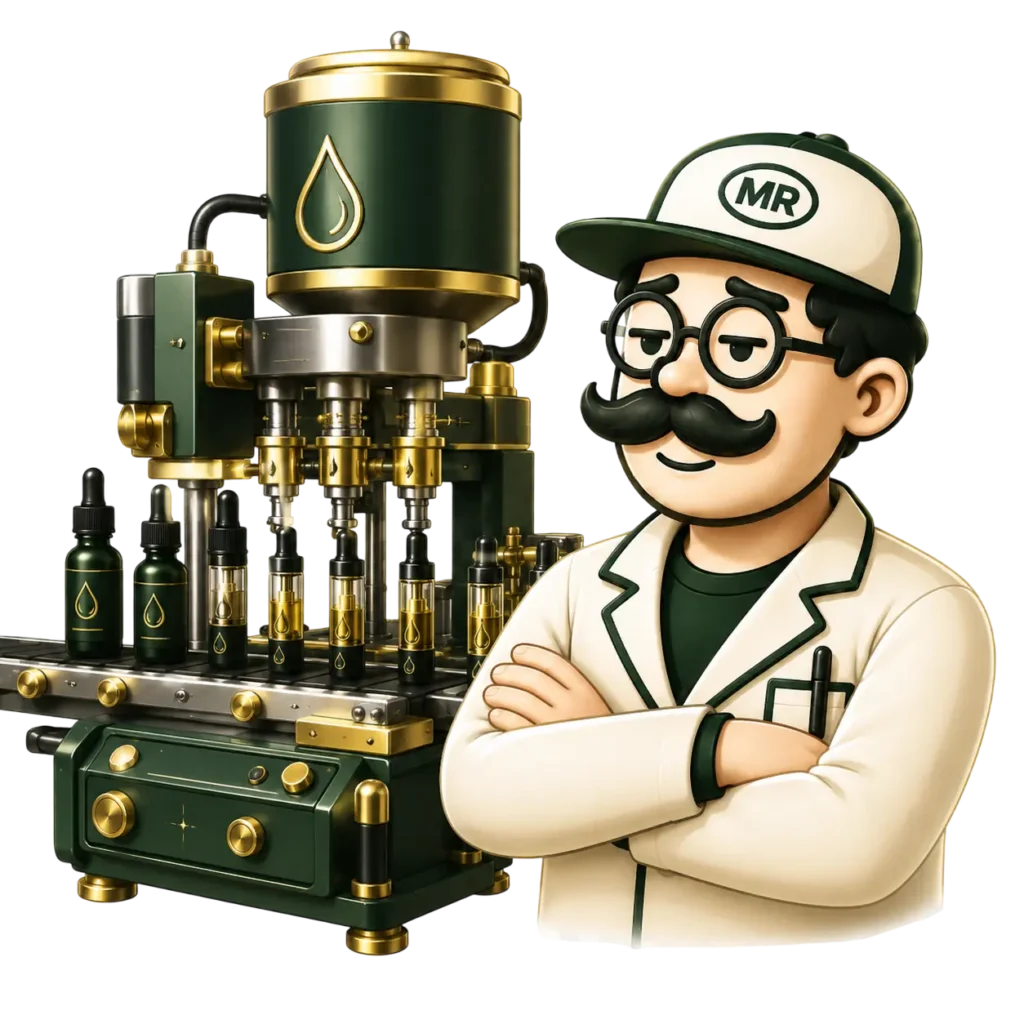
See automated filling at Mr Terpeenes
The manual route stops paying once volume climbs. Browse the semi-automatic and automatic filling machines and see where the step up begins to make sense.
Types of oil cartridge filling machine and what they cost
The market splits into three broad tiers, and choosing the wrong one is the most common upgrade mistake.
Benchtop semi-automatic (single or dual head)
Entry-level units sit on a workbench, hold one to two litres of pre-heated oil, and fill one or two cartridges per cycle. They suit brands moving 1,000–10,000 cartridges per month. Pricing ranges from roughly £1,500 to £6,000 depending on heating quality, pump type and build.
Multi-head semi-automatic (four to eight heads)
The workhorse for growing vape brands. Four to eight cartridges fill at once whilst the operator loads and unloads trays. Throughput sits comfortably between 500 and 2,000 units per hour. Expect to invest £5,000–£20,000. Most upgrade decisions land here.
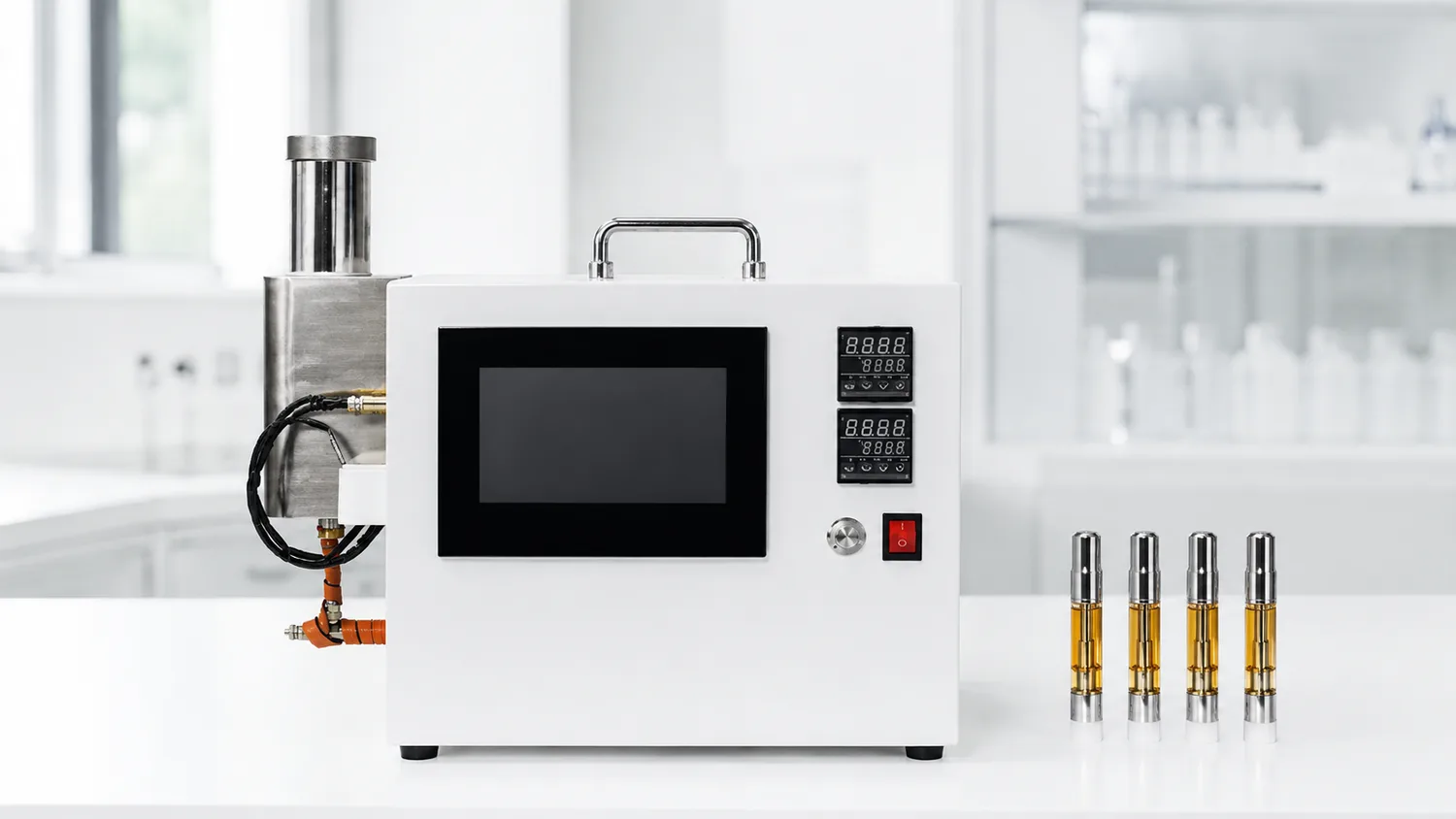
Fully automatic lines with capping
Conveyor-fed lines that handle filling, capping and sometimes labelling in a single pass. Throughput climbs to 3,000–10,000 cartridges per hour. Realistic budgets start at £30,000 and reach six figures with vision inspection and serialisation. Only justifiable when monthly volumes consistently exceed 50,000 units.
The total cost of ownership most brands forget
Purchase price is the most visible number, and the least important. The real cost of an oil cartridge filling machine is the sum of:
- Consumables and spares — seals, tubing, nozzles. Budget 3–5% of machine cost per year.
- Cleaning time — flavour changes need full cleaning cycles; underestimate this and your effective throughput drops by a third.
- Operator training — a well-trained operator outperforms a better machine in untrained hands.
- Calibration and validation — periodic dose-accuracy checks, especially after viscosity or temperature changes.
- Floor space and utilities — heated equipment, extraction and bench room add up faster than expected.
Run the maths on a 12-month horizon, not on sticker price. A £4,000 machine that needs daily two-hour cleans costs more than a £7,000 unit with quick-change tooling.
Work out the step up with Mr Terpeenes
Whether automation pays depends on your run size, staffing and cartridge format. Put those numbers in front of the team and the comparison becomes concrete.
How to choose the right oil cartridge filling machine
Before quoting suppliers, fix these specifications. Vague briefs lead to over-spending and under-performance in equal measure.
Match the machine to your oil, not the other way round
Viscosity is the single most important variable. Thin distillates flow easily; thick live-resin or full-spectrum blends need higher temperatures, larger nozzles and sometimes pressure-fed pumps. Send your actual oil to the supplier for a fill test before buying. This overview of oil filling machines for terpenes, CBD and vape oils walks through the trade-offs by pump type.
Confirm hardware compatibility
Cartridge geometry varies more than spec sheets suggest. Bore diameter, post height and centre-pin design all affect whether a nozzle seats cleanly. Test your exact cartridge SKU on the machine before signing the purchase order, and keep a backup hardware supplier on file.
Plan for cleaning and changeover
If you run two flavours in a day, the changeover time matters as much as the fill speed. Look for quick-release nozzles, tool-free disassembly and dishwasher-safe contact parts. A 15-minute changeover versus a 90-minute changeover is the difference between profitable variety and one-flavour weeks.
When buying is the wrong answer: white label as a bridge
Not every brand should own filling equipment. If your volume is climbing but your team is small, your cash is better spent on marketing, distribution and design than on capex and operator headcount. White label services let a brand scale production without the equipment, the operators or the regulatory overhead. For many brands, white label is the right answer for the first 18 months of growth; an oil cartridge filling machine becomes the right answer once order volumes are predictable.
The moment a workbench becomes a production line
There is a quiet evening in every growing vape brand when the workbench stops feeling like a craft and starts feeling like a bottleneck. The pipette that once felt artisanal now reads as risk. The flavour that took three minutes to fill becomes the flavour you do not launch, because there are not enough hours in the week to fill it twice over.
That moment is rarely dramatic. It arrives as a missed pallet, a returned batch, an operator working past midnight, a buyer asking for a fill report nobody has time to write. The upgrade is not a leap of faith — it is the calm acknowledgement that the brand has outgrown the bench. The right oil cartridge filling machine, chosen for the actual oil and the actual cartridge, does not change what a brand makes. It changes whether it can keep making it at the standard customers already expect.
For founders standing at that threshold, the next move is rarely the purchase itself. It is the production audit — current volumes, oil profile, cartridge SKUs, projected growth — that turns the decision from instinct into a number. Once that number exists, the right choice between a benchtop machine, a multi-head line or a white label partner tends to make itself.
FAQ
At what monthly volume is an oil cartridge filling machine worth it?
Most brands break even on a benchtop unit at around 1,500–2,000 cartridges per month, factoring in saved oil, faster runs and lower error rates. Multi-head machines pay back fastest above 5,000 units per month.
Can one oil cartridge filling machine handle distillate and live-resin blends?
Yes, if the pump and nozzles are sized for the more viscous blend and the reservoir reaches at least 60–70°C reliably. Always validate with a fill test on your own oil and your own cartridges.
How accurate are semi-automatic machines compared with manual filling?
A calibrated semi-automatic oil cartridge filling machine typically holds ±0.02 ml on a 1.0 ml target. Manual filling commonly varies by ±0.05–0.10 ml, which translates directly into wasted oil or short-filled cartridges.
Do I still need a capper if I buy a filling machine?
For press-fit cartridges, a benchtop capper is usually a worthwhile second purchase. It removes the most physically demanding step on the line and helps protect cartridge integrity for shelf life.
Is it better to buy a filling machine or use a white label partner?
Buy when volumes are stable, predictable and rising. Use white label when speed-to-market, cash preservation or product variety matter more than owning the production line.