
How to Order Custom Mylar Bags: Six Decisions to Make Before You Ask for a Quote

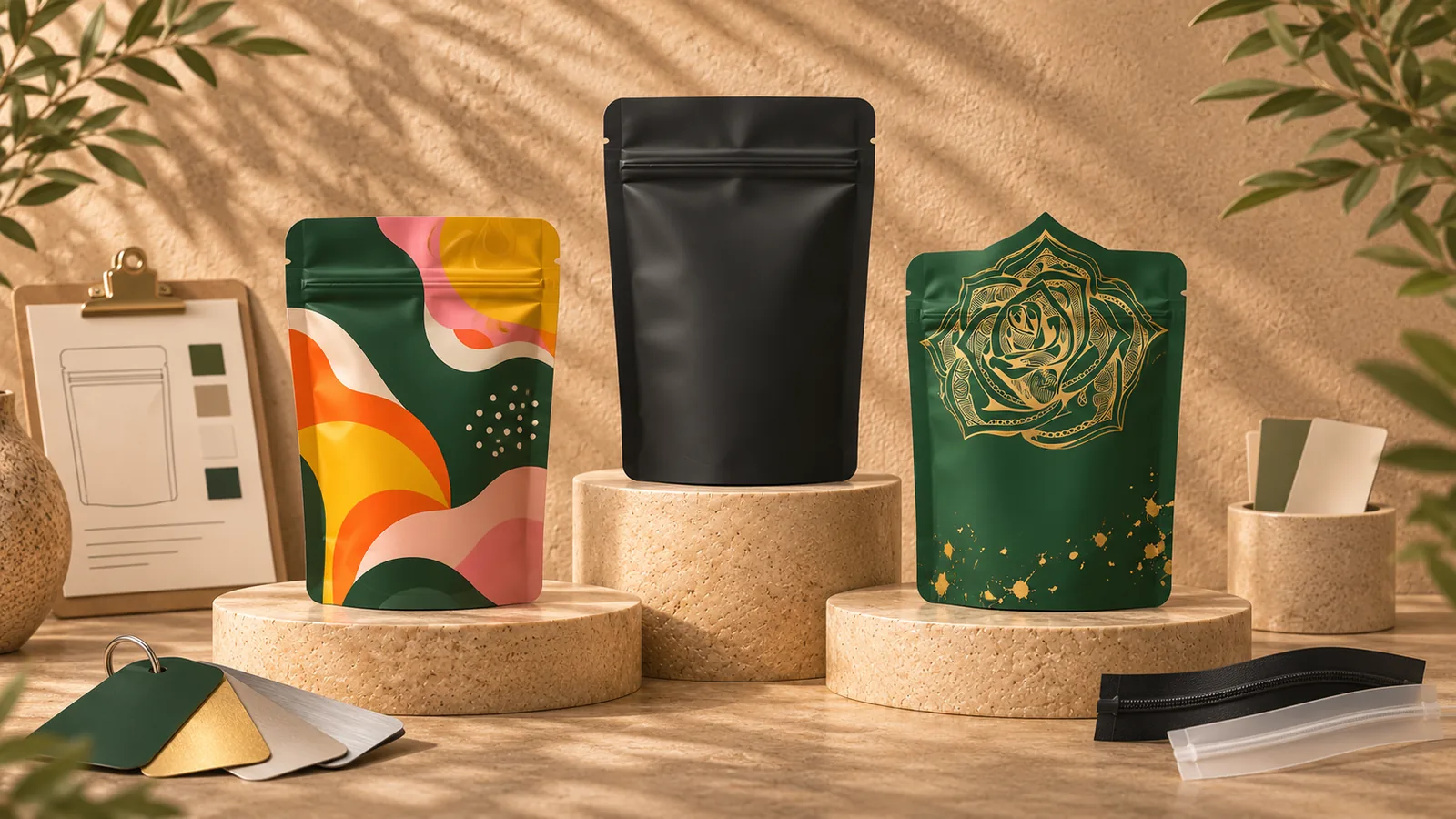
Ordering custom mylar bags comes down to six decisions:
- Format: the shape of the pouch.
- Closure and features: how it opens, reseals or dispenses.
- Layer structure: which films the bag is made from, which sets its barrier.
- Finish and print: how it looks and feels on shelf.
- Compliance needs: whether food-contact or child-resistance requirements apply in your market.
- Brief and artwork status: what you send the supplier, and how ready your design is.
The first four decide what the bag is. The fifth decides what evidence you need from the supplier. The sixth lets them price it. This guide takes them in that order, using the options documented for Mr Terpeenes mylar bags, and ends with the questions to ask at each step.
“Mylar” on a quote means a laminate, not a single film
Mylar® is a registered trademark of Mylar Specialty Films for its polyester (PET) film. In packaging the word has become shorthand for a printed, laminated barrier pouch. What you are really specifying is a laminate: several films bonded together, each with its own job.
The Mr Terpeenes packaging catalogue describes a typical three-layer build:
- a printing layer that carries the artwork (listed as MOPP, OPP, PET, NY or kraft paper);
- a barrier layer (PET, VMPET, aluminium, NY or kraft paper);
- a heat-sealing layer on the inside, which forms the seals and touches the product (PE, CPP, CPE or VMCPP).
The catalogue also lists two-, four- and five-layer composites. Keep this structure in mind through every decision below. Format, closure, barrier and finish all depend on it.
Decision 1: choose the format by how the product is filled, shown and used
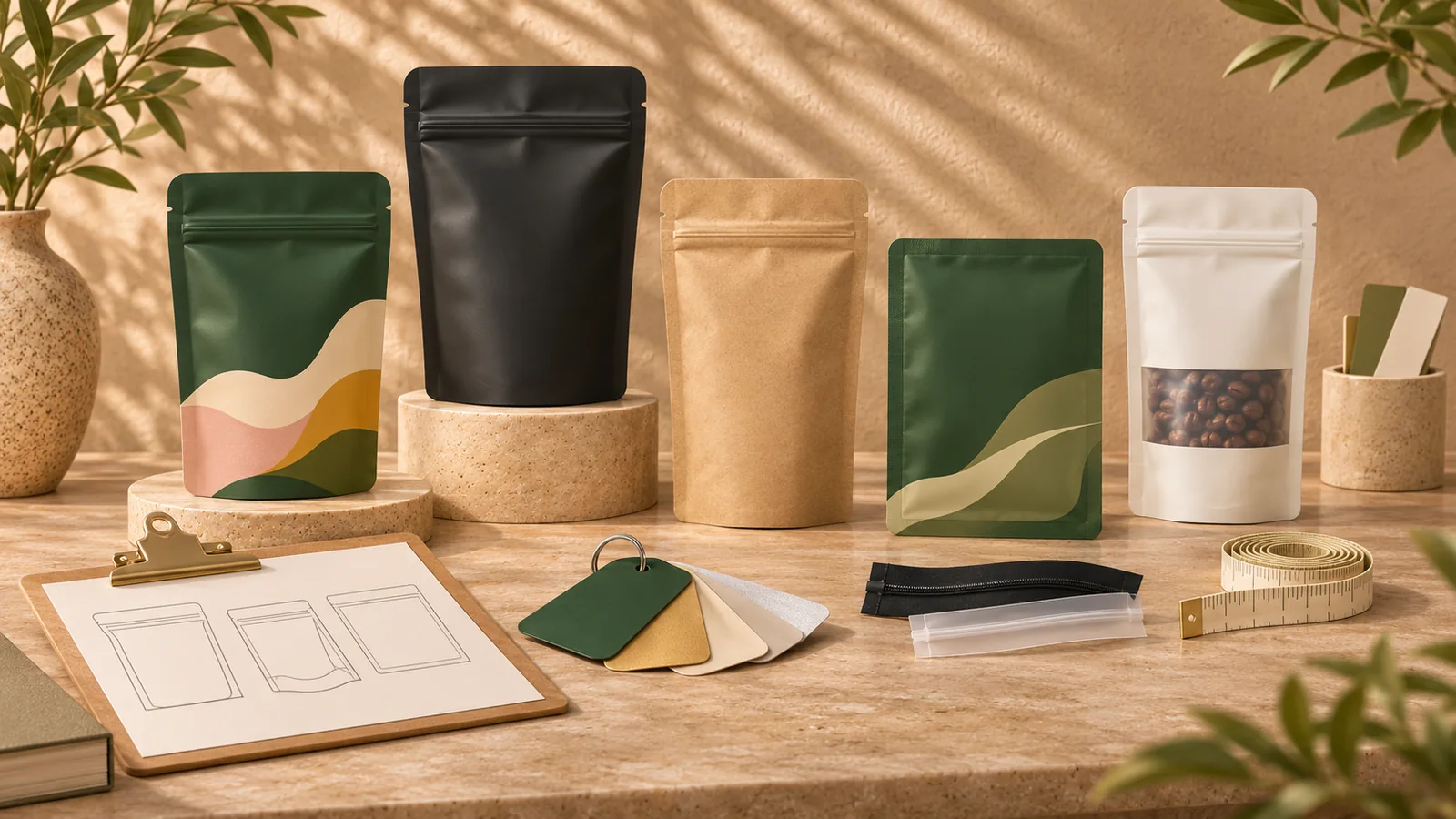
The format fixes the template your artwork must fit, so decide it first. The custom mylar bags page lists six physical formats.
| Format | What defines it | What to settle with the supplier |
|---|---|---|
| Stand-up pouch | Gusseted base, so the bag stands on shelf | Fill weight and base width |
| Flat pouch | No gusset; lies flat | Whether it will hang, stack or sit in an outer box |
| Bespoke shape | Die-cut outline designed around the brand | Minimum size of the shaped area; whether the seal follows the outline |
| Kraft paper bag | Paper outer layer with film layers behind it | Which barrier and sealing layers sit inside the paper |
| Windowed pouch | Clear panel that shows the product | Window position relative to the print, the zip and the seals |
| Liquid and nozzle pouch | Spout or nozzle for dispensing | Nozzle type and the liquid being filled |
The same page also mentions food-contact material options. These are not shapes. They describe a material specification, which the page says is confirmed per project, and it can apply to more than one of the formats above. Treat it as part of Decision 5, not as an alternative to a stand-up or flat pouch.
The catalogue adds handle options and zipper bags as further variants. Before the first conversation, know the fill weight or approximate dimensions of your product. Everything else in the format is sized around it.

Plan Your Pouch Range with Mr Terpeenes
Compare stand-up, flat, windowed and bespoke pouch formats alongside rigid boxes and display units before you settle on a packaging route for your brand.
Decision 2: the closure decides what happens after the first opening
Choose the closure together with the format. It changes the template and sometimes the height of the bag. The options documented for Mr Terpeenes mylar bags are:
- resealable zip-lock, for products used over several sessions;
- easy-tear notches, for a clean first opening, often combined with a zip;
- nozzles, for liquids;
- viewing windows. A window is not a closure, but it limits where a zip can sit.
Child-resistant options are also listed, but with conditions. The service page describes them as available “depending on the product and market” and “recommended per project rather than applied to every bag”. Child resistance is a tested property of a specific pack, not a feature that can be added to any bag. That is why this guide treats it under Decision 5.
Decision 3: barrier performance comes from the layer structure
The service page lists the barrier needs a structure can be selected around:
- moisture protection;
- oxygen barrier;
- light protection;
- seal strength.
None of these is a property of “a mylar bag” in general. Each one depends on the films chosen and on how well the seals are made. Two bags with identical artwork can perform very differently.
How to check barrier claims
The packaging catalogue lists the variables it says are tested during development. These are the ones that matter most to a buyer:
| Variable | What it tells you |
|---|---|
| Oxygen transmission rate (OTR) | How much oxygen passes through the film |
| Water vapour transmission rate (WVTR) | How much moisture passes through the film |
| Seal strength and bond strength | Whether the seals and laminate layers hold |
| Puncture resistance and tensile strength | How the bag copes with filling and handling |
If barrier matters for your product, ask for measured values for the exact structure you are buying, and for the method behind them.
Water vapour and gas transmission through plastic film are measured with recognised test methods, such as the ISO 15106 series for water vapour and ISO 15105 for gas. A transmission figure means little unless you know the method and the test conditions. A figure measured on another structure tells you nothing about yours.
Decision 4: finish and print change how the bag reads on shelf
These finishes are listed for Mr Terpeenes mylar bags:
- matte;
- gloss;
- metallic;
- kraft;
- transparent windows;
- custom shapes;
- full-colour printing.
Two of these choices are bound up with the structure, not just the artwork.
- Metallic and kraft looks come from the materials in the laminate, not only from ink. They are fixed when the structure is chosen, so decide them at Decision 3, not at the design stage.
- Matte or gloss changes how colours and small text read under shop lighting. Judge it on a printed sample, not on screen.
The print process is not published for mylar bags. Ask which process will be used for your run, because it affects how colours are matched and how reorders are reproduced.
Brief Your Mylar Bags with Mr Terpeenes
Send your product type, fill weight, preferred format, closure and artwork status, and we will review the structure and finish options that suit your bag.
Decision 5: confirm which compliance requirements apply in your market
This decision does not change how the bag looks. It changes what evidence you should ask the supplier for. The service page presents food-contact and child-resistant options as confirmed per project. That means the evidence has to be specific to your project too: a general statement in a catalogue does not replace it.
Food contact.
- Great Britain (England, Scotland and Wales). Materials intended to touch food fall under assimilated Regulation (EC) No 1935/2004. Plastic materials, including the plastic layers of a multi-layer laminate (Article 2), fall under assimilated Regulation (EU) No 10/2011. Its Article 15 requires a written declaration of compliance.
- Northern Ireland. The EU versions of these rules apply under the Windsor Framework. They are enforced through the Materials and Articles in Contact with Food Regulations (Northern Ireland) 2012.
- EU. If you sell there, the current EU texts apply.
If your product is a food, ask for the declaration of compliance for the exact structure, and check it covers the market you sell in.
Child resistance. The international reference for reclosable child-resistant packs is ISO 8317:2015, which sets performance requirements and test methods. If your product or market requires child-resistant packaging, ask for the test evidence for your exact format, structure and closure. A report on a different bag does not transfer.
Decision 6: brief the supplier, and know where your artwork stands
The quote brief on the service page has eight items. If you have worked through the five decisions above, most are already answered. Three are worth extra care:
- Fill weight or dimensions. Give the weight you will actually fill, together with a sample of the product if possible. Two products of the same weight can need different bag sizes.
- Target market. The market decides which of the Decision 5 requirements apply, so name every country you plan to sell in, not just the first one.
- Artwork status. The brief asks for status, not finished files. Say whether you have a logo only, a finished design for another pack, or nothing yet.
Mr Terpeenes does not publish a fixed minimum order or lead time for mylar bags. Treat both as items to confirm in the quote, not assumptions.
Artwork for a pouch: what is specific to bags
Artwork for a pouch is laid out on a flat template of the bag, called a dieline. Four points are specific to pouches:
- Seals and gussets. Seals take up a band around the edges, and a stand-up pouch loses part of its base to the gusset. Keep logos and text clear of both.
- The zip line. On a resealable bag, the zip runs across the front and back panels. Keep text off it.
- Windows. A window removes printable area and shows the product behind it. The design has to work with whatever the product looks like.
- One layout per size. Each format and size has its own template, even when the visual identity is the same.
Your regulatory and labelling text is your responsibility as the brand. Reserve space for it on the template before the design is approved. The service page includes artwork review and, “where required”, a sample before production. Use that review to check the points above on the actual layout for your format and size.
When a mylar bag is the wrong pack
A flexible pouch suits products sold by weight, refills, and items that need a barrier and a reseal. It is the wrong choice when:
- the product is a hard item or a gift set. A custom rigid box with a fitted insert does that job better;
- the problem is visibility at the counter. Look at custom POS displays instead.
For how pouches, boxes and displays work together across a range, see our overview of white label packaging for terpene and vape brands.
When your six decisions are made, take them to the Mr Terpeenes custom mylar bags service to request a quote.
Frequently asked questions about ordering custom mylar bags
Not necessarily. “Mylar bag” usually means a laminated barrier pouch. Whether it contains aluminium foil, metallised polyester or a clear barrier film depends on the structure chosen.
No. The brief asks for your artwork status, not finished files. Print-ready files are only needed once the format and size are agreed.
The business placing the product on the market. Reserve space for it on the template before the design is approved.
No. It describes the materials and the documentation behind them. A stand-up, flat or windowed pouch can all be specified for food contact, if the structure and its declaration support it.