
White Label Hoodies and Sweatshirts Compared: GSM, Fabric and Minimum Orders

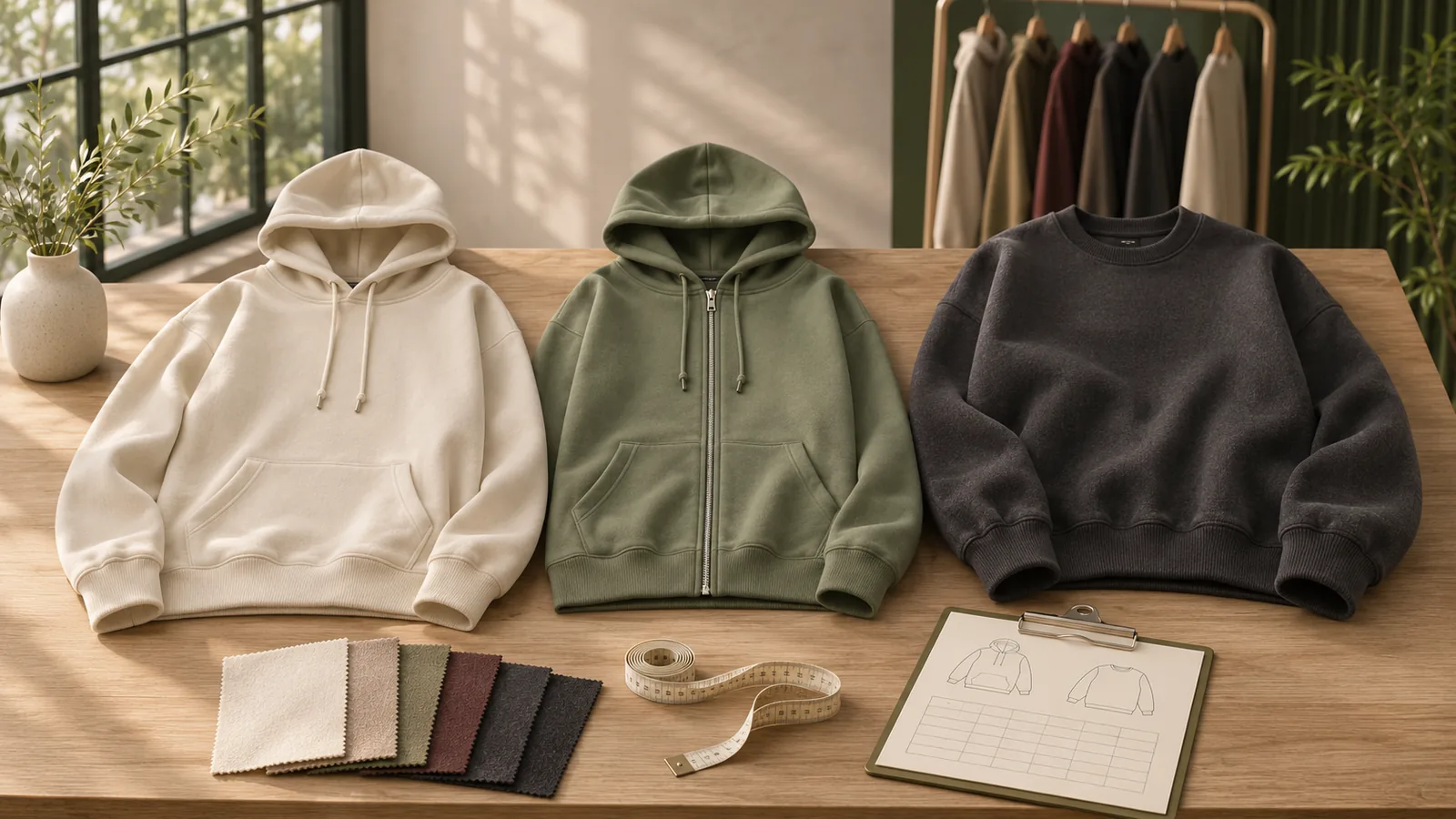
In the Mr Terpeenes white label range, the three hoodies are all 210–220 gsm. The three sweatshirts, which are crew-neck styles, run from 350 to 500 gsm. Every hoodie carries a published minimum order of 100 pieces. The one garment with a minimum of 50 is the Premium Sweatshirt.
So if you want a hood or a zip, you are choosing from the lighter garments. If you want weight, the crewnecks are where it is.
The rest of this guide explains what the published specifications tell you, and what they leave open. It then works through a small first order using only those figures, with every assumption labelled.
The six garments side by side
The white label hoodies and sweatshirts page and the clothing catalogue list the same six garments. The page calls the crewnecks “Sweatshirts”; the catalogue calls them “Crewnecks”.
| Garment | Neck and fastening | Fabric (as published) | Sizes | Published MOQ | Catalogue lead time |
|---|---|---|---|---|---|
| Standard Hoodie | Hooded pullover | 220 gsm cotton-polyester | S–4XL | 100 | 7–15 days |
| Premium Hoodie | Hooded pullover | 210 gsm 100% cotton | S–4XL | 100 | 7–15 days |
| Zip-up Hoodie | Hooded, full zip | 210 gsm 100% cotton | S–4XL | 100 | 7–15 days |
| Basic Sweatshirt (Crewneck) | Crew neck | 350 gsm cotton and spandex | S–4XL | 100 | 7–15 days |
| Standard Sweatshirt (Crewneck) | Crew neck | 380 gsm cotton | S–4XL | 100 | 7–15 days |
| Premium Sweatshirt (Crewneck) | Crew neck | 500 gsm cotton and polyester | S–4XL | 50 | 7–15 days |
Colours are listed as “various” for every garment, so the exact palette is a question for your quote.
What the GSM figures mean in this range
GSM is grams per square metre of fabric. It measures the fabric itself, not the finished garment. Our guide to planning a white label apparel range explains how fabric weight relates to quality in general. In this range, three practical points follow from the numbers:
- “Premium” does not mean heaviest. The Premium Hoodie, at 210 gsm, is lighter than the Standard Hoodie at 220 gsm. Its difference is the fibre: 100% cotton instead of a blend. Use the specification to compare garments, not the name.
- The Premium Hoodie and the Zip-up Hoodie share the same published fabric. The choice between them is about fastening, not weight.
- The step from hoodie to sweatshirt is large. The lightest crewneck, at 350 gsm, is almost 60% heavier per square metre than the heaviest hoodie at 220 gsm. That usually means a thicker, warmer fabric, although knit, fibre and finish also shape how a garment feels and drapes.
The catalogue does not specify knit, interior finish or fit. Weight alone will not tell you how a garment feels, so handle a sample of each garment you are considering before you commit.

Build Your Apparel Range with Mr Terpeenes
Look across hoodies, crewnecks, T-shirts, polos, jackets, caps and socks from one white-label merchandise range before you decide which pieces to launch first.
Fibre composition, and the label your customers will see
Three fibre mixes appear in the range:
- 100% cotton: Premium Hoodie, Zip-up Hoodie and Standard Sweatshirt.
- Cotton-polyester: Standard Hoodie and Premium Sweatshirt.
- Cotton and spandex: Basic Sweatshirt.
The blend percentages are not published. That matters if you plan to describe the fabric in your own marketing. It also matters if you sell the garments rather than give them away: textile products made available on the UK market must show their fibre composition under the Textile Products (Labelling and Fibre Composition) Regulations 2012.
Ask your supplier for the exact percentages, and agree who provides the composition label and what it will say.
Minimum orders: what the published figures confirm, and what they don’t
The catalogue publishes one minimum per garment: 100 pieces for each hoodie and for the Basic and Standard Sweatshirts, and 50 for the Premium Sweatshirt.
It does not say how that minimum can be divided. Before you plan quantities, get written answers to four questions:
- Does the minimum apply per garment style, or can styles be combined to reach it?
- Can one style’s minimum be split across colours? If so, is there a minimum per colour?
- Can it be split across the S–4XL size run in any ratio?
- Does a second design or logo position on the same garment start a new minimum?
The answers determine whether a varied first drop fits in one minimum or needs several. Until you have them, plan with the published per-garment figure, and treat any split as unconfirmed.
Plan a Hoodie Drop with Mr Terpeenes
Tell us the garments, quantities, size split, colours and logo placements you have in mind, and we will check them against the catalogue options for your drop.
Lead time: a catalogue figure, not a delivery date
Every garment in the catalogue carries a lead time of 7–15 days. The hoodies page puts it more cautiously: lead times are “typically 7–15 days, depending on the garment, order details”. Neither source says when the window starts, or which stages it covers. In particular, it does not say whether it includes:
- artwork approval;
- sampling;
- branding;
- delivery.
Plan around the figure, not with it. Ask your supplier what the window covers for your order and when it begins. Then build your schedule backwards from the date you need the garments in hand.
Branding: questions to ask before choosing a method
The hoodies page says branding and finishing options “can vary depending on the selected garment, quantity, print method”. It also says the design team “can support visual direction where useful, from logo positioning to colourway choices”. It does not publish which decoration methods are offered for each garment.
For each garment you shortlist, ask in writing:
- Which decoration methods are available for this garment at this quantity?
- Where can the logo go, and at what maximum size? Chest, back, sleeve and hood each have their own limits.
- Does the number of colours in the design change the method or the price?
- Can the original neck label be replaced with a brand label, and what does that involve?
- How will the garments be packed? For example, folded, bagged, or sorted by size.
For a general comparison of decoration methods, see our white label apparel guide. Which methods apply to these garments is a question for the quote.
A worked example: staff kit plus a small retail drop
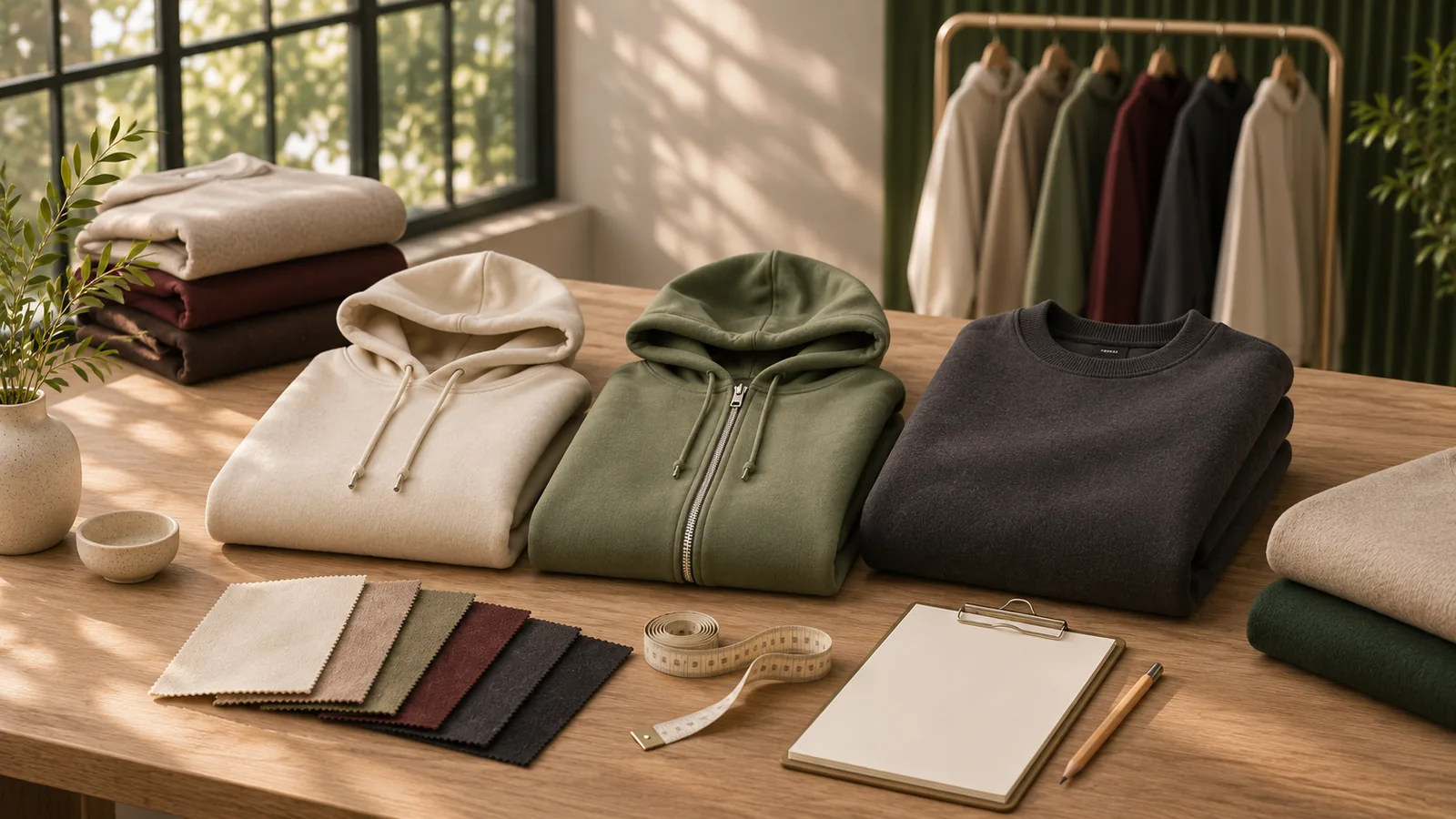
Here is how a brand might use the published figures to plan a first order. Everything marked assumption has to be confirmed with the supplier.
The brief. A brand wants zipped tops for staff at trade events, and a heavier piece to sell alongside its products.
Choosing the garments.
- Staff: the Zip-up Hoodie. It has the zip the brief asks for, in 210 gsm 100% cotton, with a published minimum of 100 pieces.
- Retail: the Premium Sweatshirt. At 500 gsm it is the heaviest garment in the range, and at 50 pieces it has the lowest published minimum.
Quantities. Taking the published per-garment minimums, the starting point is 100 Zip-up Hoodies and 50 Premium Sweatshirts, or 150 pieces in all.
- Assumption: each style’s minimum applies separately and cannot be combined.
- Assumption: each style’s quantity can be split across sizes as the brand chooses.
If the supplier sets a minimum per colour, a two-colour retail drop could need more than 50 sweatshirts.
Branding. One chest logo on both garments, plus a back print on the staff hoodies only. This is a proposal: which branding options are available for each garment has to be confirmed with the supplier. Ask whether the back print changes the method, the price or the minimum (see the four MOQ questions above).
Timing. Work backwards from the first event date. Then confirm what the 7–15-day catalogue window covers and add the other stages around it: artwork approval, any sample, branding if it is not included, and delivery. No duration for those stages is published. Get them from the quote.
The result is a brief with two garments, proposed quantities based on the published minimums, a proposed branding plan per garment subject to confirmation, and a target date, ready to send.
Next step
When you have shortlisted garments and quantities, compare the six options on the white label hoodies and sweatshirts page and request a price for the ones that fit your brief.
Frequently asked questions about hoodie GSM and minimum orders
No. It is a crew-neck sweatshirt, called the Premium Crewneck in the catalogue, in 500 gsm cotton and polyester. It has the lowest published minimum in this range: 50 pieces.
The Premium Sweatshirt at 500 gsm. The three hoodies are 210–220 gsm.
Both are published as 210 gsm 100% cotton. The difference is the full zip.