
Valencene Terpene Profile: Aroma, Sources and Use in Citrus Blends

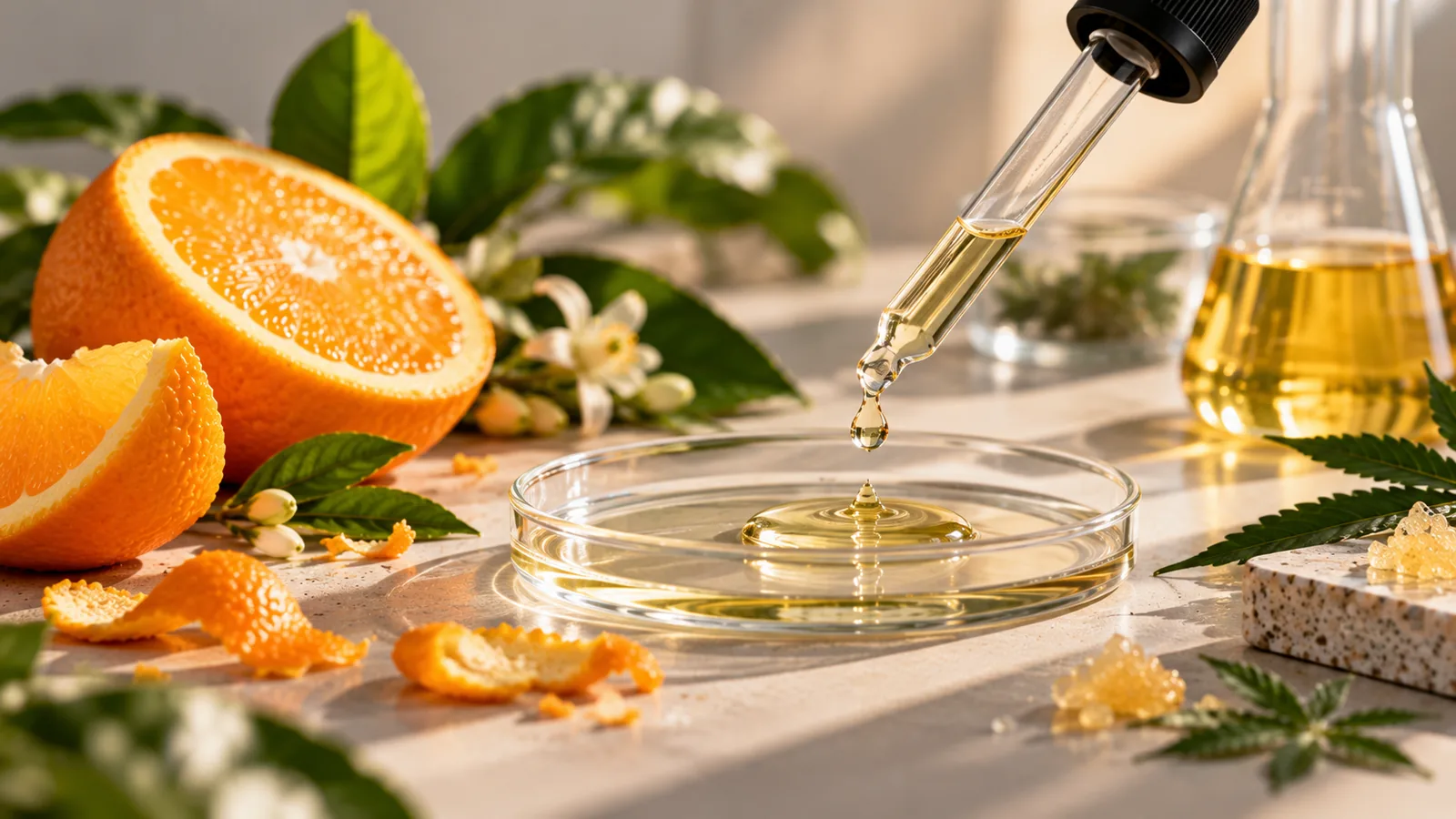
Peel an orange and the first thing you smell is mostly limonene. Behind that bright opening sits a softer, slightly woody citrus note, and valencene is one of the compounds that contributes to it.
The short answer: valencene is a sesquiterpene with a citrus, green and woody aroma. It makes up well under 1% of orange peel oil, appears in most other citrus oils and occurs in small, variable amounts in hemp. It cannot stand in for limonene, and it is the usual starting material for producing nootkatone, the compound behind grapefruit’s character.
Valencene is a woody-citrus sesquiterpene from orange peel
Valencene is a sesquiterpene hydrocarbon with the molecular formula C15H24 and a molecular weight of 204.35 g/mol. The PubChem record for (+)-valencene lists it under CAS number 4630-07-3. ChEBI, the European chemical-entity database, classifies it as a sesquiterpene with two joined rings and no oxygen in its structure.
The label matters more than it sounds. Monoterpenes such as limonene are built from ten carbon atoms; sesquiterpenes such as valencene from fifteen. That puts valencene in the same family as humulene and β-caryophyllene, which share its C15H24 formula but arrange the atoms differently. In citrus fruit a dedicated enzyme, valencene synthase, produces it, and Sharon-Asa and colleagues found that the gene responsible becomes active as the fruit matures, in step with valencene building up.
What valencene smells and tastes like
The Flavor and Extract Manufacturers Association lists valencene’s flavour profile as “citrus, green, oil, wood” on its FEMA 3443 entry. The Good Scents Company describes a 10% dilution as sweet, fresh citrus with grapefruit, orange and woody facets and a dry, green, oily edge.
In a composition that tends to read as orange with less sparkle and more body. As a larger molecule, valencene is generally less volatile than lighter monoterpenes such as limonene, which suits it to rounding out a citrus accord rather than opening it. We found no published odour threshold for valencene, so how strongly it registers at a given level is best judged in the blend itself.

Explore citrus terpene profiles at Mr Terpeenes
Orange character usually comes from several compounds working together. Compare the citrus-led terpene profiles we stock in the UK by their listed aroma notes and dominant terpenes.
Where valencene is found: orange oil, other citrus and, in small amounts, cannabis
Despite the name, valencene is a minor part of orange oil. The Good Scents Company’s compiled analyses put it at roughly 0.04–0.3% of cold-pressed orange oils, while a 2019 review of citrus volatiles by González-Mas and colleagues reports limonene at 90–97% of sweet orange oil. The same review found valencene in every citrus species it covered except bergamot.
Levels also vary widely between varieties. Yu and colleagues describe valencene as abundant in the juice of some mandarins, such as Fortune, and undetectable in others, such as Murcott. Sweet orange oil carries other minor contributors too, including linalool, which is part of why no single molecule explains the smell of an orange.
In hemp, valencene is present but small and inconsistent. Pellati and colleagues analysed six fibre-type hemp samples and detected it in five of them, at between 0.1% and 1.4% of the measured signal (relative peak area), and not at all in the sixth. Lists of “high-valencene strains” circulate widely online, but we could not trace them to published analyses, so we don’t repeat them here.
Valencene and limonene are not interchangeable
Both come out of orange peel, which is why they get confused, but they do different jobs. Limonene is a light monoterpene that supplies the immediate, fresh lift; valencene is a heavier sesquiterpene that rounds and extends it. Nootkatone, made from valencene, belongs in the same comparison:
| Valencene | Limonene | Nootkatone | |
|---|---|---|---|
| Class | Sesquiterpene hydrocarbon | Monoterpene hydrocarbon | Sesquiterpenoid ketone |
| Formula | C15H24 | C10H16 | C15H22O |
| FEMA flavour profile | Citrus, green, oil, wood | Citrus, mint | Grapefruit |
| Where it comes from | Minor component of citrus peel oils | Main component of orange oil | Trace amounts in plants; commonly produced from valencene |
The table also explains a trade term that causes confusion. Products sold as “orange terpenes” are usually a limonene-rich fraction of orange oil, so they are close to pure d-limonene, not valencene. A valencene ingredient is a separate, much more concentrated material.
Swapping one for the other changes a profile’s shape, not just its strength. Replacing limonene with valencene loses the opening sparkle, while relying on limonene alone tends to give a citrus note that fades sooner.
Citrus profiles for production at Mr Terpeenes
Once a citrus direction is settled, supply becomes the next question. Check bulk quantities and UK dispatch for the terpene profiles you plan to scale into regular production.
Valencene is the starting point for nootkatone, the grapefruit molecule
Nootkatone is a closely related compound whose flavour profile FEMA lists simply as “grapefruit”. Plants accumulate it only in trace amounts, so it is mainly produced rather than extracted, and valencene is the usual starting point. A review by Fraatz, Berger and Zorn describes how valencene can be oxidised to nootkatone using enzymes, microorganisms or chemical oxidants.
Two points are often confused online. First, the published routes from valencene to nootkatone all rely on a catalyst, an oxidant or a biological system; we found no study showing that valencene becomes nootkatone during ordinary storage. Suppliers still set storage conditions for valencene, so follow the data sheet for the material you hold. Second, the insect-repellent registration granted by the US Environmental Protection Agency in 2020 covers nootkatone, not valencene.
How valencene is used in flavour and citrus blends
Valencene is an established flavouring ingredient. Besides its FEMA GRAS listing, the Joint FAO/WHO Expert Committee on Food Additives evaluated it in 2004 as JECFA No. 1337 and concluded there was “no safety concern at current levels of intake when used as a flavouring agent”. It is also on the EU Union list of flavourings as FL 01.017.
Supply has shifted too. Because the natural concentration is low and extraction is costly, valencene is also produced by fermentation: Chen and colleagues report engineered yeast reaching 539.3 mg/L, and FEMA lists a separate fermentation-derived “Valencene 80 extract” as FEMA 4838.
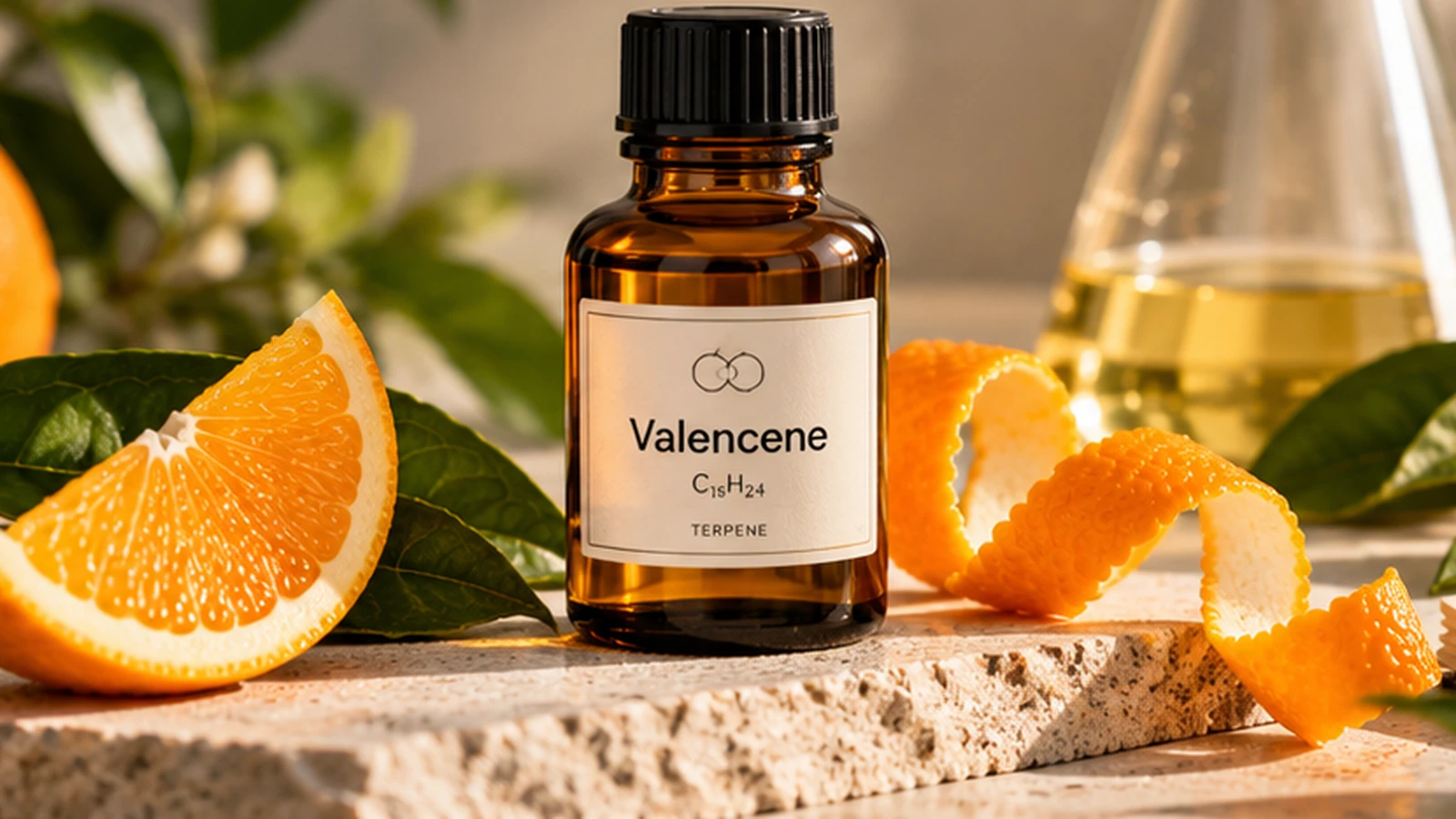
On the bench, valencene’s role in a citrus blend is body rather than lift. Typical uses include:
- Extending a limonene top note, helping the orange impression carry through.
- Adding peel realism, the slightly oily, woody side of real zest that a pure limonene accord lacks.
- Bridging citrus to woody or herbal notes, where a sesquiterpene sits more comfortably than a monoterpene.
We don’t suggest inclusion levels, because they depend on the base, the format and the rest of the profile. Our guide to recreating and adjusting a terpene flavour profile sets out a method for testing small changes one at a time.
Checking whether a terpene profile contains valencene
The certificate of analysis is the place to look, but read it carefully. Many standard terpene panels test for a fixed list of compounds, and valencene is not always on it, so an absent line can mean “not tested” rather than “not present”. Our checklist of what to check on a terpene COA covers how to tell the difference.
Handling information sits in the safety data sheet. In notifications to the European Chemicals Agency, nearly all companies classify undiluted valencene as an aspiration hazard (H304, “may be fatal if swallowed and enters airways”), the same classification notified for d-limonene. It relates to the neat liquid and is managed through the precautions on the supplier’s safety data sheet. Our guide to reading a terpene safety data sheet explains what that classification means in practice.
We don’t currently sell valencene as a single isolate. For citrus work, the starting point is a complete profile whose data sheets list its dominant terpenes. You can compare the profiles we hold in the UK, priced in GBP, in our terpene profiles range.
Frequently asked questions about valencene
Valencene is a terpene in the strict sense: a sesquiterpene hydrocarbon, C15H24, made only of carbon and hydrogen. Terpenoids carry oxygen-containing groups. Nootkatone, which can be produced from valencene by oxidation, is the related terpenoid of the pair.
No. Limonene is a ten-carbon monoterpene that makes up 90–97% of sweet orange oil. Valencene is a fifteen-carbon sesquiterpene present at well under 1%. Limonene gives an orange note its fresh opening; valencene adds a heavier, woodier body that tends to linger.
Partly. Published descriptions of valencene include grapefruit alongside citrus, orange, woody and green facets. The defining grapefruit character belongs to nootkatone, the compound produced when valencene is oxidised by enzymes, microorganisms or chemical reagents.
Sometimes, in small and variable amounts. One study of six fibre-type hemp samples found it at between 0.1% and 1.4% of relative peak area in five of them and not at all in the sixth. Its presence describes aroma only and predicts nothing about effects.
Valencene is listed as FEMA GRAS 3443 and appears on the EU Union list of flavourings as FL 01.017. JECFA evaluated it in 2004 and found no safety concern at current levels of intake when used as a flavouring agent. These listings cover flavouring use only.
Research on valencene so far is limited to cell and animal studies, and no human trials have been published. A 2023 review noted that this makes it difficult to describe any health benefit, so we make no health claims for it.