Humulene Terpene Profile: Aroma, Uses and Blending Notes

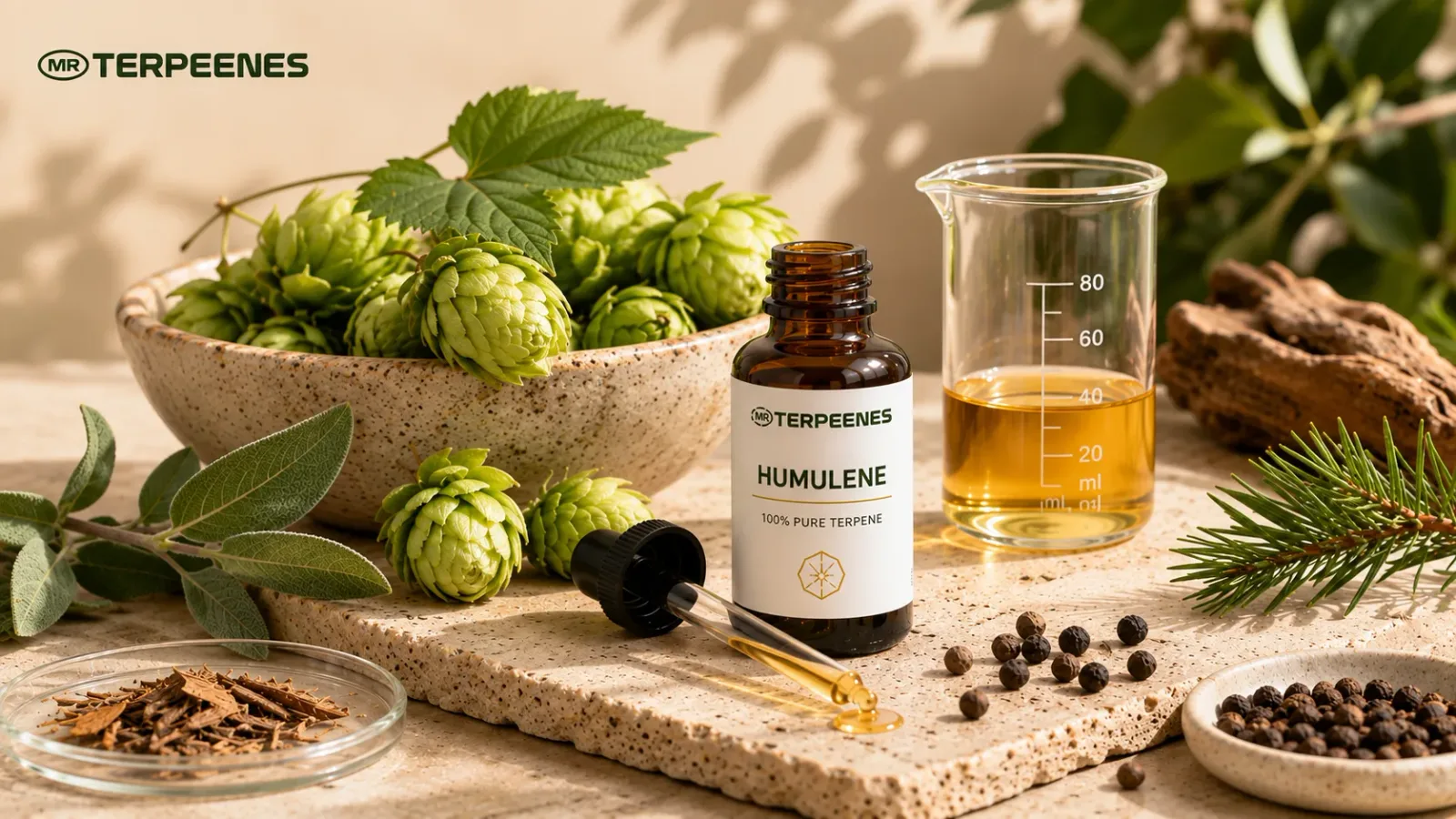
The humulene terpene is one most people have smelled without naming it. Crush a hop cone and the dry, woody note under the citrus and pine is largely this molecule, which carries the name of the hop plant. On a bench it does a job few terpenes do cleanly: it adds depth and dryness without sweetness, close to the opposite of the floral lift a terpene such as linalool contributes.
The short answer: humulene, also written alpha-humulene, is a sesquiterpene with a woody, earthy, herbal aroma and a recognisably hoppy character. It occurs in hops, sage, ginger, black pepper and cannabis, and shares a biosynthetic origin with beta-caryophyllene. In a blend it supplies structure and dryness rather than lift, and turns a profile austere long before it makes it loud.
What humulene is
Humulene is a sesquiterpene hydrocarbon: fifteen carbons, rather than the ten that build monoterpenes such as limonene, myrcene and the pinenes. Its molecular formula is C15H24, its molecular weight 204.35 g/mol, and it appears under CAS number 6753-98-6 and the systematic name (1E,4E,8E)-2,6,6,9-tetramethylcycloundeca-1,4,8-triene in the PubChem compound record.
Structurally it is monocyclic: one eleven-membered ring carrying three double bonds, with no oxygen in the molecule. With no hydroxyl group it behaves as a plain non-polar hydrocarbon in a base material, and its stability problems come from those double bonds. The name traces back to Humulus lupulus, the hop plant.
Humulene, alpha-humulene and α-humulene all name one molecule. The alpha prefix survives from older nomenclature rather than marking a second product. Some paperwork still indexes it as alpha-caryophyllene, a synonym dealt with further down this page.
What humulene smells like
Humulene smells woody, earthy and dry, with a green herbal edge and the hoppy character most people recognise before they can name it. Underneath sits a faint spice, closer to dry wood than to the pepper of beta-caryophyllene, and no sweetness. That absence is the point: most terpenes bring sugar, fruit or resin with them, and humulene is one of the few ways to dry a blend without thinning it.
Perception depends on concentration, on the terpenes around it and on the aromatic matrix of the base. Neat, humulene reads flat and slightly bitter, a poor guide to what it will do in a formulation. At low inclusion in a mixed profile it stops registering as a separate note and works as background dryness. Against sweet or citrus material it reads as balance; among other dry, herbal components it pushes the whole thing austere.
Why humulene is associated with hops
Humulene is tied to hops because hops are its namesake and its most studied source. In hop essential oil, myrcene is normally the largest single component of fresh material, with alpha-humulene and beta-caryophyllene the two principal sesquiterpenes behind it. The proportion between those two serves in brewing as a varietal marker: the noble European varieties associated with Saaz, Hallertau and Tettnang are humulene-rich, many high-alpha bittering varieties are not.
What it contributes there is the herbal, green, woody side of hop aroma rather than the fruit and citrus modern varieties are bought for. It is also chemically active over time: humulene oxidises readily, and its oxidation products, principally the humulene epoxides, carry much of the character that reaches finished beer. Sensory work on sesquiterpene-rich hop fractions, including a study in Food Research International by Lafontaine and colleagues, has tracked how those fractions read inside a product rather than in a vial. Brewing is simply where humulene has been measured most carefully.
Where else humulene occurs naturally
Humulene is common across aromatic plants, usually as a supporting component. The sources that matter to formulation work are these:
- Hops (Humulus lupulus) — the reference source and the origin of the name.
- Common sage (Salvia officinalis) — sitting behind the herbal, camphoraceous top notes.
- Ginger (Zingiber officinale) — the dry, woody end of the rhizome rather than its heat.
- Black pepper and clove — both carry it alongside far more beta-caryophyllene.
- Balsam fir and other conifers — the source of its resinous association.
- Cannabis (Cannabis sativa) — across many cultivars, covered next.

Compare woody terpene profiles at Mr Terpeenes
Humulene reads differently beside the notes it has to balance. See which single terpenes and ready blends are stocked in the UK before committing to a dry, woody direction.
Humulene in cannabis terpene profiles
Humulene is reported across many cannabis cultivars, generally as a minor part of the terpene fraction rather than a leading one. Where it sits at higher relative levels the aroma is usually described as earthy, herbal or hop-like — the direction the isolated material points in anyway.
It rarely acts alone. Humulene and beta-caryophyllene arise from the same biosynthetic branch, so reports show them moving together and a cultivar noted for one almost always carries the other. No single terpene defines how a cultivar smells; the recognisable part of an aroma lives in the proportions between many volatiles.
Two cautions. Humulene content does not predict a physiological outcome, so a certificate of analysis supports aroma decisions and nothing more. And indica and sativa labels describe lineage rather than chemistry, a point covered in our breakdown of what an indica terpene profile actually contains. Neither substitutes for a chromatogram. Alpha-humulene has been examined for anti-inflammatory activity, most often through work by Fernandes and colleagues in the European Journal of Pharmacology, which tested it in animal models. That is preclinical evidence, and the common claim that humulene suppresses appetite in people has not been shown in human trials.
How humulene behaves in a blend
Humulene is structural rather than decorative: rarely the note a customer names, often the reason a profile holds together. Four contributions come up repeatedly:
- Woody depth. It fills the lower-middle of a profile, where sweet and citrus material leaves a gap.
- Dryness. It reduces the impression of sweetness without removing the components producing it.
- Herbal structure. It gives botanical credibility to blends that would otherwise read as confectionery.
- Contrast. Against citrus and fruit it creates tension, which often separates an interesting profile from a flat one.
What happens when humulene dominates
Humulene rarely shouts. It flattens. An over-dosed blend does not smell strongly of hops so much as it stops smelling appealing: sweetness reads muted, fruit dull, and what remains is dry, sharply herbal and often called bitter or medicinal. Because the failure presents as absence rather than excess, it gets misdiagnosed and the wrong component corrected. Weight compounds it — humulene is less volatile than the monoterpenes it sits with, so it lingers after the brighter notes fade.
Terpenes that pair well with humulene
These pairings describe direction, not recipes. Inclusion levels depend on the base, the format and the target; a figure carried over from another project is a guess wearing a decimal point.
Humulene and beta-caryophyllene
The pairing that occurs by default in nature and works by design on the bench. Caryophyllene supplies warm pepper and spice, humulene dry wood and green herb, and together they build a sesquiterpene base. Because plants already present them as a pair, the combination reads botanically plausible in a way a single sesquiterpene rarely does.
Humulene and myrcene
An earthier, deeper direction. Where myrcene supplies a musky, faintly fruity base, humulene dries it out and stops it turning syrupy. This is the combination behind grounded, resinous profiles, and the likeliest to overshoot, since both work in the same low register.
Humulene and pinene
Green, forest-like and fresh. Pinene brings a sharp resinous lift humulene cannot produce alone, and humulene gives it somewhere to land. Reading how pinene behaves in terpene formulations is worth doing first, because pinene leaves the profile well ahead of the humulene beneath it.
Humulene and limonene
Straight contrast, dry herbal against bright citrus. Humulene keeps limonene’s citrus character from reading as a cleaning product, and the citrus keeps humulene from reading as bitter. Small movements matter: the two work at opposite ends of the profile, and the balance point is narrow.
Humulene for production runs at Mr Terpeenes
Once a woody direction is settled the question turns to supply. Review bulk quantities, minimum orders and UK dispatch times for humulene before scaling a formulation.
Humulene vs beta-caryophyllene
Humulene and beta-caryophyllene are not the same compound. They are structural isomers: both sesquiterpene hydrocarbons, formula C15H24, molecular weight 204.35 g/mol, arranged differently. Humulene is monocyclic, a single eleven-membered ring. Beta-caryophyllene, listed in its own PubChem record under CAS 87-44-5, is bicyclic and contains a strained four-membered ring fused to a nine-membered one.
They occur together because they are made together, both derived from farnesyl pyrophosphate through a shared cationic intermediate. That common origin is where the confusing synonym came from: humulene was once catalogued as alpha-caryophyllene, and the label still turns up on older paperwork.
| Humulene (alpha-humulene) | Beta-caryophyllene | |
|---|---|---|
| Structure | Monocyclic, eleven-membered ring | Bicyclic, includes a cyclobutane ring |
| CAS number | 6753-98-6 | 87-44-5 |
| Core aroma | Woody, earthy, herbal, hoppy | Peppery, spicy, warm, woody |
| Sweetness | None | Slight warmth, faintly balsamic |
| Role in a blend | Dryness and green structure | Warmth, spice and body |
| Typical failure | Profile turns flat and austere | Profile turns sharply peppery |
In practice they do different jobs. Caryophyllene adds something a taster can point to; humulene changes the setting the other notes are heard in. A blend carries both without redundancy. Our profile of beta-caryophyllene’s peppery character covers that side of the pair in full.
Formulation notes for working with humulene
Humulene rewards a slow hand. The margin between structure and austerity is narrow, and the mistake is hard to see once made.
- Start below where you think it should sit. Humulene is easier to add than to disguise, and nothing cancels excess dryness.
- Judge it in the blend, never from the bottle. Neat humulene smells bitter, which predicts little about a fraction of a percent in a base.
- Assess after the blend has settled. Its low volatility means the dry tail arrives late, so a same-day verdict under-reads it.
- Change one variable per iteration and record by weight. Drop counts do not survive a change of pipette or viscosity.
- Compare iterations side by side. Dryness is a relative judgement, and the nose calibrates to it quickly one sample at a time.
Nor should an inclusion level be ported between bases: what works in neutral distillate reads differently in an extract already carrying its own sesquiterpenes. The step-by-step method we use for mixing terpenes sets out the bench discipline that keeps iterations comparable.
Humulene isolate or a complete terpene blend?
An isolate is a correction tool. When a profile reads too sweet, too soft or short of structure, single humulene addresses that one property and measures what changed. It is also how a house profile gets built deliberately.
What an isolate cannot do is reproduce a botanical character alone. The hop-like impression associated with the humulene terpene comes from it sitting in a matrix of myrcene, caryophyllene, esters and oxidation products, in proportions that took a plant to assemble. A complete blend is the right starting point when the brief names a cultivar; isolates adjust it afterwards.
Storage and handling considerations for humulene
Humulene’s three double bonds make it susceptible to oxidation, and that is the practical risk. Air converts part of it to humulene epoxides and related products, which smell different from the parent compound. The change is gradual and easy to miss until a batch fails against a reference.
The habits that protect it are ordinary: keep containers sealed, minimise headspace, decant into smaller vessels as stock depletes, store cool and dark, and avoid warm-and-cool cycling. An opened container ages faster than an unopened one, so rotate stock. The general principles of terpene storage and shelf-life management apply, with the added point that oxidation changes the aroma before anything measurable on a specification sheet. Sesquiterpenes are less volatile than monoterpenes, so humulene tolerates gentle warming better than a top note — a relative statement, not a licence. The Safety Data Sheet supplied with a material governs handling and transport.
Frequently asked questions about humulene
What does humulene smell like?
Woody, earthy and dry, with a green herbal edge and a clearly hoppy character. There is a faint dry spice underneath and no sweetness. Neat it reads flat and bitter; at low inclusion in a blend it works as background dryness rather than a note anyone identifies.
Is humulene the same as alpha-humulene?
Yes. All three name the same compound, CAS 6753-98-6. The alpha prefix comes from older nomenclature, not a difference in the material. It is sometimes indexed as alpha-caryophyllene, a synonym for humulene and not a form of beta-caryophyllene.
Is humulene found in hops?
Yes, and hops are where it gets its name. In hop essential oil, alpha-humulene is one of the two main sesquiterpenes alongside beta-caryophyllene, behind myrcene in fresh material. Humulene-rich varieties are the noble European types grown for herbal, green aroma rather than bitterness.
Is humulene found in cannabis?
Yes, across many cultivars, usually as a minor component of the terpene fraction. It contributes earthy, herbal and hop-like character and almost always appears with beta-caryophyllene. Its presence describes aroma only; a reported percentage predicts nothing about effect.
What is the difference between humulene and caryophyllene?
They are structural isomers sharing the formula C15H24. Humulene has a single eleven-membered ring; beta-caryophyllene is bicyclic with a strained four-membered ring. Humulene smells dry, woody and herbal, beta-caryophyllene peppery and warm. The same biosynthetic route makes both, which is why they appear together.
Can humulene dominate a terpene blend?
It can, though not by becoming loud. Too much mutes sweetness and fruit and leaves a dry, sharply herbal profile that panels call bitter or medicinal. Because the fault reads as something missing rather than added, it is often misdiagnosed. Dose low and reassess once the blend has rested.