Small Batch Oil Filling Machines: When to Move From Manual Filling to Semi-Automatic Production

A small batch oil filling machine earns its place the moment filling stops being a task and becomes a constraint — when the units your team can fill in a session, rather than demand, set the ceiling on what you can sell.
Most oil brands start with a bench, a syringe or pipette, a tray of bottles and a steady hand. That is cheap, flexible and entirely appropriate early on. It rarely fails loudly: it fails as a Saturday spent filling instead of selling, a tray where fill levels visibly differ, or a wholesale enquiry declined because there is no way to fill it before the courier cut-off.
Semi-automatic filling sits between hand-filling and a full production line, and for most growing brands it is a logical next step rather than a leap. This guide covers what these machines do, the signals that you have outgrown manual work, how throughput and consistency change, and how to weigh the investment without over-buying. At MR TERPEENES we speak to brands at this stage regularly, and the framework below reflects the questions that recur.
What Is a Small Batch Oil Filling Machine?
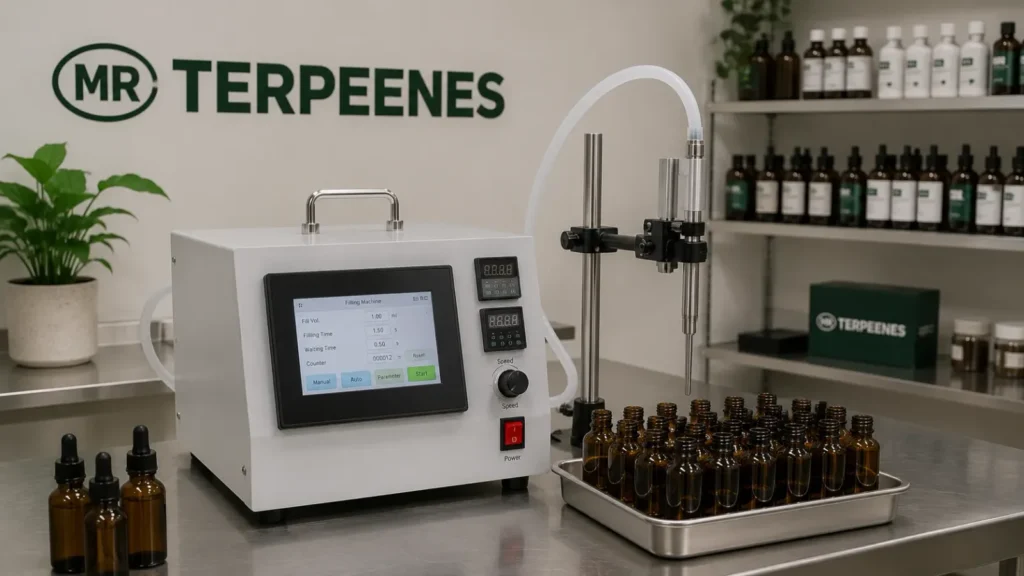
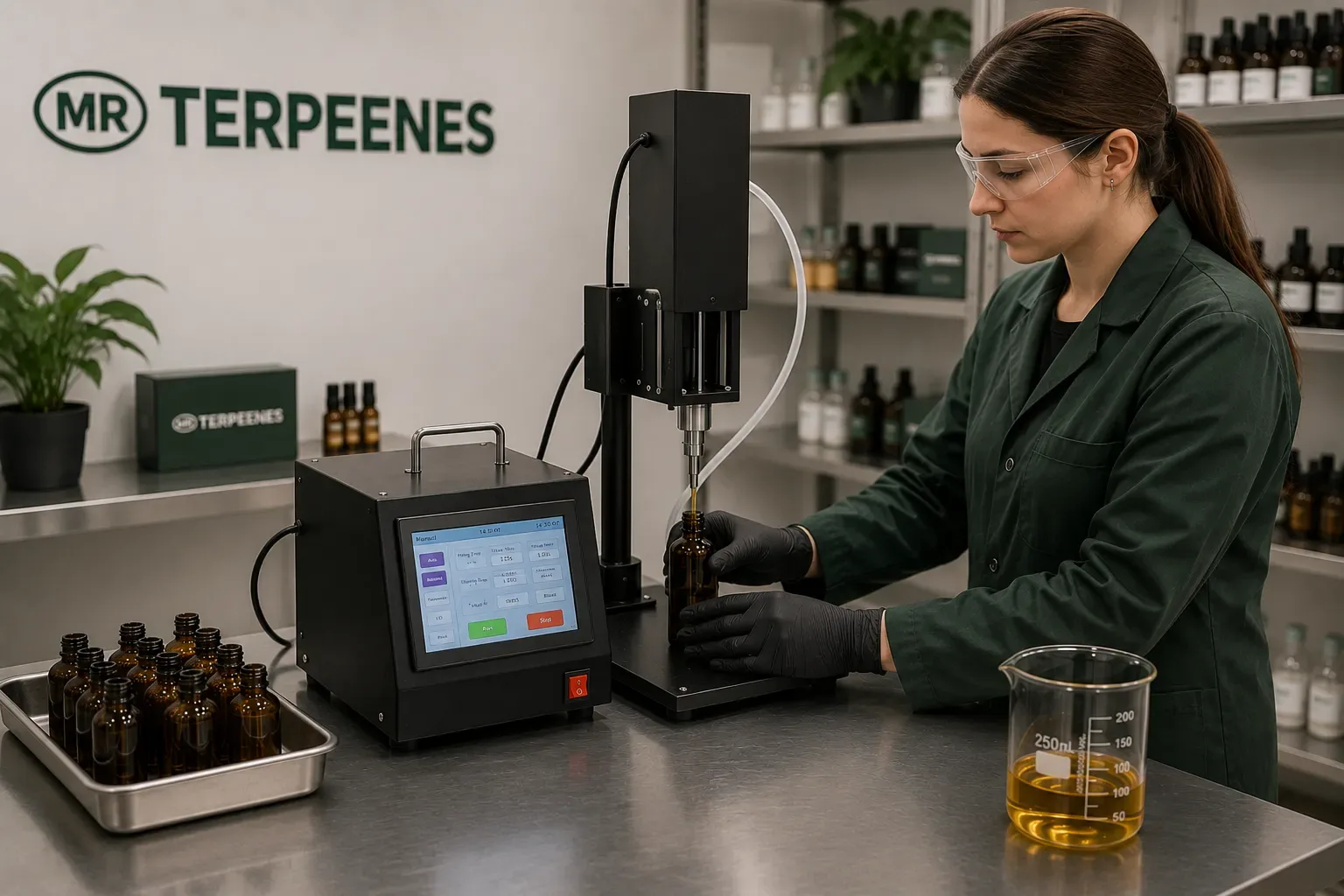
A small batch oil filling machine is a compact, benchtop system that doses a preset volume of oil into bottles, vials or cartridges repeatedly and to a consistent fill level, without an operator measuring each unit by hand.
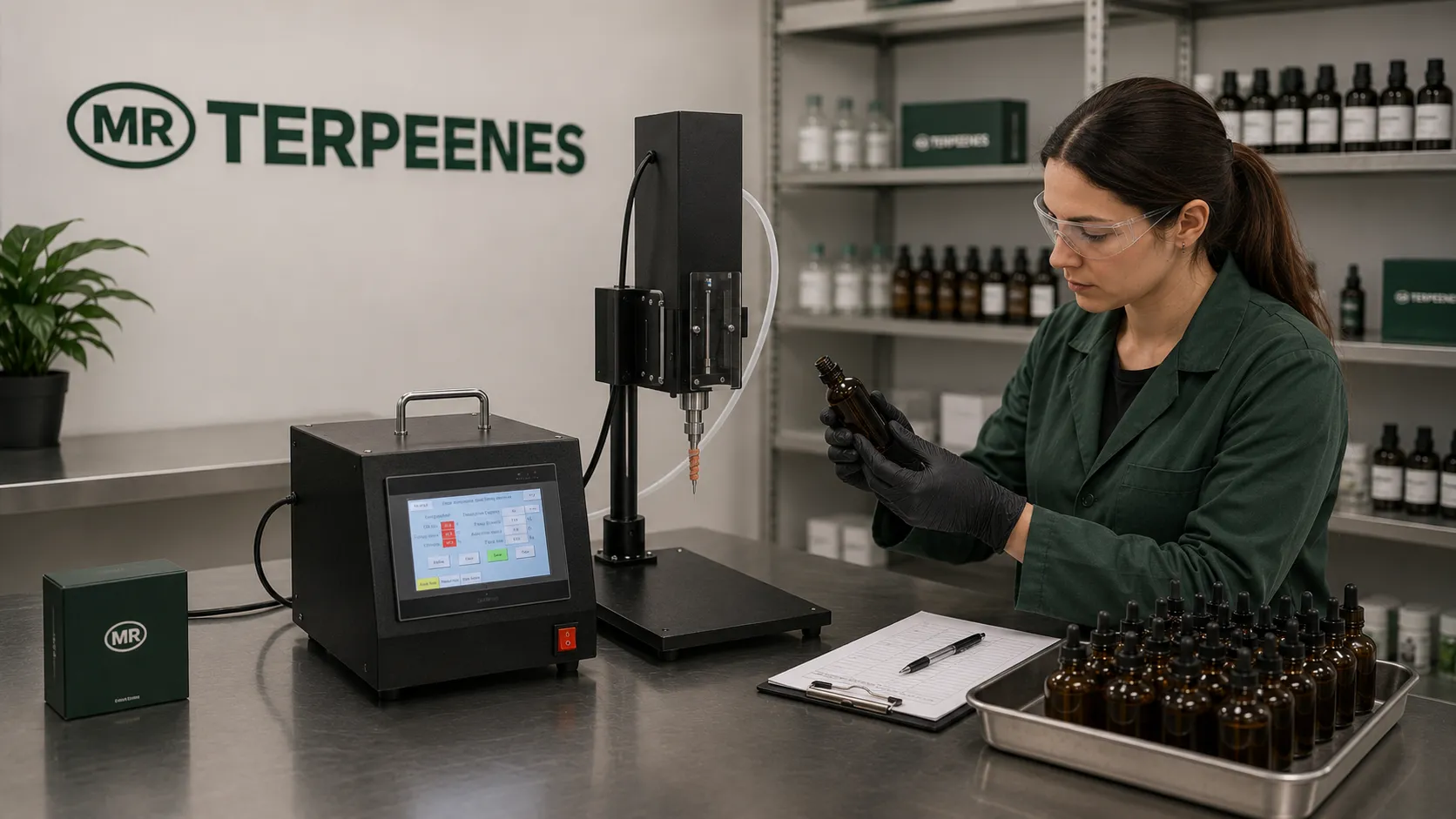
At its core is a pump — peristaltic, gear or piston, depending on the product — fed from a reservoir and triggered by a foot pedal or sensor. The operator sets the target volume once, then loads and removes containers. The skilled part of the job shifts from measuring to loading, checking and packing.
These systems typically suit:
- brands filling terpene blends, CBD oils, tinctures or flavour concentrates into small bottles and droppers;
- white label and contract producers running short runs across several client SKUs;
- teams past product development, with repeat orders to fulfil;
- operations where fill accuracy matters commercially, because the product is expensive per millilitre.
Position matters here. Manual filling offers maximum flexibility and minimum outlay, but every unit depends on operator judgement. A fully automatic line removes the operator from dosing entirely, and demands standardised packaging, stable volumes and floor space to justify itself. A semi-automatic setup keeps a person in the loop for loading and inspection while taking variability out of the dose. For a brand that is growing but not yet running standardised high volume, that middle position is usually the efficient one.
Signs Your Manual Filling Process Is Holding You Back
Volume alone is a poor trigger. Some brands filling modest quantities should already have a machine; some higher-volume operations genuinely should not. These are the signals worth watching:
- Inconsistent fill levels. Bottles in the same tray looking visibly different, or topping units up by eye, means dosing is no longer under control.
- Filling eats the week. When a founder or operations lead spends whole days on the bench, the real cost is the work not being done elsewhere.
- Fatigue late in a run. Accuracy at unit 30 and unit 300 should match. With manual filling it usually does not, and errors concentrate at the end of a batch.
- Visible product loss. Drips, over-pours, purged syringes and transfer residue are all margin, and small percentages compound with high-value oils.
- Rework and rejects. Underfilled bottles reopened, or overfilled ones leaking in transit, show the process tolerance is too wide.
- An improvised workflow. If every batch is set up slightly differently, neither the process nor the output is repeatable.
- Adding a SKU feels heavy. When a new size or blend is limited by filling capacity rather than demand, the bench is the bottleneck.
- Nervous production windows. Filling right up to the dispatch deadline leaves no margin for anything going wrong.
One signal is manageable. Three or four together generally mean the process, not the team, is the limiting factor.
Small-batch filling kit from Mr Terpeenes
Small runs punish the wrong machine faster than large ones. Browse the filling options sized for pilot batches and short production runs before scaling anything up.
Manual Filling vs Semi-Automatic Filling: The Practical Difference
The difference is less about raw speed than about where variability sits. Manual filling makes the operator responsible for every dose; semi-automatic filling makes the machine responsible for the dose and the operator responsible for the flow of containers.
| Factor | Manual filling | Semi-automatic filling |
|---|---|---|
| Dose control | Set by operator judgement on every unit | Set once, repeated by the machine |
| Consistency across a batch | Tends to drift as a run progresses | Stable from first unit to last |
| Operator role | Measuring and filling | Loading, inspecting and packing |
| Effect of fatigue | Direct impact on accuracy | Limited impact on dose accuracy |
| Product loss | Drips, over-pours and transfer residue | Contained flow path, less spillage |
| Capital outlay | Minimal | Defined upfront investment |
| Changeover between products | Fast — swap the tools | Requires a cleaning cycle |
| Best suited to | R&D, samples, one-offs, very short runs | Repeat orders, multiple SKUs, growing volume |
Note the row where manual filling wins outright: changeover. A pipette moves between products in seconds; a machine needs flushing. That trade-off is why the sensible answer for many brands is not to abandon manual filling, but to keep it for development work while running production batches on a machine.
How Throughput Changes in Small-Batch Production
Throughput is the number of finished units you can reliably produce in a given period of usable production time. Headline fill rates describe a machine running under ideal conditions; they exclude setup, cleaning, changeovers, inspection and packing.
What changes with a semi-automatic setup is the shape of the process more than the peak speed:
- The bottleneck moves. Once dosing is automated, the constraint usually shifts to capping, labelling or packing — useful information, and the reason a filler alone sometimes disappoints brands expecting the whole line to speed up.
- Output becomes more stable. A predictable rate matters more than a fast one when you are quoting lead times.
- Manual repetition drops. Fewer repeated hand movements means less fatigue and better batch repeatability.
- Cleaning becomes scheduled rather than incidental. A machine with awkward disassembly quietly erases the time it saves; our oil filling machine maintenance checklist covers what that routine should look like.
The practical test: time a full batch from setup to packed units, including cleaning, and compare it with your manual equivalent. Total elapsed time tells you far more than peak fill rate.
When ROI Starts to Make Sense for a Small Batch Oil Filling Machine
Return rarely comes from one dramatic saving. It accumulates, and it is worth assessing all of it rather than fixating on unit cost.
- Recovered time. Hours moved off the bench into sales, formulation or account management — often the largest component, and the easiest to underestimate.
- Reduced product loss. Tighter dose control means less over-pouring and residue, which compounds across a year with high-value oils.
- Less rework. Fewer units to top up, reopen, relabel or write off.
- Capacity you can actually sell. Accepting an order you would previously have declined is a genuine return, even though it is not a cost saving.
- Better use of the team. Filling is usually the least skilled and most time-consuming task in the workflow.
- Fewer consistency complaints. Rebuilding a retail buyer’s confidence costs more than the machine that would have prevented the problem.
Be sceptical of confident payback claims, including your own. Account for consumables and spares, cleaning time, operator training, periodic accuracy checks and the space the machine occupies. A cheaper unit that is slow to clean can cost more over twelve months than a better-specified one. Model it against a full year of your actual batch pattern, and be honest about whether volumes are stable enough to rely on. If they are not, that argues for waiting — or for using a production partner instead.
Size your first line with Mr Terpeenes
Batch size, viscosity and cartridge type decide which machine earns its place. Walk through the requirement with the team before ordering equipment you may outgrow.
What to Consider Before Choosing a Semi-Automatic Filling Setup
Fix these before approaching suppliers. A vague brief produces either an over-specified machine or one that cannot handle your product.
- Oil type and viscosity. The single most important variable. Thicker or more resinous blends need heating, wider flow paths and sometimes a different pump. Send a sample for a fill test rather than relying on a general specification.
- Fill volume and tolerance. Define both the target and the variation you can accept; very small and very large doses stress the same machine differently.
- Container format. Bottle height, neck diameter and opening size affect whether a nozzle seats cleanly. Test with your real packaging.
- Batch frequency and SKU count. Ten SKUs in short runs is a different problem from two SKUs in long runs. Frequent changes mean prioritising tool-free changeover over headline speed.
- Cleaning and maintenance. Ask how the flow path is dismantled, which parts contact the product and how long a full clean takes.
- Workspace and utilities. Bench space, power, ventilation and somewhere to stage filled units before capping.
- Capping. Decide early whether it stays manual; it is the most common next bottleneck.
- Future scaling. Can the setup be extended, or paired with capping and labelling later, without being replaced?
For how pump type and container format interact, our guide to choosing an oil filling machine for terpenes, CBD and vape oils works through the trade-offs, and our filling and capping machinery page sets out the semi-automatic and automatic options alongside each other.
Why Small Brands Often Move to Semi-Automatic Before Fully Automatic
Skipping to a fully automatic line is tempting and, for most growing brands, wrong. A semi-automatic machine keeps complexity low: fewer components to fail, fewer settings to get wrong, a shorter learning curve — which matters when the operator also handles despatch and customer emails. It preserves control, because someone handling every container spots a cracked bottle, a misaligned cap or a colour shift that an automated line would pass straight through to packing.
It also keeps the investment proportionate. Capital tied up in equipment is capital not spent on stock, marketing or hiring, and a machine sized for volumes you have not reached is an expensive way to store optimism. Automatic lines assume standardisation, whereas brands still adding SKUs and testing packaging need flexibility more than speed. A year of real batches also tells you your true throughput requirement and where the line struggles, which makes any later automation decision informed rather than a guess.
How This Fits Into a Broader Production Setup
Filling is one step in a chain running from formulation to a packed, labelled, saleable unit. Improving it in isolation moves the constraint rather than removing it, so map the sequence before buying anything.
For cartridge-based brands the considerations differ — cartridge geometry, capping method and hardware compatibility all come into play. Our comparison of an oil cartridge filling machine versus manual filling covers those thresholds specifically, with indicative volumes and equipment tiers. If the cartridge format itself is undecided, start with custom vape cartridges and our vape hardware range, since hardware choice constrains which filling setups will work. Consistency ties it together: a machine improves dose accuracy but cannot compensate for an unstable blend or an undocumented process, and the principles in our guide to a consistent terpene product from sample to scale apply before and after any purchase.
Owning equipment is not the only route. White label production scales output without capital expenditure or operator headcount. Where volumes are unpredictable, or cash is better deployed into distribution and brand, white label is often the sensible answer — and it does not preclude buying a machine later. Many brands run both: white label for volume lines, an in-house machine for short runs and specials.
Frequently Asked Questions
What is a small batch oil filling machine?
It is a compact, benchtop filling system that doses a preset volume of oil into bottles, vials or cartridges consistently, without the operator measuring each unit by hand. The operator loads and removes containers while a pump handles the dosing, which makes fill levels repeatable across a batch.
When should I stop filling oil bottles manually?
When filling limits what you can sell rather than simply taking time. In practice that shows up as inconsistent fill levels, whole days lost to the bench, visible product waste, rework, or declining orders you cannot fill in time. Several of these signals together is a stronger indicator than volume alone.
Is a semi-automatic oil filling machine worth it for a small business?
It can be, provided order volumes are reasonably predictable and filling is a recurring constraint. The return comes from recovered hours, reduced product loss, less rework and capacity you can actually sell, rather than from one large saving. If volumes are still erratic, a production partner is usually the lower-risk option.
What are the advantages of semi-automatic filling for small batches?
More stable output, better batch repeatability, less manual repetition and reduced product loss, while keeping an operator in the loop for inspection and handling. Compared with a fully automatic line it involves lower complexity, a smaller footprint and a more contained investment.
How do I know if manual filling is slowing my production?
Time a complete batch end to end — setup, filling, capping, inspection, packing and cleaning — and compare that against the demand you are trying to meet. If the total consistently exceeds your available production window, or accuracy declines towards the end of a run, filling is the constraint.
What should I consider before buying a small batch filling machine?
Oil viscosity, target fill volume and acceptable tolerance, container format, how often you change product, cleaning and changeover time, available workspace, whether capping stays manual, and whether the setup can be extended later. Always request a fill test using your own product and packaging before committing.