
Indica Terpene Profile: Earthy, Sweet and Gas Notes for Modern Blends


An indica terpene profile is an aroma direction rather than a fixed formula. Buyers use the term for blends that read earthy, sweet, woody or gassy, but no single chemical recipe defines it, and two products sold under that label can smell noticeably different.
In short: there is no universal indica formula. The label describes a sensory direction that often combines earthy and herbal depth, woody or peppery spice, sweet dessert or dark fruit accents and a gassy top character. What a given blend actually smells like depends on which components are present and in what proportion.
What does an indica terpene profile mean in practice?
In the trade, an indica terpene profile is shorthand for a mood: darker, heavier and rounder than the citrus and pine directions filed under sativa. It is a communication tool between buyer and supplier, not a specification.
The label carries no compositional guarantee. Research in Nature Plants found that samples labelled Sativa and Indica were genetically indistinct on a genome-wide scale. The same work did link the labels to a small number of terpenes: myrcene, guaiol and the eudesmols correlated with Indica labelling, bergamotene and farnesene with Sativa. The authors concluded that the vernacular labels track aroma rather than ancestry.
Read commercially, that is useful rather than damning. An indica terpene profile is real as a sensory grouping and unreliable as a formula, so judge the specific product, its documentation and its performance in a sample.
What does an indica terpene profile usually smell and taste like?
Most blends in this family are built in layers. Few contain every layer, and the balance between them separates one product from the next.
- Earthy and herbal base. Damp soil, dry herb and a musky weight that anchors the profile.
- Woody, peppery or spicy middle. Dry spice and warm timber that give structure through the palate.
- Sweet, berry, creamy or dessert accents. Grape, cherry, vanilla and baked cake notes above the base.
- Gas, skunk, diesel or kush character. A pungent, solvent-like sharpness that reads as intensity.
- Citrus or fresh top notes. Lemon, lime or herbal brightness used for contrast, not as the headline.
Some formulas are dark and kush-led with almost no sweetness. Others are dessert-forward, creamy or fruit-driven and would surprise anyone expecting weight. Both are sold as an indica terpene profile, which is why the label needs checking against a sample.
Common terpenes found in indica-style profiles
The table covers aroma contribution only. Treat it as vocabulary for briefing a supplier, not as a recipe for an indica terpene profile.
| Terpene | Typical aroma contribution | Possible role in the blend | Important limitation |
|---|---|---|---|
| Myrcene | Earthy, herbal, musky | Provides the heavy base | Correlated with Indica labelling, but not in every blend sold this way |
| Beta-caryophyllene | Peppery, dry spice, woody warmth | Adds structure under sweet accents | Dominates quickly and can flatten delicate fruit notes |
| Limonene | Citrus lift | Creates contrast against an earthy base | Often read as a sativa marker, so use it deliberately |
| Linalool | Floral softness | Rounds sharp edges in creamy directions | Small proportions shift a profile noticeably |
| Humulene | Woody, earthy, hop-like dryness | Adds dry depth without sweetness | Can read as bitter when too far forward |
| Pinene | Pine freshness and structure | Sharpens the top of a heavy profile | Common across every category, so it signals nothing |
For a single-terpene view, our guides to the earthy role of myrcene and caryophyllene’s peppery aroma go further than a table can.
Where do the gas and skunk notes come from?
Gas is a sensory descriptor, not a chemical one, and there is no single gas terpene behind it. The pungency buyers call gas, dank or skunk comes from a combination of compounds, several of which are not terpenes at all.
Work in ACS Omega identified a family of prenylated volatile sulphur compounds in cannabis, with 3-methyl-2-butene-1-thiol pinpointed as the main odourant behind the skunky character. A later study found that cultivars with very similar terpene profiles can smell markedly different, with minor non-terpenoid compounds driving the divergence.
For anyone formulating an indica terpene profile, perceived gas depends on interaction between components rather than one ingredient, and on concentration, since compounds of this kind change character sharply with dose. A botanical blend can recreate a gassy direction through aroma formulation without reproducing every volatile in plant material, so describe what it delivers sensorially rather than claiming equivalence.

See the indica profiles at Mr Terpeenes
Indica-leaning profiles differ more in aroma than most spec sheets suggest. Browse the range held in the UK and see which directions are worth sampling.
Indica-style blend or strain-specific terpene profile?
The choice is between a family and an individual. A broad indica terpene profile leaves room for a house signature; a named cultivar gives recognition your customer can already picture.
| Approach | What it tries to reproduce | Sensory flexibility | Best suited to | Main buyer consideration |
|---|---|---|---|---|
| General indica-style blend | A broad aroma family | High | House ranges needing a shared character | Descriptions vary by supplier, so the sample decides |
| Strain-specific profile | The identity of one named cultivar | Low by design | Products sold on cultivar recognition | Competitors can buy the same profile |
| Flavour-infused profile | A flavour impression, not botanical fidelity | Medium | Ranges competing on taste | May overwrite a characterful base |
| Custom formulation | Your own written brief | Highest | Brands with a signature and repeat volume | Needs development time, minimums and records |
If you are leaning towards a named cultivar, read how one is constructed first. Our breakdowns of the Wedding Cake aroma direction and the Gelato profile show the detail involved, and the wider guide to strain-specific terpene profiles covers how these are sold.
Main indica aroma directions for modern product ranges
Five directions cover most of what sells under an indica terpene profile heading.
1. Earthy and kush-led
Deep, herbal and dry, with pungency rather than sweetness carrying the profile. Supports connoisseur-facing positioning. The risk is reading as flat to shoppers used to dessert flavours.
2. Sweet and dessert-led
Cake, vanilla and confectionery notes over a softer base. Strong shelf appeal and easy to label. Watch for a sugary impression that fatigues over repeated use.
3. Berry and dark fruit
Grape, cherry and blueberry accents on an earthy foundation, often supporting purple-led branding. Distinctive, though fruit can read as artificial if pushed too far above the base.
4. Gas and savoury
Pungent, funky and solvent-like, signalling intensity. Effective for premium and concentrate positioning. The risk is polarisation: what attracts a specialist deters a mainstream shopper.
5. Creamy, citrus and hybrid-style
A middle ground where earthy depth is lifted by lemon or a creamy centre. Broad appeal and flexible across formats, though a profile with no dominant note risks being forgettable, much like the fruit-led strain profiles built purely for contrast.
How should a brand choose an indica terpene blend?
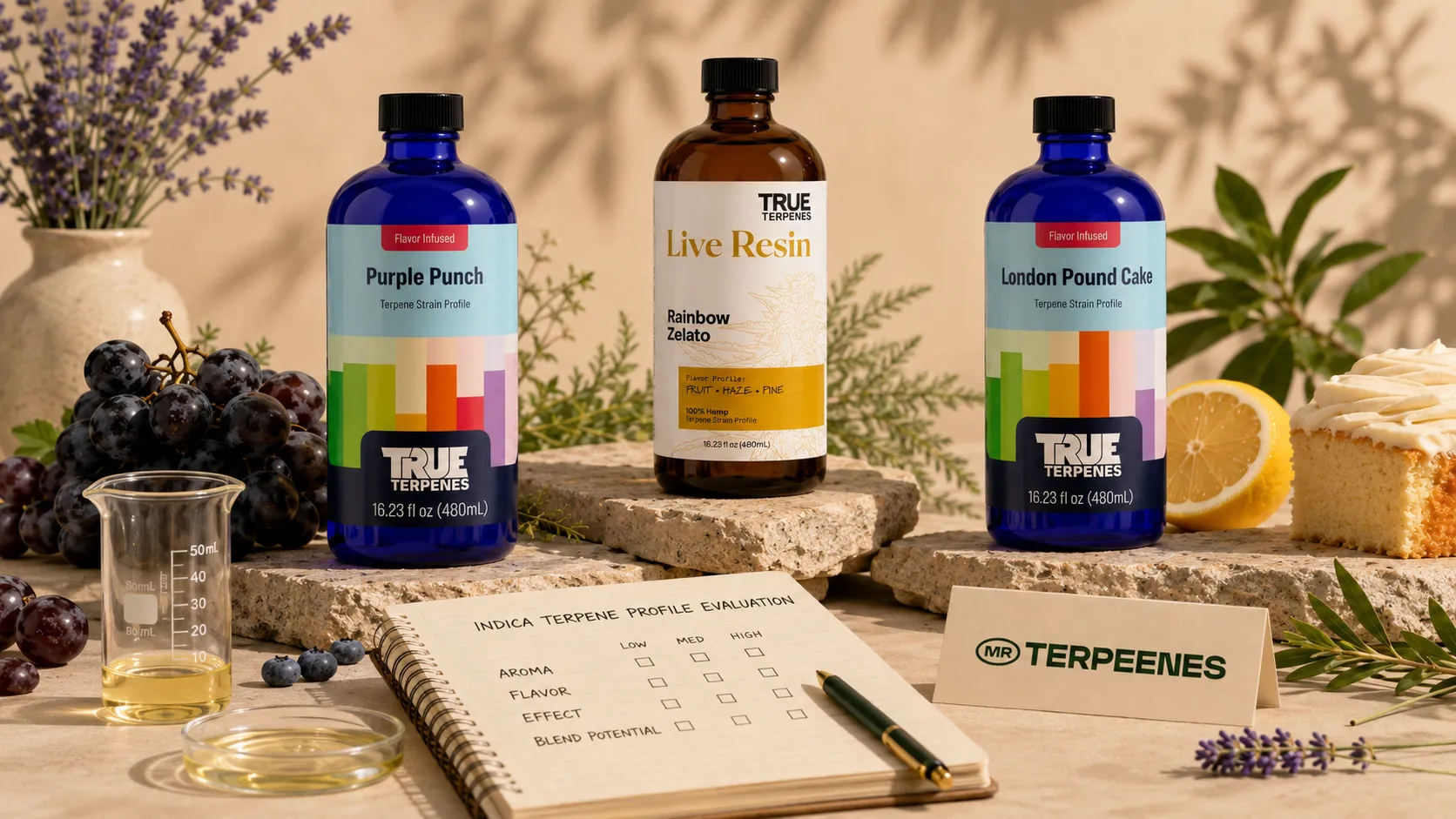
The first four steps decide the direction. The rest decide whether a specific blend is safe to commit to.
- Define the target aroma in writing, including which layer leads.
- Decide between a broad direction and a named strain before requesting samples.
- Evaluate the base material. A neutral distillate accepts a loud profile more readily than a characterful rosin.
- Choose the flavour intensity you need, since infused blends and cultivar profiles behave differently in one base.
- Review the documentation for the exact SKU, including the Certificate of Analysis and Safety Data Sheet.
- Run controlled pilot batches with every other variable held constant.
- Record the formula by weight so the result is reproducible.
- Evaluate aroma, flavour and finish separately, then re-assess after the settling period.
- Confirm batch consistency and supply before the profile enters a roadmap.
- Approve the profile formally, and only then scale.
Do not carry an inclusion percentage across from another project. True Terpenes sets out handling and dilution questions in its published product FAQs; consult the current documentation for the specific product and validate through controlled testing. Where the base is an extract, our guide to adapting blends to rosin, resin and distillate covers what changes.
Which products represent different indica-style directions?
These six profiles are held for UK and European buyers and show how differently one indica terpene profile brief can be answered.
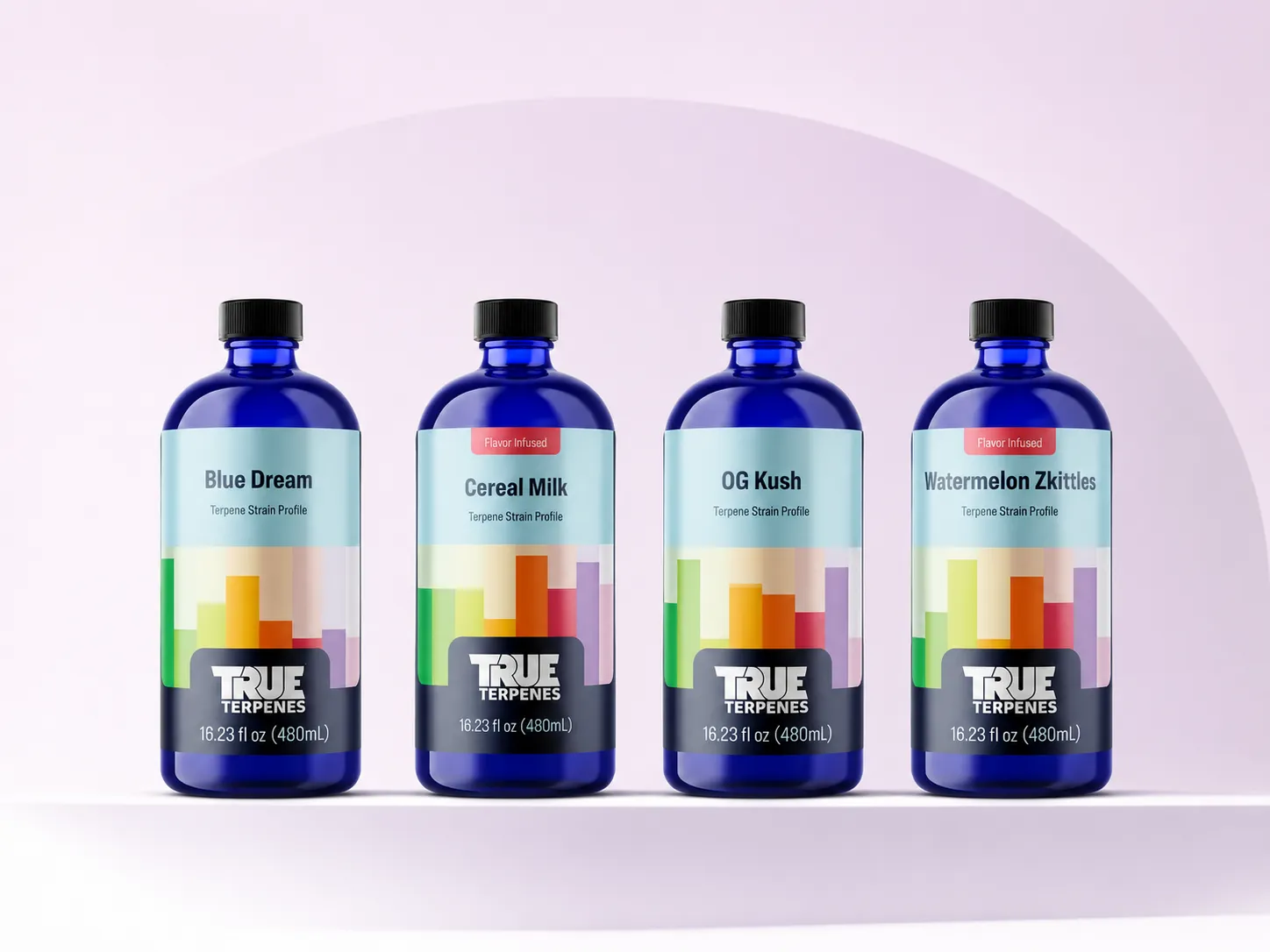
- Earthy and kush-led: OG Kush Cultivar Series pairs pungent herbal and gassy tones with earthy pine and a citrus edge. Dosi Kush Cultivar Series takes the same base savoury, with earthy funk cut by lemon pepper.
- Sweet and dessert-led: London Pound Cake is a flavour-infused profile built on moist cake sweetness with lemon zest and a light floral edge.
- Berry and dark fruit: Purple Punch layers blueberry, cherry and grape with vanilla and a tangerine finish.
- Gas and savoury: Permanent Marker Live Resin is dank and gassy with an adhesive-like funk over sweet grape and floral highlights.
- Creamy and hybrid-style: Rainbow Zelato Live Resin combines overripe pineapple and brown sugar with cedar and pine, lifted by lemonade and herbal accents.
None represents the whole category alone. The documentation supplied with each order is set out in our quality and compliance approach.
Indica terpene profile buyer checklist
- Target sensory direction defined and written down
- General family or named strain selected
- Base material assessed for how much flavour it will accept
- Desired intensity recorded
- Product documentation reviewed for the exact SKU
- Pilot batch completed on the intended base
- Formula recorded by weight
- Aroma, flavour and finish evaluated separately
- Batch consistency considered for repeat production
- Commercial availability confirmed for the volumes you need
Shortlist your aroma direction with Mr Terpeenes
Aroma direction is easier to judge in a sample than on a label. Browse the strain-specific terpene profiles held for UK and European brands and narrow your shortlist before committing to a production run.
Frequently asked questions
What is an indica terpene profile?
An indica terpene profile is a commercial description of an aroma direction rather than a defined chemical composition. It usually points to a blend with earthy or herbal depth, often combined with woody spice, sweet or dark fruit accents and a gassy character. Components and proportions vary considerably between suppliers and products.
Which terpenes are common in indica-style profiles?
Myrcene, beta-caryophyllene, humulene and linalool appear frequently, with limonene or pinene used for contrast. Myrcene contributes the earthy, musky base, caryophyllene the peppery structure, humulene a dry woody depth and linalool a floral softness. Presence and proportion differ by product, so read the documentation rather than assuming a standard combination.
Do all indica terpene blends contain myrcene?
No. Myrcene showed the strongest correlation with Indica labelling in the Nature Plants analysis, which is why it is so closely associated with the category, but correlation is not composition. Plenty of blends sold in this direction are dessert-led or fruit-led and lead with other components.
What makes an indica terpene profile smell earthy or gassy?
Earthiness generally comes from terpenes such as myrcene and humulene. Gas is different: research in ACS Omega attributes the skunky character largely to volatile sulphur compounds rather than terpenes, and shows that cultivars with similar terpene profiles can smell very different. In a botanical blend, that direction is recreated through aroma formulation.
Is an indica terpene profile the same as a strain-specific blend?
No. An indica-style blend represents a broad aroma family and leaves room for a brand to build its own signature. A strain-specific profile reproduces the recognisable identity of one named cultivar, which brings recognition but far less flexibility. Both are legitimate, and they answer different commercial questions.
How should brands test an indica terpene blend before scaling?
Shortlist three or four profiles, prepare small batches at a fixed inclusion level, and hold the base material, hardware and every other variable constant. Record quantities by weight, assess aroma, flavour and finish, then re-assess after the settling period suited to your format. Our walkthrough on comparing terpene samples sets out the method.
Choosing the right indica terpene profile for your product
The label is the least informative part of the decision. Two products described identically can sit at opposite ends of the sensory range, and the word indica tells you nothing about which one is in front of you.
What does inform it is a short list: aroma direction, target customer, product format, base material, flavour intensity, documentation, controlled testing and commercial availability at the volume you need. Answer those and the shortlist narrows to two or three candidates. The terpene profiles collection covers individual cultivars in more depth, and the botanical blends held for UK and EU brands sit in the terpenes category. If you are still choosing between a broad indica terpene profile and a named cultivar, our team can advise on which suits your base and format.