Linalool Terpene Profile: Aroma, Uses and Blending Notes

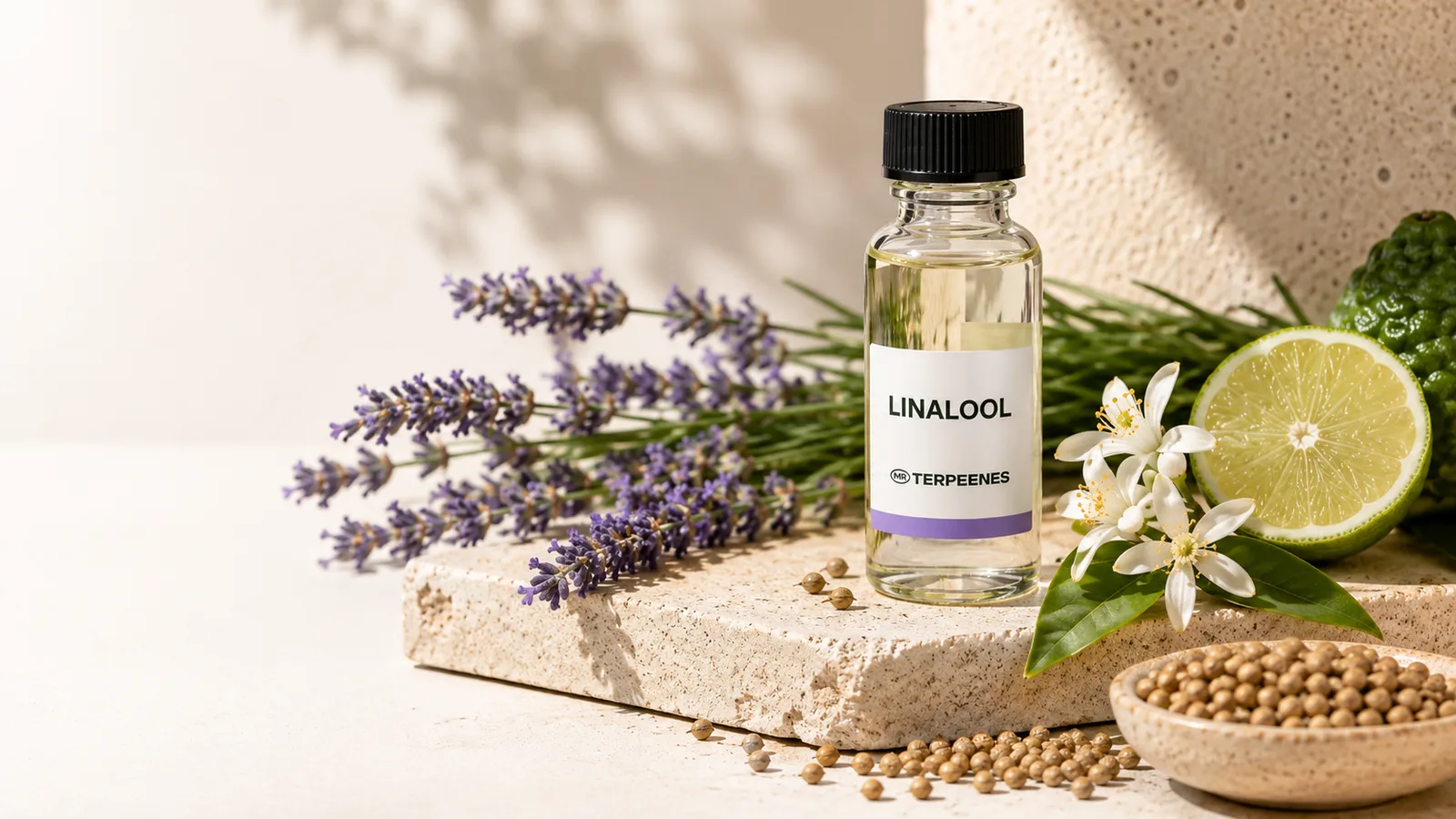
The linalool terpene is one of the most recognisable floral notes available to a formulator, and one of the easiest to overdo. It is the molecule most people are describing when they say something smells of lavender, yet it turns up just as reliably in coriander seed, ho wood, basil and citrus peel. It also changes character sharply with dose: at a fraction of a percent it reads as softness, and a little higher it reads as perfume.
In short: linalool is an acyclic monoterpene alcohol with a soft floral aroma carrying light citrus and dry woody facets. In a blend it rounds harsh edges, adds lift and creates a sense of softness. It is potent, dose-sensitive and prone to oxidation, so it is normally dosed low, added late and stored cold, sealed and away from light.
What linalool is
Linalool is a monoterpene alcohol with the molecular formula C10H18O and a molecular weight of 154.25 g/mol, listed under CAS number 78-70-6 and the systematic name 3,7-dimethylocta-1,6-dien-3-ol in the PubChem compound record. Structurally it is acyclic, meaning it has no ring, and its hydroxyl group sits on a fully substituted carbon, making it a tertiary alcohol.
That distinction has practical consequences. Most of the terpenes a blending bench handles day to day — limonene, myrcene, the pinenes — are hydrocarbons with no oxygen in the molecule. Linalool is not. The hydroxyl group makes it more polar, which alters how it distributes through a base material, and considerably more reactive towards oxygen. Much of what follows about handling, storage and dosing comes back to that single functional group.
What linalool actually smells like
The core of the linalool aroma is soft, floral and unmistakably lavender-adjacent. Around that core sit a light sweetness that never becomes sugary, a thin citrus edge closer to petitgrain than to lemon peel, and a dry, faintly woody-green undertone that keeps the floral from reading as candied.
What changes most is the impression at different inclusion levels. At very low levels, linalool is rarely identified as lavender at all; it registers as roundness or a slight cosmetic smoothness in whatever it has been added to. Push it up and the lavender character becomes nameable. Push it further and it turns soapy and perfumed, with a fabric-conditioner quality that pulls attention away from everything else. The surrounding matrix matters as much as the dose: the same quantity behind a heavy earthy base and behind a bright citrus top will not read the same way.
The two enantiomers do not smell the same
Linalool exists as two mirror-image forms. (R)-(−)-linalool, or licareol, occurs in lavender, rose and neroli and reads as woody lavender. (S)-(+)-linalool, or coriandrol, occurs in coriander seed and sweet orange and reads sweeter and more citrus-like, in the petitgrain direction. Sensory work in Chemical Senses by Sugawara and colleagues found the two are distinguished not only in description but in measured physiological response.
The consequence for a buyer is simple: a specification sheet saying linalool does not say which enantiomer, or in what ratio. Two materials can both be accurate to their documentation and still smell different on the bench, which is why a sample decides the question and a certificate does not.
Natural sources of linalool
Linalool is one of the most widely distributed terpenes in the plant kingdom, which is part of why it is available commercially at scale. The sources that matter most to formulation are these:
- Lavender (Lavandula angustifolia) — the reference point, though lavender oil is a mixture in which linalool sits alongside linalyl acetate.
- Coriander seed (Coriandrum sativum) — unusually rich in linalool, skewed towards the sweeter (S)-(+) form.
- Ho wood (Cinnamomum camphora, linalool chemotype) — a major commercial source of high-purity material.
- Rosewood (Aniba rosaeodora) — historically important, now largely displaced.
- Basil, bay laurel and mint — culinary herbs carrying the floral-sweet side of the aroma.
- Citrus peel and bergamot — where linalool sits under dominant limonene as a softening layer.
Source matters beyond provenance. Different botanical origins deliver different enantiomeric ratios and different trace impurities, and both shift the finished smell. This is the practical reason why swapping one linalool supplier for another can change a blend that was otherwise untouched.

Explore floral terpene profiles at Mr Terpeenes
Linalool is easier to judge beside the profiles it sits in. Browse the single terpenes and botanical blends held in the UK before committing to a floral direction.
Linalool in cannabis terpene profiles
In cannabis material, linalool is normally reported as a minor constituent, well behind myrcene, limonene and beta-caryophyllene in the terpene fraction of most cultivars. Its contribution is a facet rather than a foundation: the floral softness that shows up in creamy dessert directions and in purple, dark-fruit profiles, usually sitting under sweeter and heavier notes.
Identifying a single terpene does not explain how a cultivar smells. Aroma perception depends on the combination of components, their proportions and their absolute concentration, and cannabis also contains non-terpenoid volatiles that carry much of the character buyers respond to. A cultivar described as linalool-forward can smell quite unlike another with a similar reported linalool figure.
A note on the search term linalool terpene effects, which is common enough to address directly. Linalool has been examined in laboratory and animal studies, and it carries long-standing traditional associations through lavender. Controlled human evidence is considerably thinner than the volume of online discussion suggests, and the two should not be conflated. Nothing here is a health claim: material sold for aroma and flavour work belongs in sensory language, not therapeutic language. Claims that indica and sativa categories produce predictable effects sit outside what the aroma data supports.
How linalool behaves in a blend
Linalool earns its place through four jobs, and it does all four at low inclusion.
- Floral lift. It opens the top-to-middle of a profile without the sharpness citrus terpenes bring.
- Rounding. It takes the bite off aggressive edges — resinous pine, raw zest, solvent-like gas character — without removing them.
- Perceived softness. In dessert and confectionery directions it reads as texture rather than as a separate note.
- Bridging. It connects floral, herbal and citrus material that would otherwise sit as separate ideas in one bottle.
The failure mode is equally consistent. Linalool dominates faster than most formulators expect, and once it does the profile reads as perfumed rather than botanical. Its floral tail is also more persistent than the sharpest citrus top notes, so a dose that seems balanced at first sniff can read heavy once the blend has settled. Judging it on the initial impression alone is the most common route to an over-dosed blend.
Terpenes that pair well with linalool
These pairings describe aromatic direction, not ratios. Inclusion levels depend on the base material, the format and the target, and any figure carried over from another project is a guess.
Linalool and limonene
A floral-citrus direction with cologne-like brightness. Linalool takes the sharpness off zest while the citrus keeps the floral from turning soapy, which makes this one of the more forgiving combinations. Our limonene terpene profile covers the citrus side in more detail.
Linalool and myrcene
Floral over depth. Set against myrcene’s earthy, musky base, linalool supplies the soft top that produces creamy and powdery directions. The base tends to bury the floral, so linalool is usually adjusted after the myrcene level is settled rather than before.
Linalool and beta-caryophyllene
Floral against dry pepper and wood. The caryophyllene terpene profile gives structure so the floral has something to sit on, and linalool in return softens the peppery bite. The result reads warm and rounded, and it holds up well in heavier bases.
Linalool and pinene
Floral with fresh resinous green. Linalool blunts the sharp edge of a pinene terpene profile while the pine stops the floral drifting sweet. This is the pairing behind herbal, open-air directions rather than confectionery ones.
Source linalool in volume from Mr Terpeenes
Bench work eventually becomes a purchase order. Review volume pricing, minimum order quantities and UK lead times for linalool before a floral direction reaches production.
Formulation notes for working with linalool
The working method matters more with linalool than with most terpenes, because the margin between rounded and perfumed is narrow.
- Dose it as an accent. Treat linalool as a modifier rather than a base component unless the brief calls for a floral headline.
- Add it last. Fix the core of the profile first, then adjust linalool against a finished impression.
- Assess it in the matrix, not neat. Neat linalool says almost nothing about how it will read at a fraction of a percent in a distillate or a rosin.
- Allow a settling period, then re-assess. Floral notes commonly read stronger after rest than on the day.
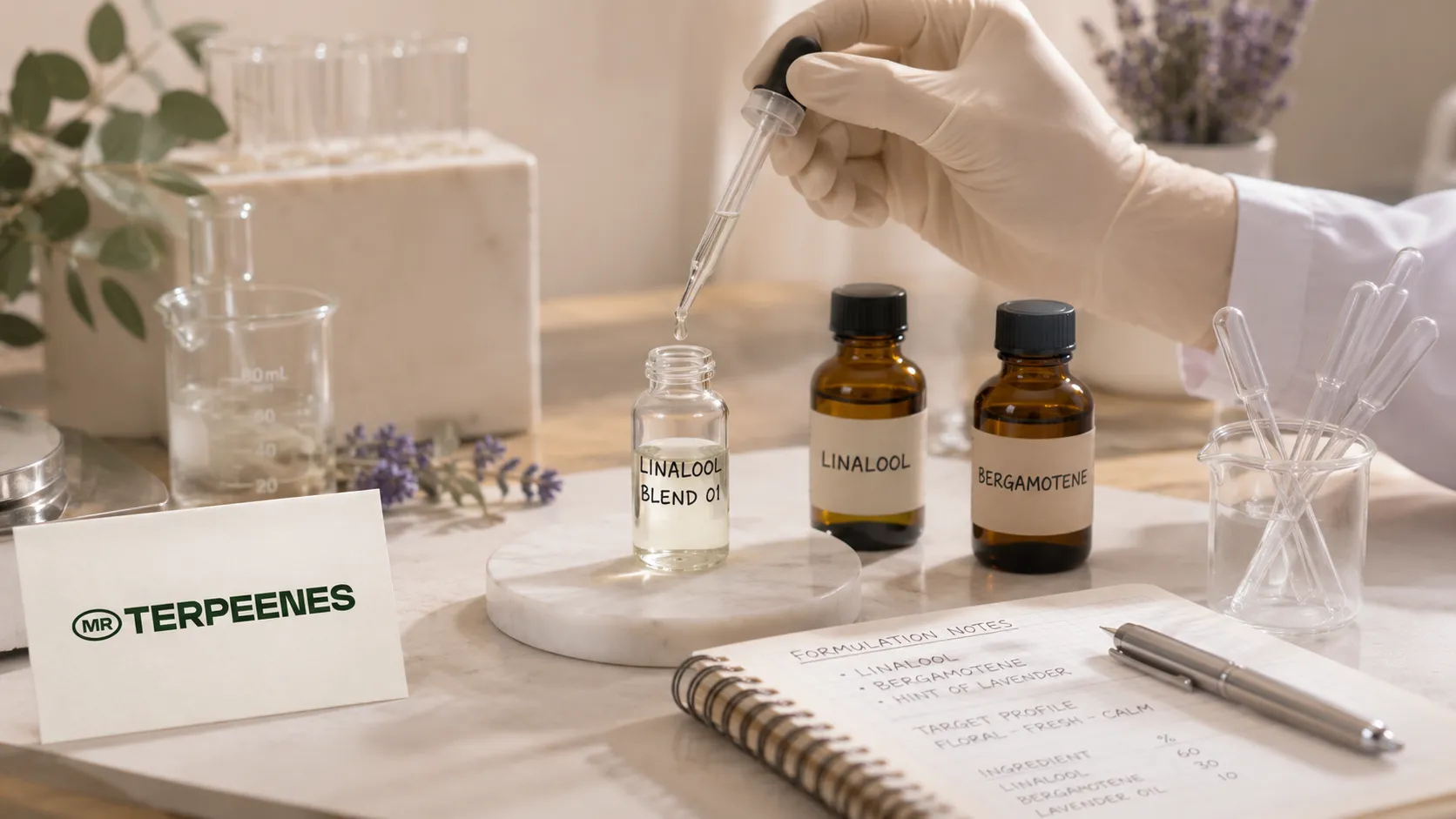
- Record by weight and change one variable per iteration. Drop counts are not reproducible across viscosities, pipettes or temperatures, and a result you cannot trace to a cause is not a result.
- Do not port an inclusion level between bases. A level that works in a neutral distillate will behave differently in a characterful extract.
Concentration dependency deserves emphasis on its own. More linalool does not produce a more authentic floral profile; past a certain point it produces a cosmetic one, and the extra material removes the botanical impression the brief was asking for. Our step-by-step method for mixing terpenes sets out the bench discipline that keeps iterations comparable.
Linalool isolate or a complete terpene blend?
An isolate is the right tool for a correction. If a profile is harsh at the top, thin in the middle or missing a floral facet, a single terpene lets you address that one thing and measure the difference. Isolates are also how a team builds a house profile from first principles and keeps a written record of it.
A complete blend is the right tool for a target already defined by a large number of interacting components. Reproducing a recognisable cultivar is not a job a single molecule can do, however accurate that molecule is, because the recognisable part of the aroma lives in the interaction between dozens of volatiles. Most benches use both: a blend for the direction, isolates to tune it. The single terpenes and botanical blends held in the UK cover both routes.
Storage and handling considerations for linalool
Linalool autoxidises on contact with air, and the oxidation products — principally hydroperoxides — are a recognised contact sensitisation concern in a way that fresh, unoxidised linalool is not. The International Fragrance Association addresses this in its Standards Library: linalool and linalool-rich naturals should be used with peroxide levels kept as low as practical, with a good manufacturing practice limit of 20 mmol/L and an antioxidant added at the time of production.
In practice that means a short list of habits: keep containers sealed and headspace minimal, decant into smaller vessels as stock depletes rather than leaving a part-empty drum, store cool and dark, and avoid repeated warm-cool cycling. Age matters as much as storage temperature, so rotate stock rather than holding it. The wider question of storing terpenes and protecting shelf life applies to linalool with more force than to the hydrocarbon terpenes.
On volatility, PubChem records a boiling point in the region of 194–200 °C at atmospheric pressure and a closed-cup flash point commonly reported between roughly 71 and 78 °C. Those figures indicate general behaviour under heat; they do not replace the Safety Data Sheet supplied with a specific material, which governs handling, storage and transport decisions.
One regulatory point is worth knowing even outside cosmetics. Linalool is a declarable fragrance allergen under Annex III of EU Cosmetics Regulation (EC) No 1223/2009, requiring individual labelling above 0.001% in leave-on products and 0.01% in rinse-off products, and that allergen list was substantially expanded by Regulation (EU) 2023/1545. Other product categories carry their own rules, so confirm what applies to your format rather than assuming the cosmetics threshold transfers.
Frequently asked questions about linalool
What does linalool smell like?
Soft, floral and lavender-like, with a light sweetness, a thin petitgrain-style citrus edge and a dry woody undertone. Its perceived character shifts with dose: low levels read as softness rather than as a nameable floral note, and high levels read as soapy or perfumed.
Is linalool a terpene or an alcohol?
Both. It is a monoterpene that carries a hydroxyl group, which makes it a monoterpene alcohol. That oxygen atom is what separates its handling requirements from hydrocarbon terpenes such as limonene and myrcene.
Is linalool only found in lavender?
No. Lavender is the best-known source, but coriander seed, ho wood, basil, bay laurel, mint, bergamot and citrus peel all contain it, and ho wood is a major source of commercial material. Different origins deliver different enantiomeric ratios, so they do not smell identical.
Is linalool the same as lavender oil?
No. Lavender oil is a mixture containing linalool alongside linalyl acetate and many other components. Isolated linalool is a single compound and will not reproduce lavender oil on its own.
Is linalool found in cannabis?
Yes, generally as a minor component of the terpene fraction rather than a dominant one. It contributes floral softness to creamy and dark-fruit directions and is rarely the note a cultivar is recognised by.
Which terpenes blend well with linalool?
Limonene for a bright floral-citrus direction, myrcene for floral over an earthy base, beta-caryophyllene for warmth and structure, and pinene for a fresh herbal character. Choose the pairing by the direction required; the inclusion level is a bench question, not a fixed ratio.
Can linalool dominate a terpene blend?
Easily, and faster than most formulators anticipate. Its floral tail also persists longer than sharp citrus top notes, so a blend that seems balanced when first mixed can read heavily perfumed after it has settled. Dosing low and re-assessing after rest is the usual safeguard.