


Ocimene Terpene Profile: Aroma, Uses & Blending Notes

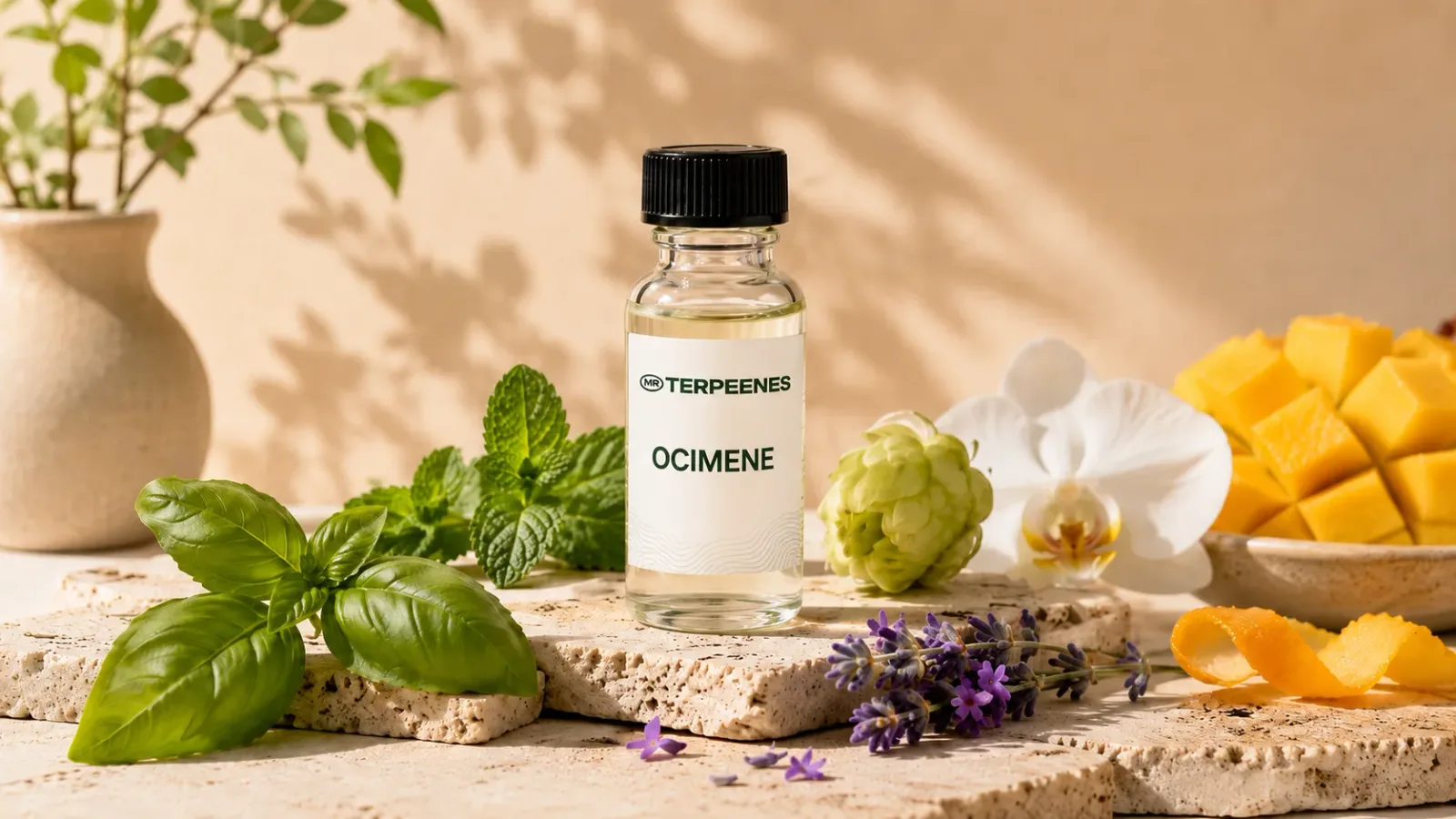
The ocimene terpene is what formulators reach for when a blend smells accurate but inert. It carries the green, faintly sweet lift of crushed basil, of mango skin, of a hop cone opening — and it is largely gone again by the time anyone has finished describing it. Few terpenes contribute so much to the opening of a profile and so little to what is left ten minutes later.
The short answer: ocimene is an acyclic monoterpene hydrocarbon with a sweet, herbaceous, green aroma carrying citrus and light floral facets. It occurs across a very large share of flowering plants — basil, mint, lavender, orchids, hops and cannabis among them — and functions in nature as a signalling volatile rather than a structural one. In a blend it behaves as a top note: it supplies freshness and lift, evaporates early, and turns thin and solvent-like when over-dosed.
What ocimene is
Ocimene is a monoterpene: ten carbons, molecular formula C10H16, molecular weight 136.23 g/mol. It is acyclic, meaning it has no ring, and it is a plain hydrocarbon with no oxygen in the molecule, which places it structurally beside myrcene rather than beside an alcohol such as linalool.
What sets it apart from both is that ocimene is a triene: three carbon–carbon double bonds, two of them conjugated. Almost every practical property below — its lightness on the nose, its early exit from a blend, its short working life once opened — follows from that arrangement. The name traces back to Ocimum, the botanical genus of basil.
Ocimene, beta-ocimene and alpha-ocimene are not interchangeable
Ocimene is a family name rather than a single substance, and the distinction matters as soon as you read a specification sheet.
- (E)-β-ocimene, or trans-beta-ocimene, is what is meant in almost every commercial and scientific context. Systematic name (3E)-3,7-dimethylocta-1,3,6-triene, CAS number 3779-61-1, catalogued in PubChem as CID 5281553.
- (Z)-β-ocimene, the cis form, is the same skeleton with the opposite geometry at one double bond. It is the less abundant of the two in plant material.
- α-ocimene moves a double bond to the end of the chain — (3E)-3,7-dimethylocta-1,3,7-triene — and is a genuinely different compound with its own PubChem record, not a synonym.
Material sold simply as ocimene is normally β-ocimene, usually a mixture of the E and Z forms with a small α fraction. Ask for the isomer breakdown when aroma has to be reproducible batch to batch: the ratio moves with the source, and it moves the smell with it.
What ocimene smells like
Ocimene smells sweet, green and herbaceous, with a fresh citrus edge and a light floral top. Underneath sits a dry, faintly woody terpenic note that stops it reading as fruit. Comparisons to crushed basil, to unripe mango skin and to the green part of a hop cone are all pointing at the same character from different angles.
Two qualifications matter more here than with most terpenes. The first is concentration: at trace level ocimene registers as brightness rather than anything nameable, at moderate level the green-herbal character becomes identifiable, and higher still it goes sharp, thin and slightly solvent-like. The second is context. Ocimene has very little body of its own, so what it appears to smell of is largely decided by what sits beneath it — over citrus it reads more citrus, over a floral base it reads floral. Descriptors are consensus vocabulary rather than measurements, which is why a sample settles what a certificate cannot.
Where ocimene is found naturally
Ocimene is among the most widely distributed volatiles in the plant kingdom. In a review in Molecules, Farré-Armengol and colleagues report that trans-β-ocimene occurs in the floral scent of 71% of the 90 plant families surveyed and 47.5% of 291 species, placing it among the four commonest floral volatiles alongside benzaldehyde, limonene and linalool. The sources that matter to formulation work:
- Basil (Ocimum basilicum) — the namesake and the reference point for the green-herbal impression.
- Rosemary and thyme (Rosmarinus officinalis, Thymus vulgaris) — both named in the review.
- Mint, parsley and tarragon — culinary herbs, where it sits under sharper top notes.
- Snapdragon and orchids — ornamentals where ocimene is a principal scent component, not a trace one.
- Citrus peel and mango — the fruit side, and the origin of the sweet-tropical association.
- Hops and cannabis — both carry it in the terpene fraction.
Ocimene is a signalling molecule, not a structural one
Plants do not emit ocimene continuously. They release it, and that difference explains the compound better than any descriptor list. It is a classic herbivore-induced plant volatile: vegetative tissue emits it after insect damage, and the emission is understood to attract the natural enemies of whatever is feeding. Floral emission follows daily rhythms, with snapdragon peaking between 11:00 and 18:00.
The review’s authors propose β-ocimene as a generalist pollinator attractant while noting candidly that direct behavioural tests are lacking. The evidence is firmer inside the hive: Maisonnasse and colleagues, writing in PLOS ONE, identified E-β-ocimene as a volatile brood pheromone in Apis mellifera. None of that transfers to a product claim. It is context for why a molecule this volatile is this widespread, and why it reads as living plant material rather than as extract.

Explore fresh terpene profiles at Mr Terpeenes
Ocimene is judged against the notes it has to lift, not on its own. Browse the single terpenes and botanical blends held in the UK before settling a green direction.
Ocimene in cannabis terpene profiles
Ocimene is reported across cannabis cultivars, generally as a minor to moderate part of the terpene fraction rather than a leading one, and its biosynthesis is well characterised. In work on Cannabis sativa terpene synthases published in PLOS ONE by Booth, Page and Bohlmann, (E)-β-ocimene appears among the major products of the enzyme family behind the terpene content of Finola resin, alongside β-myrcene, limonene, α-pinene, β-caryophyllene and α-humulene. One enzyme in that family proved highly specific for (Z)-β-ocimene.
Where ocimene sits at higher relative levels the aroma is usually described as sweet, tropical or fresh-herbal, the direction the isolated material points in anyway. No single terpene explains how a cultivar smells: the recognisable part of an aroma lives in the proportions between dozens of volatiles, several of them not terpenes at all.
Two cautions carry over from every profile in this series. A reported ocimene percentage supports aroma decisions and nothing else; it does not predict a physiological outcome. And indica and sativa labels describe lineage rather than chemistry, so neither substitutes for a chromatogram.
How ocimene behaves in a terpene blend
Ocimene is a top note and behaves like one: low molecular weight, a boiling point recorded by PubChem at 174–175 °C at atmospheric pressure, and a habit of making its case early and then withdrawing. Four contributions come up repeatedly on the bench:
- Lift. It opens the top of a profile that is correct but flat, without the sharpness citrus terpenes bring.
- Green freshness. It gives the impression of a living plant, hard to build from sweet or resinous components.
- Botanical credibility. Because it is so widespread in nature, a trace makes a constructed profile read as plausible rather than assembled.
- Bridging. It connects citrus, floral and herbal material that would otherwise read as separate ideas in one bottle.
What happens when ocimene dominates
An over-dosed ocimene blend does not smell of basil. It smells thin. The green note detaches from the base, goes sharp and solvent-like, and the profile picks up a synthetic edge that panels describe as harsh or chemical. Because the fault sits at the top it is the first thing anyone smells, which makes it damaging out of all proportion to the quantity involved.
The opposite risk is just as real. Ocimene fades faster than the heavier components around it, so a dose judged correct on the day can read as absent a week later. That is why ocimene is assessed twice.
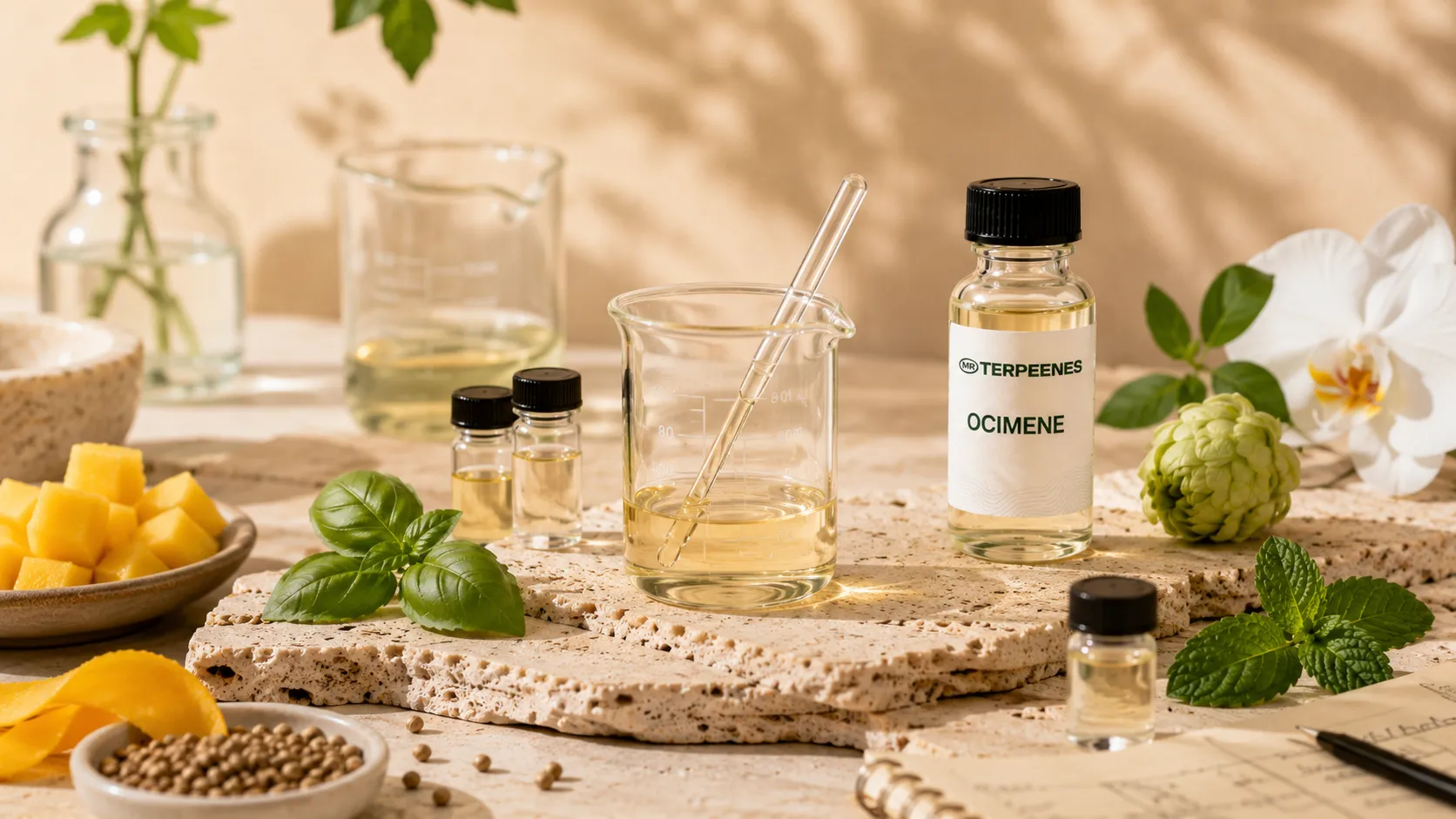
Terpenes that pair well with ocimene
These pairings describe direction, not recipes. Inclusion levels depend on the base, the format and the target, and a figure carried over from another project is a guess with a decimal point attached.
Ocimene and limonene
Green-citrus and bright. Ocimene gives the citrus character of limonene a herbal edge that stops it reading as cleaning product, and the citrus gives ocimene somewhere to land. Both are volatile, so the pair lives at the top and needs something heavier beneath it.
Ocimene and linalool
Green over soft floral. The two occur together in lavender and basil, so the pairing reads botanically plausible, and the floral roundness linalool contributes takes the edge off ocimene’s green top. Watch the balance: linalool dominates faster than expected while ocimene fades faster, so a ratio that works on day one drifts towards perfume by day seven.
Ocimene and myrcene
Fresh over depth, and the most forgiving of these. Where myrcene supplies a musky, faintly fruity base, ocimene sits on top and stops it turning syrupy. Both are acyclic hydrocarbons, and they behave as if they belong together, which in many plants they do.
Ocimene and pinene
Sharp, green and open-air. Pinene brings a resinous, coniferous cut that ocimene softens towards fresh herbs rather than forest floor. Both leave early, so a blend built mainly on this pair can smell excellent when mixed and hollow once rested.
Ocimene with caryophyllene or humulene
The contrast pairing, and the one that answers the volatility problem. A sesquiterpene base gives the green top something to depart from: the warm pepper of beta-caryophyllene reads as body, the dry wood of humulene as a botanical floor. Both are heavier and slower than ocimene, which is the point: the blend keeps its shape once the top note has gone.
Source ocimene in volume from Mr Terpeenes
A bench decision becomes a purchase order soon enough. Review bulk quantities, minimum order levels and UK dispatch times before a fresh green direction reaches a production run.
Ocimene compared with three other fresh terpenes
Ocimene is often specified when terpinolene, limonene or pinene was what was actually wanted. All four read as fresh and do different jobs.
| Core aroma | Role in a blend | Typical failure | |
|---|---|---|---|
| Ocimene | Sweet, green, herbaceous, light floral | Top-note lift and botanical freshness | Turns thin and solvent-like, then fades early |
| Terpinolene | Fresh, sweet, piney with a citrus-herbal edge | Complexity across the top and middle | Reads soapy and generic at high inclusion |
| Limonene | Bright citrus zest | Immediate brightness and appeal | Reads as cleaning product |
| Pinene | Sharp resinous conifer | Cutting freshness and dryness | Reads harsh and turpentine-like |
The nearest neighbour is terpinolene, and the two are easy to confuse blind. Terpinolene is the more complex of the pair and holds position longer; ocimene is greener, sweeter and leaves sooner, and our terpinolene profile covers that side in full. Against limonene and pinene the distinction is easier: ocimene is the only one that reads as leaf rather than peel or resin.
How ocimene is used commercially
Ocimene has a long history in fragrance, used for green, herbal and fresh-floral accords and for the naturalness that keeps a composition from reading as constructed. In flavour work it contributes to herbal and tropical fruit directions at low inclusion. Both exploit one property: high impact at the top, low persistence.
In terpene formulation it appears in two roles. As a component of botanical terpene blends it supplies the fresh-green facet of a reconstructed cultivar profile. As an isolate it is a correction tool, added when a profile is technically right but reads closed or flat at the top. No isolate reproduces a botanical character alone: the impression of basil, or of a named cultivar, comes from ocimene sitting in a matrix of dozens of volatiles in proportions it took a plant to assemble. A blend sets the direction, isolates tune it, and the single terpenes and blends held in the UK cover both routes.
Practical considerations when blending with ocimene
Ocimene punishes a heavy hand faster than most terpenes, and a slow assessment almost as badly.
- Start well below where you think it should sit. Its impact per unit is high, and thinness at the top cannot be corrected by adding anything else.
- Add it late. Settle the base and the middle first, then adjust ocimene against a finished impression.
- Judge it in the blend, never from the bottle. Neat ocimene reads sharp and says little about what a fraction of a percent does in a distillate or rosin.
- Assess twice, immediately and after rest. The first reading catches over-dosing, the second catches the fade.
- Record by weight and change one variable per iteration. Drop counts do not survive a change of pipette, temperature or viscosity, and a result you cannot trace to a cause is not a result. Our terpene ratio calculator converts between percentage and volume.
- Do not port an inclusion level between bases. A level that works in neutral distillate behaves differently in an extract carrying its own volatiles, a point that runs through choosing terpenes for distillate.
The step-by-step method we use for mixing terpenes sets out the bench discipline that keeps iterations comparable.
Storage and handling considerations for ocimene
The three double bonds that make ocimene smell the way it does also make it reactive. Conjugated systems of this kind are susceptible to oxidation and to light-driven change, so ocimene has a shorter useful life in an opened container than the more stable hydrocarbon terpenes. The aroma shifts before anything appears on a specification sheet, which is how a batch passes its paperwork and still fails a reference sample.
The habits that protect it are ordinary: keep containers sealed, minimise headspace, decant into smaller vessels as stock depletes rather than leaving a part-empty drum, store cool and dark, and avoid repeated warm-and-cool cycling. Rotate stock, since age matters as much as storage conditions. The general principles of terpene storage and shelf-life management apply here with more force than to a sesquiterpene.
The recorded boiling point of 174–175 °C is at the low end for a terpene and indicates general behaviour under heat rather than a processing instruction. The Safety Data Sheet supplied with a specific material governs handling, storage and transport decisions.
Frequently asked questions about ocimene
What does ocimene terpene smell like?
Sweet, green and herbaceous, with a fresh citrus edge, a light floral top and a dry woody undertone. Crushed basil, unripe mango skin and the green part of a hop cone are the usual comparisons. At trace level it reads as freshness; at high inclusion it turns thin and solvent-like.
Is ocimene a monoterpene?
Yes. Ocimene is an acyclic monoterpene hydrocarbon, formula C10H16, molecular weight 136.23 g/mol. Its three carbon–carbon double bonds make it a triene, which accounts for both its volatility and its reactivity.
Is ocimene the same as beta-ocimene?
Not exactly. Ocimene is a family of closely related isomers; β-ocimene is the branch commercial and scientific material almost always refers to, usually the (E) form, CAS 3779-61-1. α-ocimene has a double bond in a different position and is a separate compound, so the two are not interchangeable on a specification.
Where is ocimene naturally found?
Very widely. Published surveys place trans-β-ocimene in the floral scent of 71% of 90 plant families and 47.5% of 291 species examined. Basil, rosemary, thyme, mint, parsley, snapdragon, orchids, citrus peel, mango, hops and cannabis all contain it.
What terpenes blend well with ocimene?
Limonene for green-citrus brightness, linalool for a soft floral direction, myrcene for freshness over an earthy base, pinene for a sharp herbal character. Pairing it with beta-caryophyllene or humulene answers a different problem: a sesquiterpene base holds the profile together once the ocimene has evaporated.
How is ocimene used in terpene blends?
As a top note, at low inclusion, added late. In a complete botanical blend it supplies the fresh-green facet of a reconstructed profile. As an isolate it corrects a blend that reads closed or flat at the top. It cannot reproduce a botanical character alone, because that character comes from many volatiles in proportion.