

Types of Rigid Boxes: How to Choose the Construction, Closure, Insert and Finish

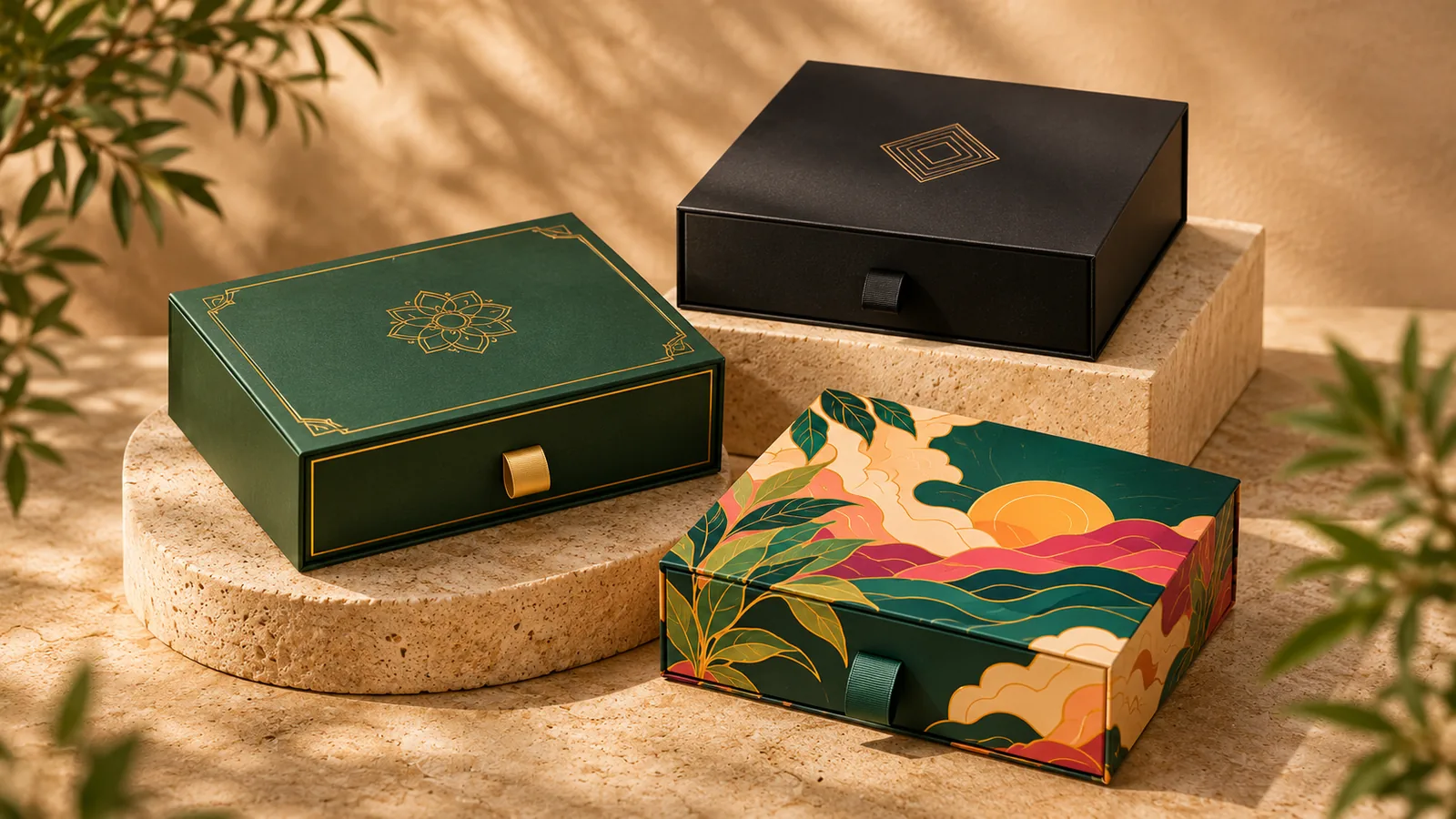
A rigid box is easiest to specify if you describe it in four layers:
- Construction: how the box is built. The main constructions are lid and base, drawer (tray and sleeve), hinged or book-style, tube, and folding rigid.
- Closure: how it opens and stays shut, for example a lift-off lid, a magnetic catch, a button release or a ribbon pull.
- Insert: what holds the product in place inside.
- Finish: the surface and decoration: lamination, foil, embossing, spot UV, interior print.
Most box names you will see on a supplier page combine two of these layers. A “magnetic box” names a closure, a “windowed box” names a feature, and a “drawer box” names a construction. This guide separates the four so you can build the box your product needs, using the formats documented in the Mr Terpeenes packaging range.
What makes a box rigid
A rigid box, also called a set-up box, is made from thick board wrapped in printed paper or another outer material. It keeps its shape from the factory, unlike a folding carton, which ships flat and is folded into shape at packing.
The Mr Terpeenes packaging catalogue gives one documented construction: a lid-and-base gift box in “1000g rigid cardboard and 157g C2S” (paper coated on both sides), with spot UV and soft-touch lamination. The catalogue also lists folding rigid formats for projects where storage space matters more than a fully set-up box.
The eight styles on the service page, sorted by what they describe
The custom rigid boxes service lists eight styles. They are not eight separate categories. Some describe how a box is built, some how it closes, and one describes a feature. That is why a single box can be several of them at once: a drawer box with a window and a button release, for example.
| Style on the page | What it describes | Can combine with |
|---|---|---|
| Lid and base | Construction: a separate lid lifts off a base tray | Windows, inserts, ribbons |
| Drawer | Construction: an inner tray slides out of an outer sleeve | Button release, pull tabs, windows |
| Book-style | Construction: a hinged lid that opens like a cover | Magnetic closure, inserts |
| Tube | Construction: a cylindrical body with a lid | Inserts |
| Folding rigid | Construction: rigid panels designed to fold flat | Ribbons, inserts |
| Magnetic closure | Closure: magnets hold a hinged lid or flap shut | Book-style and other hinged builds |
| Button slide | Closure mechanism: a drawer released by pressing a button | Drawer construction |
| Windowed | Feature: a clear panel in the lid or sleeve | Most constructions |
In short, start from the construction and treat the other three as options on top of it.
Naming the layers separately also makes quotes easier to compare. Two suppliers can mean different builds by “a magnetic box”. A brief that says “book-style construction, magnetic closure, EVA insert, soft-touch wrap” leaves little room for interpretation. Use the same wording on every quote you request, so the prices you get back describe the same box.

Find Your Box Format with Mr Terpeenes
See how rigid boxes, printed pouches and counter displays fit together across a product range, then choose the pack that suits each item you sell.
Five constructions and their documented uses
The catalogue shows examples of each construction, together with the use it was designed for.
- Lid and base. A gift box with tissue and shredded paper inside, made for gift presentation.
- Drawer. Several drawer boxes for vape and cartridge packaging, with EVA sponge or foam inserts. One version has a PVC window. A custom drawer box is listed for vape and edible packaging.
- Book-style. A book-shape box with a paper insert and custom slots, made for gift boxes.
- Tube. A paper cylinder tube box with an EVA sponge insert, listed for vapes, cosmetics and gift packaging.
- Folding rigid. A foldable box with a ribbon, made for gifts.
The service page names the sectors the range is designed for:
- vape hardware;
- cosmetics and skincare;
- gift sets;
- electronics;
- supplements;
- promotional products;
- retail launches;
- premium private-label brands.
The magnetic closure has no catalogue example, so treat it as an option to discuss rather than a proven build for your product.
If your product is vape hardware, our guide to packaging for vape hardware covers cartridge, battery and all-in-one formats in detail. This guide stays with the box itself.
Closures shape the opening, and some are tied to the construction
The service page lists these opening systems, each “reviewed for opening feel and secure closure”:
- drawer pull tabs;
- magnetic closures;
- hinged book-style opening;
- lid and base;
- button release;
- foldable formats.
Two practical points follow from the classification above:
- Some closures need a particular construction. A button release belongs to a drawer box. A magnetic catch needs a hinged lid or flap. Choosing either one also chooses the construction, so decide them together.
- The closure changes the insert and the artwork. A pull tab or ribbon needs a fixing point. A magnetic flap adds a panel that also carries print.
Child resistance is not a box style. The service page says child-resistant options “may be available where applicable to the product and target market”, and that suitability “must be reviewed against the box structure, opening system and project requirements”. The international reference for reclosable child-resistant packs is ISO 8317:2015. If your product needs child resistance, ask for test evidence that covers the exact box, closure and insert you are ordering.
The insert holds the product; the box presents it
It helps to keep three jobs apart, because each is handled by a different part of the pack:
- Presentation is the box: its construction, closure and finish.
- Holding the product in position is the insert.
- Protection in transit is the packing route: how the boxes are packed, and what outer shipper they travel in. The catalogue lists custom corrugated shipping boxes as an outer.
A rigid box with a well-cut insert presents a product well. That alone does not make it a shipping carton.
The service page lists these insert types:
- EVA foam;
- paperboard;
- blister or formed inserts;
- shredded paper;
- fabric- or paper-lined inserts;
- custom-cut slots and die-cut cavities;
- multi-product compartments;
- protective sleeves.
Three questions narrow the choice:
- How many items go in the box? A single item suits a cut cavity. A set needs compartments, so each piece has a defined place.
- How will the customer lift it out? The page notes that inserts are specified around “product dimensions, removal needs and presentation style”. A finger notch or ribbon is part of the insert design.
- Is the insert on display? Lined inserts and printed interiors are presentation choices. Plain foam is a functional one.
Inserts are cut to the product. Send the final product or its exact dimensions, not a prototype, because a small change in the product means a new cut.
Specify Rigid Boxes with Mr Terpeenes
Tell us the product, its dimensions, the box style, insert and finishes you have in mind, and we will review a rigid box construction around them.
Finishes: choose one or two that carry the brand
The service page lists:
- full-colour print;
- matte and gloss lamination;
- soft-touch lamination;
- spot UV;
- foil stamping;
- embossing and debossing;
- kraft finishes;
- printed interiors;
- custom windows;
- ribbons and pull tabs.
The table shows what each of the main effects means for your artwork.
| Finish | What it does | What to settle before artwork is final |
|---|---|---|
| Soft-touch lamination | Velvety matte surface | How dark solids and fine detail reproduce; judge on a finished sample |
| Spot UV | Gloss highlight on selected areas | Which elements are highlighted; usually a separate layer in the artwork file |
| Foil stamping | Metallic area applied to the wrap | Foil colour and exact area; also a separate layer |
| Emboss or deboss | Raised or recessed shape | Position and depth; very small text may lose definition |
| Printed interior | Print inside the lid or tray | A second artwork, often missing from the first brief |
Each extra finish adds a production step. One or two finishes chosen to carry the brand usually read better than every option combined.
Soft-touch, foil and embossing in particular look different on screen than in the hand, so ask to see a physical example of any finish you have not used before. If your range has several products, decide early whether they all share one finish set or whether a hero product gets an extra effect. That decision sets how many artwork variants your designer will need.
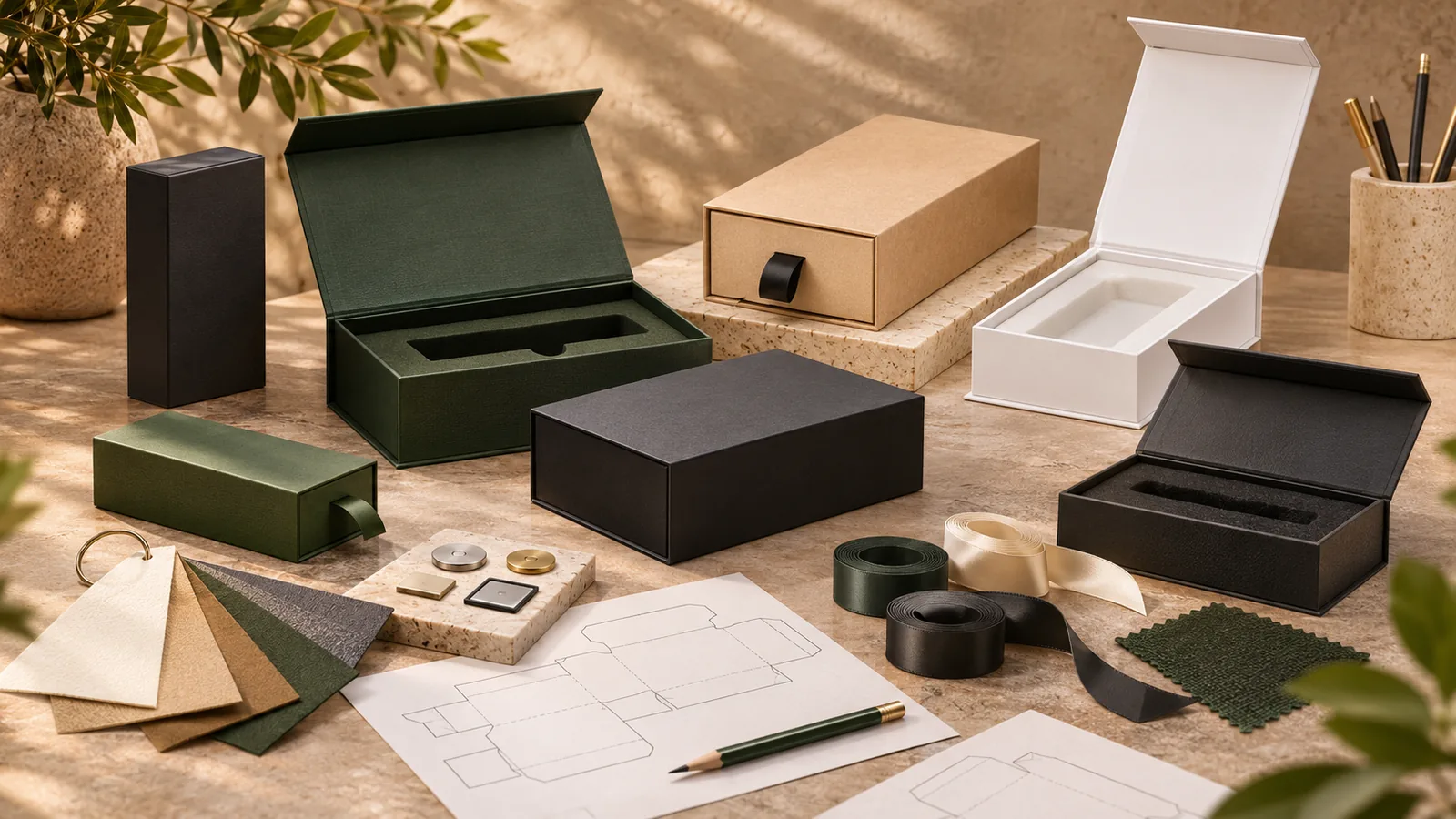
Rigid box, pouch or display: decide by the job the pack must do
A rigid box is one of three packaging routes in the range. Which one fits depends on what happens to the pack after it leaves you, not on the product category.
| If the pack must… | Consider |
|---|---|
| Present a hard product or a set in a fitted insert | A rigid box |
| Hold a product sold by weight, with a barrier and a reseal | A custom mylar bag |
| Get the product noticed at the counter | A custom POS display |
| Reach a customer by post | A rigid box packed inside an outer shipper |
For how the three routes combine across a range, see our overview of white label packaging for terpene and vape brands.
Before you ask for a quote
The service page asks for nine items. Most follow from the four layers in this guide. Five are worth settling before you get in touch:
- The final product’s dimensions and weight. Everything else is built around them.
- The construction, with a fallback in case the first choice doesn’t suit the product.
- Any closure that depends on the construction, such as a button release or a magnetic catch.
- The insert type and the number of items.
- The target market. It decides whether child resistance or other requirements apply.
Mr Terpeenes does not publish a fixed minimum order or lead time for rigid boxes. Ask for both in the quote. The page says samples or prototypes “can be reviewed where suitable for the project”, so if you can, ask to review one with your real product inside before production is approved.
With the construction, closure, insert and finish decided, send your brief through the Mr Terpeenes custom rigid boxes service.
Frequently asked questions about rigid box types
It is a closure rather than a separate construction. Magnets hold a hinged lid or flap shut, most often on a book-style box.
Most rigid set-up boxes arrive assembled, which is why they keep their shape. Folding rigid formats are designed to fold flat for storage.
It is designed for presentation. Protection in transit depends on how the boxes are packed and on the outer shipper.
After the construction is chosen, and against the final product’s dimensions.